Measles Epidemic 1991 -Compelling Narrative

I saw two personal heroes yesterday –Donald Schaffner and Paul Offit.  This happened at the 13th annual Donald Schaffner conference.

Dr. Schaffner is a former surgeon at Children’s Healthcare of Atlanta .  In recent years, he has battled a number of medical problems.  During my early years as an attending, he and I worked together to help a number of children.  His patience, caring, and dedication to providing the best care were unrivaled.

I had never met Dr. Offit in person and this was the first time that I heard him speak.  However, he has been an outspoken advocate for vaccines and has written extensively on this subject; in addition, he has cast a critical eye on some alternative medicine practices.  I have quoted him numerous times on this blog (see links below). His topic for this conference: “The Philadelphia Measles Epidemic of 1991: Lesson from the Past or Prologue to the Future.”

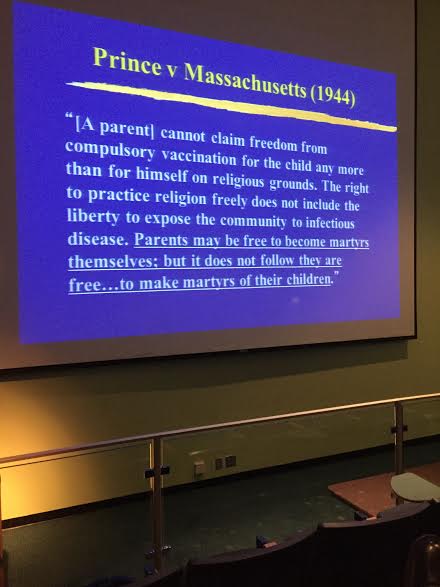
This was an amazing narrative of the measles epidemic combining the epidemiology, with journalism, law, politics, and the history of refusing vaccines.  I did not take any notes, though I did take two pictures.  The lecture was effective because it was presented like any good story with lots of details, facts, and passion.  The lies and mistakes were discussed as well.

Legal Foundation for Compulsory Vaccination during Measles Epidemic

Legal Foundation for Compulsory Vaccination during Measles Epidemic

High case fatality among those who claimed religious exemptions to vaccine

High case fatality among those who claimed religious exemptions to vaccine

Key points:

  • Religious vaccine exemption was claimed initially by Christian Scientists. This has been expanded by other groups claiming personal beliefs.
  • Vaccine successes have made people forget how dangerous diseases like measles can be; unfortunately, resurgence of these diseases may be necessary to convince people that vaccination is worthwhile

One more link -yesterday on NPR: Measles Still Kills

Related blog posts:

Measles, Seizures and Sometimes Death due to Vaccine Delays and Avoidance

Three recent news items provide more up-to-date reasons for childhood vaccines.

1. Delaying vaccines may increase seizures –here’s the link and an excerpt (from NY Times):

Some parents postpone their children’s vaccinations because they believe the delay decreases the risk. But a new study finds the opposite may be true.

The analysis, published online in Pediatrics, involved 5,496 children born from 2004 to 2008 who had seizures in the first two years of life.

For children who received any of their shots as recommended before age 1, there was no difference in the incidence of seizure in the 10 days after vaccination compared with the period before vaccination. But compared with giving it in the first year, giving the measles-mumps-rubella vaccine at 16 months doubled the incidence of seizure, and giving the measles-mumps-rubella-varicella vaccine at that age increased it almost six times.”


2. Rate of measles infections at 20 year high –here’s the link and an excerpt: (from USA Today)

The USA has the most measles cases in 20 years…The confirmed case count for 2014, as of May 23, was 288 and growing, the CDC says. That number includes 138 cases from Ohio, where the biggest outbreak is ongoing – and where the actual count is 166 as of Thursday, according to the state Health Department.

The nationwide total is the highest for late May since 1994, when 764 cases were reported, the CDC says. It surpasses the 220 cases reported in all of 2011, which was the most in the post-2000 era.

“This is not the kind of record we want to break, but should be a wake-up call for travelers and for parents to make sure vaccination records are up to date,” said Anne Schuchat, director of the CDC’s National Center for Immunizations and Respiratory Diseases. Schuchat…Before the measles vaccine became available in 1963, the virus infected about 500,000 Americans a year, causing 500 deaths and 48,000 hospitalizations.

Cases this year have been reported in 18 states and New York City. Ninety percent have been among people who have not been vaccinated or have unknown vaccination status, according to the CDC. Most of the patients report religious, philosophical or personal reasons for avoiding vaccines.”


3. When parents withhold vaccines, vulnerable children get sick and sometimes die  –here’s the link (reference noted from Eric Benchimol’s twitter feed) and an excerpt:

Jason Lawson recalled a terrifying 10 days in B.C. Children’s Hospital when his son Beckett was six, after Beckett became severely ill from chicken pox.

At the time, Beckett was still receiving a maintenance dose of chemotherapy to kill potential cancer cells. That treatment also suppressed Beckett’s immune system.

When an unvaccinated child at the school passed on chicken pox, the consequences were dire — at one point the virus got into Beckett’s liver and started to do damage, which in some cases can be irreversible….

Lawson said he’s speaking out to remind families that protecting their friends and neighbours is another good reason to make the effort.

Take home message:  With every medical intervention, there are risks and benefits.  Those who forego vaccines increase the risk for themselves, their families and friends.

Related blog posts:


Life and Limb: The Price of Not Vaccinating Children

A recent article in USA Today focused some light on the issue of vaccine avoidance and its consequences. Two specific examples in the article included the death of an infant to pertusis and healthy boy who lost his arms and legs as a consequence of the measles. In my opinion, the authors and editors of this publication make a mistake by offering up too much credence to the vaccine naysayers presumably to provide a “balanced report.”  Their arguments should have been subjected to further scrutiny.  Here’s the link, decide for yourself:

http://usat.ly/1lEVlOe

Excerpt:

Recent measles outbreaks in New York, California and Texas are examples of what could happen on a larger scale if vaccination rates dropped, says Anne Schuchat, the CDC’s director of immunizations and respiratory diseases. Officials declared measles, which causes itchy rashes and fevers, eradicated in the United States in 2000. Yet this year, the disease is on track to infect three times as many people as in 2009. That’s because in most cases people who have not been vaccinated are getting infected by others traveling into the United States. Then, Schuchat says, the infected spread it in their communities.

The 189 cases of measles in the U.S. last year is small compared with the 530,000 cases the country used to see on average each year in the 20th century. But, the disease — which started to wane when a vaccine was introduced in 1967 — is one of the most contagious in the world and could quickly go from sporadic nuisance to widespread killer.

Measles kills about once in every 1,000 cases. As cases mount, so does the risk. “We really don’t want a child to die from measles, but it’s almost inevitable,” says Schuchat. “Major resurgences of diseases can sneak up on us.”…

Even so, in some states the anti-vaccine movement, aided by religious and philosophical state exemptions, is growing, says Paul Offit, chief of infectious diseases at Children’s Hospital of Philadelphia. He points to states like Idaho, Illinois, Michigan, Oregon and Vermont — where more than 4.5% of kindergartners last year were unvaccinated for non-medical reasons — as examples of potential hot spots. Such states’ rates are four times the national average and illustrate a trend among select groups.

“People assume this will never happen to them until it happens to them,” Offit says. “It’s a shame that’s the way we have to learn the lesson. There’s a human price for that lesson.”

The most vulnerable are infants who may be too young to be vaccinated, children with compromised immune systems and others who may be unable to be vaccinated for medical reasons, scientists say.

Related blog posts:

Why Doctors Don’t Want Unvaccinated Children in Their Practice

This is a good read by Russell Sanders from The Daily Beast. Here’s the link along with an excerpt:

http://thebea.st/1lpV5Wl  (link from Atul Gawande’s twitter feed)

No contemporary phenomenon confounds and confuses me more than seemingly sensible people turning down one of the most unambiguously helpful interventions in the history of modern medicine.

There are few questions I can think of that have been asked and answered more thoroughly than the one about the safety and effectiveness of vaccines.

The measles-mumps-rubella vaccine does not cause autism.

The HPV vaccine is safe.

There is no threat to public health from thimerosal.

I often wonder why a parent who believes vaccines are harmful would want to bring their children to a medical doctor at all…

If vaccines caused the harms Jenny McCarthy and her ilk claim they do, then my persistence in giving them must say something horrifying about me. Why would you then want to bring your children to me when you’re worried about their illnesses? As a parent myself, I wouldn’t trust my children’s care to someone I secretly thought was a fool or a monster.

It’s not merely that I don’t want to have to worry that the two-week-old infant in my waiting room is getting exposed to a potentially-fatal case of pertussis if these parents bring their children in with a bad cough. It’s not just that I don’t want their kid to be the first case of epiglottitis I’ve ever seen in my career. Those are reasons enough, to be sure. But they’re not all.

What breaks the deal is that I would never truly believe that these parents trust me. Giving kids vaccines is the absolute, unambiguous standard of care, as easy an answer as I will ever be able to offer.

If they don’t trust me about that, how can I hope they would if the questions ever got harder?

Related blog entries:

Unrelated link: Medical app (from Kipp Ellsworth twitter feed): http://goo.gl/pV4vJC :BabyGrow App Enables Parents to Track Children’s CDC/WHO Growth Curves.


Why I have always liked Arthur Caplan…

I have been a fan of Arthur Caplan for a long time.  In medical school, I had the good fortune to study closely with several brilliant bioethicists including Baruch Brody and Tristram Engelhardt.  Since that time, I have remained interested in bioethics.  Arthur Caplan has been a leading voice in bioethics for a long time and often approaches topics in a no-nonsense manner.

A recent link (from John Pohl’s twitter feed) chronicle.com/blogs/conversation/2014/01/07/distinguishing-science-from-nonsense/ … and excerpt from Arthur Caplan addresses the need for a better appreciation of science; this short opinion piece ties together brain death, vaccines, evolution, and nutritional supplements:

A key reason for the poor performance of our children with respect to science is that American culture is both ignorant of and disrespectful to science.

As I write this, two women in ICUs in the United States are on life support despite having been pronounced dead by medical experts. These women, a teenager in Oakland, Calif., and a young woman in Fort Worth carrying a 14-week-old fetus when she died, were found to be dead on the basis of brain death. Both had their bodies maintained by machines (in Oakland it was with the support of her family; in Texas it was against family wishes). Neither the news media nor the medical profession seemed to be able to explain that brain death is truly death. Nor did the public seem inclined to listen, believing that somehow a miracle might occur.

At the same time as those cases emerged, a poll was released by the Pew Research Center showing that a third of Americans do not believe in evolution. They think that “humans and other living things have existed in their present form since the beginning of time.” Twenty-four percent acknowledge evolution but believe that a Supreme Being has directly guided life on earth.

And as I write this, flu season has begun. The federal Centers for Disease Control and Prevention estimates that last year 381,000 Americans were hospitalized because of the flu. They also estimate that the flu vaccine prevented 79,000 hospitalizations and 6.6 million illnesses. Yet a tiny cabal of kooks and know-nothings has gotten so much attention that barely half of all Americans get a flu shot.

The problem does not end there. The multibillion-dollar nutritional-supplements industry has no solid evidence for the efficacy of its products, while there are plenty of instances in which death and disability have been linked to poorly manufactured or mislabeled supplements. Yet our airwaves are full of ads and endorsements for this cornucopia of malarkey.

The point ought to be clear. Children are not going to flourish at science in a society that treats science either as something you can believe in selectively, something that is simply one point of view, or something about which anyone can have a credible opinion no matter how ill-qualified, dumb, or misinformed.

If we want to have a brighter economic future, then we need to start thinking about science education outside of our schools. We need editors who refuse to put fringe points of view on the air. We need scientists who see it as their duty to engage broader audiences—not just their peers—about their work. We need the training of scholars in the public understanding of science so that more voices are heard respecting science and the scientific method.

We need our courts to better vet who can speak for science. And we need more scientists as role models rather than the athletes and entertainers so put before the eyes of kids who may find it a bit hard to take chemistry, ecology, epidemiology, statistics, and geology seriously when their home life is filled with the musings of the casts of Duck Dynasty, Here Comes Honey Boo Boo, and Long Island Medium.

And we wonder why Johnny and Jane can’t distinguish science from nonsense.

Arthur L. Caplan is a professor of bioethics and director of the division of medical ethics at NYU Langone Medical Center.

The Paradox of Vaccine Resistance

A recent editorial highlights the fact that the “last mile is the longest” when it comes to eradicating diseases with vaccines (NEJM 2013; 368: 1374-75).  The point the authors make is that as vaccines become successful, there is increasing refusal in communities to receive vaccines.  Few individuals may have direct or indirect experience with vaccine-preventable diseases when initial efforts are successful.

Much like bacterial resistance to antibiotics, individuals may become resistant to the use of vaccines when the perception of their utility dissipates.  As such, the authors note that eradication efforts going forward must not be a half-hearted effort. “If a disease such as measles is considered a priority by the global public health community, human and financial resources should be committed up front to a full-scale eradication initiative.”

Related blog entries:

Vaccine successes and ambitions

“Designing Tomorrow’s Vaccines” is a fascinating assessment of the success of vaccines as well as a look into the what future vaccines may accomplish (NEJM 2013; 368: 551-60).

First, I like the quote from Thomas Jefferson noted in the article:

“I avail myself of this occasion of rendering you a portion of the tribute of gratitude due to you from the whole human family.  Medicine has never before produced any single improvement of such utility…mankind can never forget that you have lived. Future nations will know by history only that the loathsome small-pox has existed and by you has been extirpated.”  Letter to Edward Jenner (May 14, 1805).

Jefferson’s enthusiasm was not without merit.  “In the 20th century alone, smallpox claimed an estimated 375 million lives.”  Yet, “since 1978, not a single person has died from smallpox.” Unfortunately, at this time, every year “more than 1.5 million children (3 per minute) die from vaccine-preventable diseases.”

Previous success in the U.S: Comparison of the estimated number of cases per year in the 20th century with the number of deaths in the year 2002 from the same diseases:

  • Poliomyelitis: 1.63 million vs 0
  • Diptheria: 17.6 million vs 0
  • Measles: 5.03 million vs 36
  • Pertusis: 1.47 million vs 6632
  • Rubella: 4.77 million vs 20
  • Smallpox: 4.81 million vs 0

Despite these advances, vaccines have “yet to realize their full potential.”  Effective vaccines are needed for malaria, HIV, and tuberculosis.  Vaccines for influenza which rely on 50-year-old technology need to be improved.

So how can this be achieved?

  • Improved knowledge of atomic structure/structural biology has provided new insights into neutralizing antibodies along with specific antibody reactions. This can counter immune evasion by targeting highly conserved regions
  • Millions of gene sequences encoding antibodies within a single individual can be analyzed to improve vaccine design
  • Genomewide sequencing of microbes has improved selection of vaccine targets
  • Improvements in delivery systems, like using viruslike particles or nanoparticles; alternatively, gene-based delivery of vaccines is feasible
  • Recombinant techniques has allowed a shift from egg-based methods

What is not on the horizon  — a vaccine for the half-truths that permeate the discussion.

Related posts:

Antibiotic resistance: doomed to repeat

“We’re doomed to repeat the past no matter what. That’s what it is to be alive. It’s pretty dense kids who haven’t figured that out by the time they’re ten.” Kurt Vonnegut, Bluebeard

“Those who don’t know history are destined to repeat it.” Edmund Burke

Antibiotic resistance has been occurring for billions of years and will keep on happening (NEJM 2013; 368: 299-301).  This commentary offers a different perspective and indicates that Kurt Vonnegut’s quote is more appropriate for this post.  Some key points:

  • “We live in a bacterial world where we will never be able to stay ahead of the mutation curve.” We will run out of targets to attack microbes.
  • Bacteria “invented” antibiotics billions of years ago, and “resistance is primarily the result of bacterial adaptation to eons of antibiotic exposure.” Thus, even with good antimicrobial stewardship, resistance will still occur.
  • Antibiotic resistance has been identified in bacteria found in underground caves that have been geologically isolated from the planet surface for four million years.
  • In 1945, Alexander Fleming called for stopping the overuse of penicillin to slow the development of resistance.
  • In 2009, three million kilograms of antibiotics were administered to humans and 13 million kilograms to animals.

Possible useful steps: more vaccines to prevent infections, smaller antibiotic clinical trials, use of rapid biomarkers to withhold antibiotics from those without bacterial infections, stopping antibiotics to help livestock growth, better waste-treatment of antibiotics, ‘self-cleaning’ hospital rooms, and better drug delivery to avoid foreign materials in intensive care patients.

Related blog entry:

Protecting the most vulnerable

Although pediatric gastroenterologists are not on the front lines of the vaccine controversies, we should add our voices to support immunizations.  Some of our immunocompromised patients are among the most vulnerable and rely on herd immunity to lessen their chances of serious infection.  When healthy children and adults do not receive their immunizations, this does not only increase their risk of infections but the risk to others.

A perfect example of this is highlighted in NEJM 2012; 366: 391-92.  In 2010, California reported over 9000 cases of pertusis; of these cases, 89% occurred in infants less than 6 months.  This population is too young to be adequately immunized.  Ten of these infants died.

The author recommends trying to persuade those who are hesitant to proceed with immunizations.  Parents who are opposed based on personal beliefs will not be persuaded.

  • Remove socioeconomic barriers to vaccination
  • Enforce school entry requirements; it should not be easier to opt out of immunizations than to receive them
  • Aggressively address misinformation
  • Learn to use persuasion effectively: http://www.cdc.gov/vaccines/conversations

Additional references:

  • -NEJM 2011; 365: 1108. RV vaccine resulted in 64,000 less hospitalizations in US between 2007-2009.
  • -NEJM 2010; 362: 289, 299, & 358. Rotavirus vaccines lowering death rate in Africa & Mexico.
  • -NEJM 2011; 364: 2283. Rotavirus vaccine: risk of intussception ~1:50,000-1:70,000; thus could cause ~96 cases per year. Vaccine at same time prevented 80,000 hospitalizations & 1300 deaths in Brazil & Mexico.
  • -Gastroenterology 2007; 132: 1287. Two decades of HBV vaccination in Taiwan
  • -NEJM 2007; 16: 1275, 1278, 1281.  Medical evidence refuting Thimersol toxicity; yet many vaccine cases in litigation
  • -Liver Transplant 2008; 14: 1389.  Vaccine policies:  MMR/Varicella can be given as early as 6 months of age. Must give 3-4weeks before Tx. Can give inactivated ~6-12 mo p-OLT. Except for oral polio, good idea for contacts to get all their immunizations.
  • -Inflamm Bowel Dis 2009;15:1410–1416.  Vaccination Strategies for Patients with Inflammatory Bowel Disease on immunomodulators and biologics

Live Virus Vaccines, Generally Contraindicated in Patients Receiving Immune-Suppressive Therapy:

Anthrax vaccine
Intranasal influenza
Measles-mumps-rubella (MMR)
Polio live oral vaccine (OPV)
Rotavirus
Smallpox vaccine
Tuberculosis BCG vaccine
Typhoid live oral vaccine
Varicella
Yellow fever