
K Hammouda et al. Journal of Crohn’s and Colitis, Volume 20, Issue 8, August 2026, jjag122. Open Access! Automated AI-based Mayo Endoscopic Scoring for ulcerative colitis across adult and pediatric cohorts from diverse populations
Background: “Endoscopic evaluation remains the gold standard for assessing UC disease activity…The Mayo Endoscopic Score (MES), ranging from 0 to 3, is a widely used index to grade mucosal disease severity in trials and clinical practice, with scores of 0-1 indicating remission and 2-3 reflecting active disease.6 However, the clinical utility of MES is limited by substantial inter- and intra-observer variability7…By leveraging large, annotated datasets, DL models can automate MES grading, potentially reducing subjectivity and enhancing diagnostic consistency.11“
Methods: “Using three multi-institutional datasets, we trained and validated convolutional neural network models to predict MES. The primary dataset (LIMUC; 564 adults, 11 276 images, Turkey) supported model development, with external validation on TMC (308 adults, 7978 images, China) and the Emory Pediatric dataset (EPC; 80 children, 113 images, USA).”
Key findings:
- UC-Re for binary remission classification (MES 0-1 vs 2-3): “Achieved AUCs of 0.98, 0.95, and 0.98 across LIMUC, TMC, and EPC”
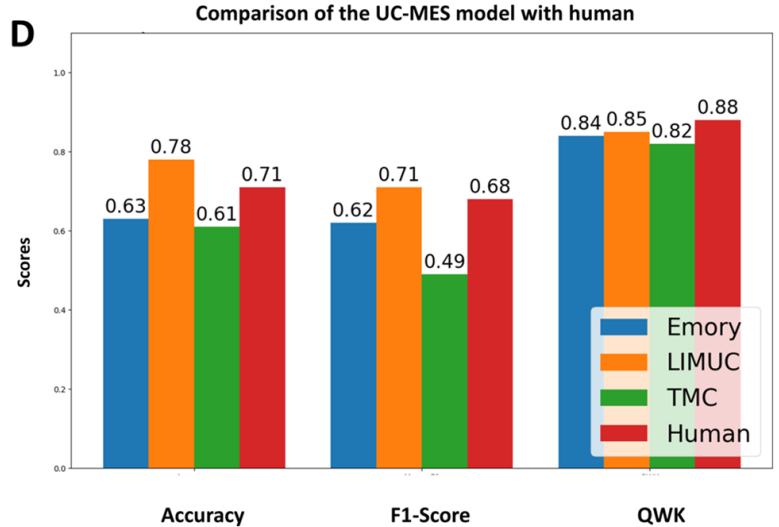
- UC-MES for four-class grading (MES 0-3): “Demonstrated strong ordinal consistency (QWK = 0.81-0.85), comparable to inter-expert agreement (QWK = 0.88)”
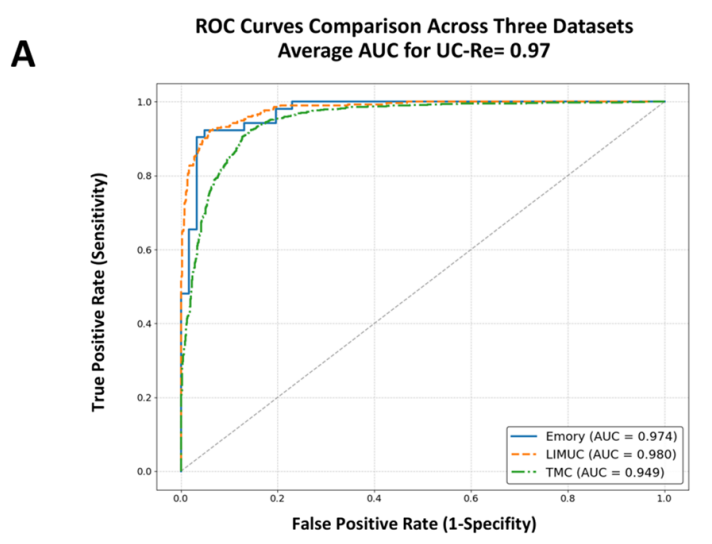
Emory, LIMUC, and TMC test sets (AUC 0.974, 0.980, and 0.949; average 0.97)
My take: This study while narrowly focusing on assessment of UC activity shows the potential of an AI-based framework to improve/standardize the interpretation of colonoscopy/endoscopy interpretation. This could help as a decision support tool and could facilitate comparison to prior evaluations. Presumably with adequate training and proof with prospective trials, these findings could be extended to a broad range of GI disorders that utilize endoscopic monitoring.
Related blog posts:
- AI for Capsule Endoscopy
- AI for GI
- The Future of Medicine: AI’s Role vs Human Judgment
- Artificial Intelligence in the Endoscopy Suite
- Video Capsule Endoscopy in VEO-IBD — Is the Juice Worth the Squeeze?
- Pediatric Capsule Endoscopy Curriculum Study
- Capsule Endoscopy More Sensitive than MRE for Crohn’s Disease
- MRE Does Not Fare Well at Detecting Lesions Evident on Upper Endoscopy
- Head-to-Head: Capsule Endoscopy versus Colonoscopy

