Each year our local CCFA chapter holds a one day seminar with separate lectures for health care providers and families. Overall, it is a good opportunity to hear ‘cutting edge’ material. I did not pick up as much at this year’s seminar as in previous years, but will highlight what I thought was most important.
Key points:
- Symptoms are not accurate at determining effectiveness of IBD therapy.
- More frequent use of objective markers are needed to optimize treatment. Mucosal healing is starting to be a target in clinical practice, but limited by number of medications available.
- Stricture classification and operative techniques were reviewed.
- IBD frequently results in psychological problems: anxiety, depression, pain, sleep. 15% of kids and 25% of adults are having thoughts of death on screening tool intake.
- Fecal microbiota transplantation (FMT) –not enough data to recommend for IBD. Clinical trials ongoing.
Debate: What should be the End Points in Therapy?
- Tanvi Dhere (Emory): Goal: clinical symptoms
- Cary Sauer (Emory Pediatrics): Goal: mucosal healing and normal bloodwork
In my opinion, this was the most thought-provoking and best presentation
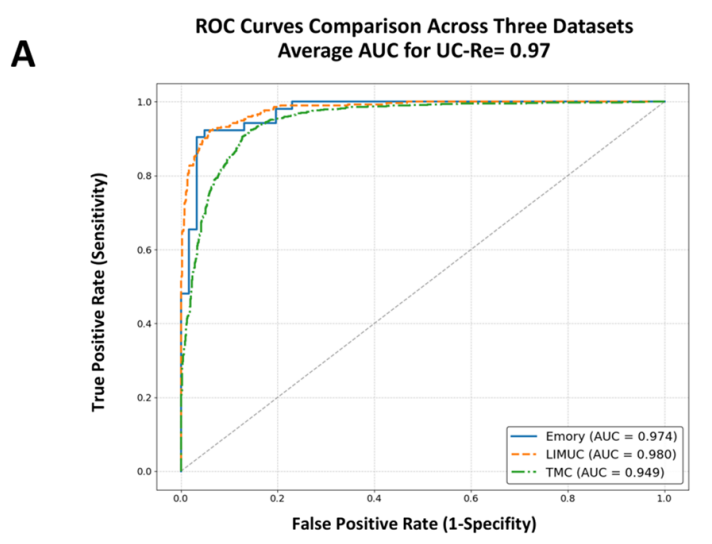
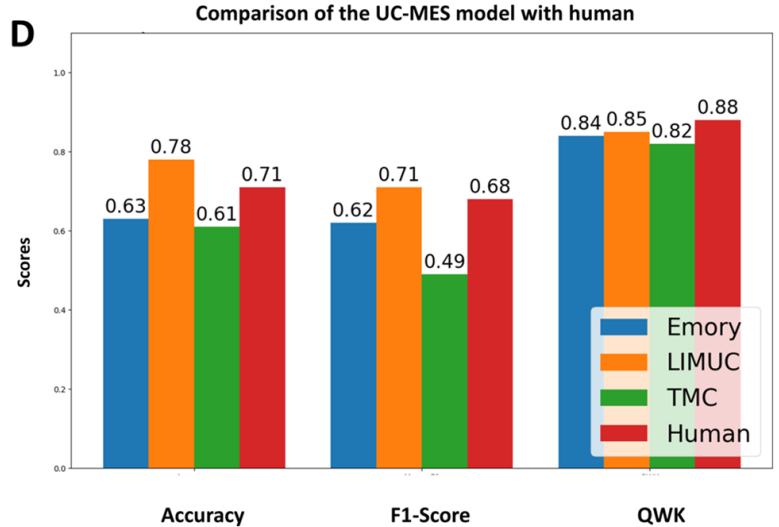
Mucosal healing (MH) consensus definition –normal mucosa after previously abnormal with complete absence of ulceration, macroscopic and histologic signs of inflammation. In practice MH = absence of ulcerations.
Reasons why mucosal healing as a target is problematic:
- Problems with MH –not validated. No long-term data utilizing endoscopic scoring indices of MH.
- MH relies on a binomial endpoint –Yes or no, but there may be intermediate endpoints.
- How likely is MH (different definitions in these studies)? SONIC –MH in 43.9% of combination Rx (30.1% in those with infliximab monotherapy); EXTEND (Adalimumab) 27% and 24.2% 12/52 weeks; MUSIC (certolizumab at 10/54 weeks) 11.5% and 18.9%.
In practice, Mayo Score 0-1 both considered to have MH.
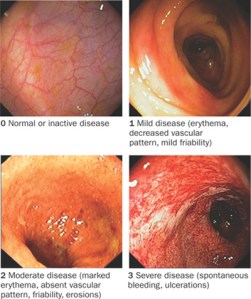
Images above online at www.nature.com
In small study, MH at 1 year were not associated with improved outcomes at 5 years. Risks of MH: more procedures, more costs of treatment, and potential for more complications.
Dr. Sauer’s reply. Three simple questions –why should I try to target MH, is it possible, what is needed to get this done?
- If the goal were only an asymptomatic patient – why do screening colonoscopy in the general population, much less in IBD?
- In IBD, long-term evolution of IBD (Cosnes J et al. Inflamm Bowel Dis. 2002 Jul;8(4):244-50) is toward structuring and penetrating disease. CD Evolution This needs to be modified if possible.
Why MH? Improved symptoms, better quality of life, less likely to develop colon cancer, and it is an objective measure of treatment response.
- In MH patients, less steroids and fewer flares over 2 year period.
- MH healing patients have sustained clinical benefit over 96 months.
- With MH, there is a decreased colectomy in UC. In one study, there was a lower colectomy rate at 8 years if colonic CD (62% vs 8%), decreased steroids in CD, decreased hospitalizations, & decreased fistulae.
Is MH possible in clinical practice? The accuracy of CDAI to detect endoscopic healing is low in patients with CD. (Bouguen G et al Clin Gastrohep 2014). More frequent adjustments in medical therapy –could lead to MH in up to 80% over 80 week study period. Same story in UC (Bouguen G et al IBD 2014).
What do I need to do to obtain MH? Endoscopy (or MRE), maximize medications (checking levels), change medications, and most important –set a target. “Adjusting infliximab dose alone could lead to MH in up to 60%.”
When to assess for MH? Consider endoscopy at 6 months into treatment if symptoms and at 12 months if in clinical remission.
Other viewpoints on MH from panel:
Dr. Loftus –“I think of this like oncology.” He agreed with using the best evaluating tool 6 months into treatment. Cross-sectional imaging is often more helpful, but may need more than one tool.
Dr. Long—“Are we going to check every 6 months?” No. She stated that she does not do this and tries to avoid repeated endoscopic procedures if this will not change treatment. Goal is to make sure patient is headed in right direction, often after starting therapy. Dr. Long stated that stool biomarkers most useful for colonic disease.
Dr. Dhere—documenting MH is important for deescalating treatment.
Millie Long “Quality of Care in IBD”
- 75% of Crohn disease patients will need surgery, 10% in 1st year
- “One way to gauge quality of care is to examine the degree of consistency in care”
- High variability in care in IBD (Aliment Pham Ther 2007; 26: 1005-18)
- “Over half of institutions with worst quality have mortality in normal range.” Outcomes may not occur until several years after treatment, thus more useful to measure process measures
PQRS IBD Quality Measures in Adults: 10 Measures
- #1 Establishing/documenting IBD type, anatomic location, and activity
- #2 Preventive care: corticosteroid sparing. Steroids associated with mortality (OR 2.1 in TREAT registry)
- #3 Preventive care: Preventing bone loss. Limiting steroid use. Recommend weight-bearing exercise, Quit Smoking, Measure DEXA, added Calicum/Vit D/Bisphosphonates
- #4: Vaccination –pneumococcal vaccine. Avoid live virus vaccines
- #5 Vaccination –influenza vaccine, zoster vaccine
- #6 Testing for latent TB prior to anti-TNF
- #7 Testing for hepatitis B virus
- #8 Testing for C diff with patients hospitalized with IBD
- #9 VTE prophylaxis in adult IBD patients. Risk assessment on admission to hospital is recommended. IBD patients have 1.5-3.5-fold higher risk of VTE àwhich can increase mortality risk
- #10 Screening for tobacco. Tobacco use after surgery increases recurrence by 2.5-fold. It also increases risk for reoperation.
Last year’s notes:
Disclaimer: These blog posts are for educational purposes only. Specific dosing of medications (along with potential adverse effects) should be confirmed by prescribing physician. This content is not a substitute for medical advice, diagnosis or treatment provided by a qualified healthcare provider. Always seek the advice of your physician or other qualified health provider with any questions you may have regarding a condition.