Flu Shots & Other Vaccines Linked to Lower Rates of Dementia

10/26/23 Washington Post: Flu shots may protect against the risk of Alzheimer’s, related dementias

An excerpt:

A number of studies have found that people receiving vaccinations for flu and several other infectious diseases appear less likely than the unvaccinated to develop dementia, although scientists aren’t sure why…

In the flu study, the researchers took participants from a national patient database, two groups of 935,887 each, one group vaccinated, the other not. To avoid the potential influence of various factors that could affect the results, the scientists ensured that each group shared many of the same characteristics… found that an annual flu vaccination for three consecutive years reduced the dementia risk 20 percent over the next four to eight years, while six shots doubled it to a 40-percent reduction…

“All this requires further studies, but vaccination, along with good diet, exercise, intellectual and emotional stimulation are key factors for healthy aging,” Hotez said.

The article notes reductions in dementia with Shingles vaccine, Tdap or Td, and pneumococcal vaccines.

These cliffs of the calanques (near Cassis, France) are about 260 meters in elevation

ChatGPT for Colonoscopy Questions Plus One

T-C Lee et al. Gastroenterol 2023; 165: 509-511. Open Access! ChatGPT Answers Common Patient Questions About Colonoscopy

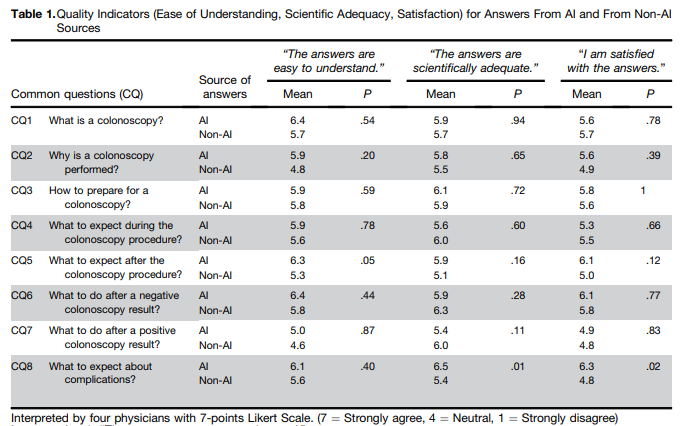
In this study, ChatGPT answers to questions about colonoscopy were compared to publicly available webpages of 3 randomly selected hospitals from the top-20 list of the US News & World Report Best Hospitals for Gastroenterology and GI Surgery.

Methods: To objectively interpret the quality of ChatGPT-generated answers, 4 gastroenterologists (2 senior gastroenterologists and 2 fellows) rated 36 pairs of CQs and answers, randomly displayed, for the following quality indicators on a 7-point Likert scale: (1) ease of understanding, (2) scientific adequacy, and (3) satisfaction with the answer (Table 1) Raters were also requested to interpret whether the answers were AI generated or not.

Key findings:

  • ChatGPT answers were similar to non-AI answers, but had higher mean scores with regard to ease of understanding, scientific adequacy, and satisfaction.
  • The physician raters demonstrated only 48% accuracy in identifying ChatGPT generated answers

My take:  This is yet another study, this time focused on gastroenterology, that show how physicians/patients may benefit from leveraging chatbots to improve communication.

Related blog posts:

Also this:

U.S. Health System: ‘World Leader in Amputations’

NY Times 8/17/23, Nicholas Kristof: How Do We Fix the Scandal That Is American Health Care?

It’s not just that life expectancy in Mississippi (71.9) now appears to be a hair shorter than in Bangladesh (72.4). Nor that an infant is some 70 percent more likely to die in the United States than in other wealthy countries….

All that is tragic and infuriating, but to me the most heart-rending symbol of America’s failure in health care is the avoidable amputations that result from poorly managed diabetes…A toe, foot or leg is cut off by a doctor about 150,000 times a year in America, making the United States a world leader of these amputations.

America’s dismal health care outcomes are a disgrace. They shame us. Partly because of diabetes and other preventable conditions, Americans suffer unnecessarily and often die young. It is unconscionable that newborns in IndiaRwanda and Venezuela have a longer life expectancy than Native American newborns (65) in the United States. And Native American males have a life expectancy of just 61.5 years — shorter than the overall life expectancy in Haiti.

The article recommends

  1. Expanding Access to Health Care
  2. Work on improving health behaviors: “smoking, eating habits and exercise — affect life expectancy even more than access to health care”…
  3. Work on poverty and education: “America’s health dysfunction is rooted in a broader national dysfunction, including deep intergenerational poverty and despair. The medical system can efficiently amputate a foot, but an improvement in self-care of diabetes sometimes requires an injection of hope and improvements in education, job training, earnings and opportunity.”

Related blog posts:

Flying “Fecal Fiasco”

9/5/23 CNN: Delta flight forced to turn around because of diarrhea incident ““It’s just a biohazard issue, we had a passenger who had diarrhea all the way through the airplane so they want us to come back to Atlanta,” a DL 194 pilot said to air traffic control.”

When a family member saw this, he wondered if someone on the plane yelled: “Is There a Gastroenterologist on This Plane?”

My take: In this case, as with a lot of GI symptoms, having a good cleaning crew is usually more important than having a good physician. And, what a terrible situation!

Related comedy (TikTok, 1 minute): Spirit Airlines Medical Emergency

“More Than Half a Million Extra Deaths” Every Year In U.S.

A previous blog post (Life Expectancy Dropping in U.S.) showed an alarming trend in which the life expectancy in the U.S. has dropped to about 76 years, nearly 6 years lower than peer countries

This article discusses this topic further. David Wallace-Wells, NY Times 8/9/23: Why Is America Such a Deadly Place? An excerpt:

“Life expectancy in the United States took an unprecedented turn for the worse, placing it not among its wealthy peers, but below Kosovo, Albania, Sri Lanka and Algeria (and just ahead of Panama, Turkey and Lebanon)…

But the loss is jaw-dropping by another measure — the sheer number of needless deaths. Before the pandemic, roughly a half million more people in America died each year than would have died, on average, in wealthy peer countries. In each of the first two years of the pandemic, the number surpassed one million….

The much larger American anomaly is its deaths among the young and middle-aged — among whom violent deaths, in particular, subtract many more years of life than would almost any natural cause of death, which overwhelmingly strikes much later in life.”

The article describes areas with excess deaths including the following:

  • Overdose deaths
  • Gun-related deaths (accidents, suicides, and homicides)
  • Excess car deaths
  • Accidents (including increased deaths from fires and drowning)
  • Maternal deaths during childbirth
  • Deaths related to chronic disease including diabetes (associated with obesity)

My take: The excess number of U.S. population dying every year is staggering and sadly, little is being done to change it.

In the News: Hunger Strike Due to Pickleball (not The Onion)

An excerpt from Newser, Couple Tired of Pickleball Noise Asks What Gandhi Would Do (July 26, 2023):

“The Canadian city of Chilliwack has just three pickleball courts. For Rajnish and Harpreet Dhawan, the problem is that the closest of them is about 30 feet from their house. The Dhawans hear the sound of ball striking paddle 11 hours every day, in every room of their home. They hear it even when no one is playing. The couple blames auditory hallucinations, heart flutters, and insomnia on the constant drumbeat, the Washington Post reports. Frustrated that complaining to city officials for nearly a year hasn’t changed the situation, they began a hunger strike, inspired by Mohandas K. Gandhi… Rajnish ended his strike Tuesday morning about 50 hours into it… Indoor courts are being built, and the ones by the Dhawans’ home are to close in November.”

Related article: Why is it called pickleball? Probably because of a “pickle boat”…not because of the dog named pickles!

My take: I am sympathetic to the Dhawans -the pickleball noise would drive me bonkers if I lived next to one of these courts.

Private Equity in Gastroenterology & More Broadly

JA Busam, EC Shah. Gastroenterology & Hepatology 2023; 19: 264-271. Open Access! The Rise of Private Equity in Gastroenterology Practices

This article provides a good review of the investment of private equity in gastroenterology practices. Key points:

  • “In addition to finding that many gastroenterologists were willing to join a PE-backed practice, PE firms found such an investment attractive because of the returns they could earn through consolidating the market.6,33…Dermatology,39 eye care,40,41 fertility,42  orthopedics,43  urology,44,45  and oncology46 are also showing increased PE activity.”
  • “The effects of PE ownership in gastroenterology are only recently being studied. Notable conclusions include increased costs of services, more visits by new patients, and increased esophagogastroduodenoscopy utilization absent any increase in total number of polyps or tumors removed.50…To increase revenue, one needs to increase either prices or volume of services provided, and it appears as if PE-backed practices are effectively doing both.”
  • “Increased volume could reflect overutilization of profitable services, unnecessary/low-value care, and/or more effective marketing, among other tactics. Higher prices could relate to more efficient charge capture, higher intensity coding, higher negotiated prices, patients being offered higher-priced services, or other causes.”

Related article: NY Times 7/10/23 Who Employs Your Doctor? Increasingly, a Private Equity Firm.

Some excerpts:

A new study finds that private equity firms own more than half of all specialists in certain U.S. markets…The medical groups were associated with higher prices in their respective markets, particularly when they controlled a dominant share, according to a paper by researchers at the Petris Center at the University of California, Berkeley, and the Washington Center for Equitable Growth, a progressive think tank in Washington, D.C. When a firm controlled more than 30 percent of the market, the cost of care in three specialties — gastroenterology, dermatology, and obstetrics and gynecology — increased by double digits...

Nearly 70 percent of all doctors were employed by either a hospital or a corporation in 2021, according to a recent analysis from the Physicians Advocacy Institute...If they could, given their rising costs and how squeezed they feel by insurers, “every independent group would want to increase its fees”

 “This builds the case for strong antitrust tools for these incrementally small but collectively larger consolidation trends,” said Erin Fuse Brown, the director of the Center for Law, Health and Society at Georgia State University.

My take: Private equity’s acquisition of medical practices is likely to drive up healthcare costs without significant improvement in patient outcomes. However, few if any other stakeholders in medical care are incentivized to provide high value care.

Related blog posts:

Watersound, FL

Chatbots Helping Doctors with Empathy

6/12/23 NY Times: Doctors Are Using Chatbots in an Unexpected Way

An excerpt:

When doctors use ChatGPT to find words to be more empathetic, they often hesitate to tell any but a few colleagues.

“Perhaps that’s because we are holding on to what we see as an intensely human part of our profession,” Dr. Moore said.

Or, as Dr. Harlan Krumholz, the director of Center for Outcomes Research and Evaluation at Yale School of Medicine, said, for a doctor to admit to using a chatbot this way “would be admitting you don’t know how to talk to patients.”

Related blog posts: