“Between 2004 and 2018, the number of reported illnesses from mosquito, tick, and flea bites more than doubled, with more than 760,000 cases reported in the United States. Nine new germs spread by mosquitoes and ticks were discovered or introduced into the United States during this period. The geographic ranges where ticks spread Lyme disease, anaplasmosis, ehrlichiosis, and spotted fever rickettsiosis have expanded, and experts predict that tickborne diseases will continue to increase.”
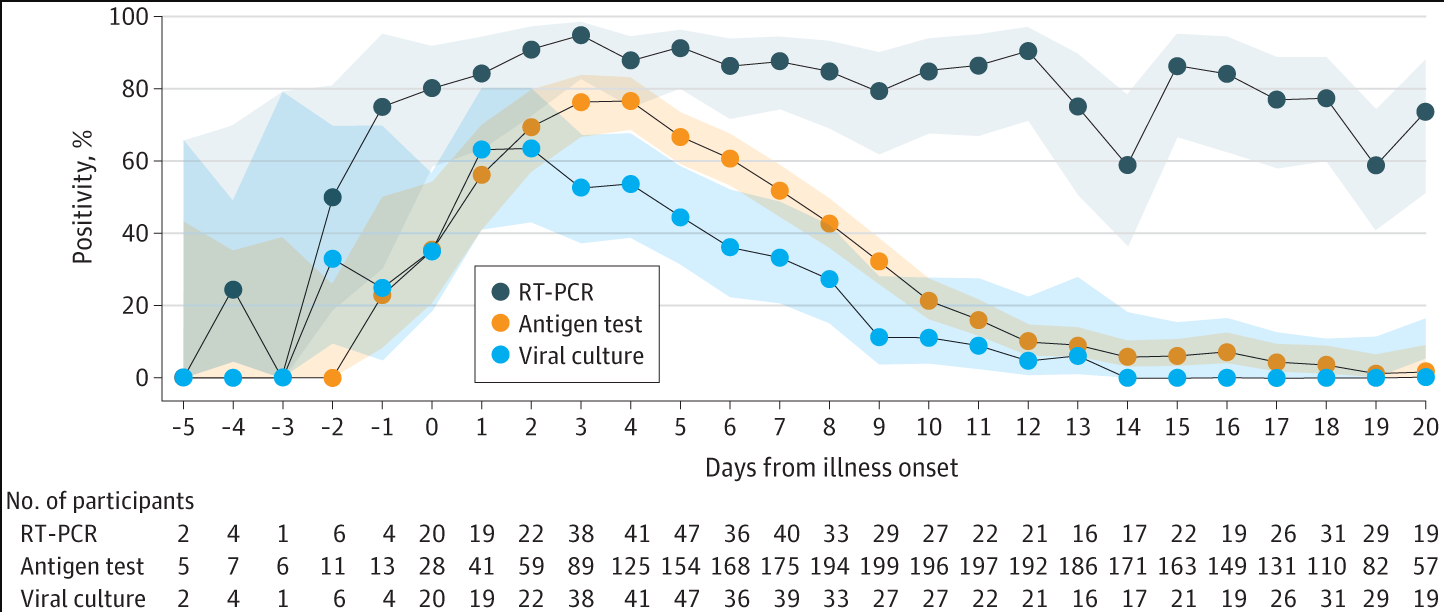
Background: This was a prospective cohort study of 225 adults and children comparing reverse transcription–polymerase chain reaction (RT-PCR)–confirmed SARS-CoV-2 infection with antigen testing (QuickVue At-Home OTC COVID-19 Test) and viral culture (January to May 2021)
Key findings:
Rapid testing (antigen) sensitivity was 64% and viral culture sensitivity was 84% when compared with same-day RT-PCR and viral culture
Rapid testing (antigen) sensitivity peaked 4 days after illness onset (77%); a second test 1 to 2 days later showed improved sensitivity (81%-85%)
My take: This study shows that a single rapid test is NOT adequate to exclude SARS-CoV-2 infection, especially if they are symptomatic (need to recheck 1-2 days later if negative rapid test). The reliability/accuracy/sensitivity is likely to vary greatly between different rapid tests and may change significantly with different viral variants.
This short commentary explains how the childhood deaths due to motor vehicle accidents have improved. “The crossing of these trend lines demonstrates how a concerted approach to injury prevention can reduce injuries and deaths — and, conversely, how a public health problem can be exacerbated in the absence of such attention.”
“The C.D.C. study covered the period from mid-December to late February, during which about 400 children were hospitalized with Covid at the select hospitals participating in the study.”
“Among the children who tested positive for the virus before or during their hospitalization, three-quarters of them were admitted primarily for Covid, rather than other illnesses, the C.D.C. said.”
This retrospective cohort study followed 17.6 million adult residents of California for up to 12 years.
Key findings:
Overall rates of homicide were more than twice as high among cohabitants of handgun owners than among cohabitants of nonowners (adjusted hazard ratio, 2.33).
These elevated rates were driven largely by higher rates of homicide by firearm (adjusted hazard ratio, 2.83).
Among homicides occurring at home, cohabitants of gun owners had sevenfold higher rates of being fatally shot by a spouse or intimate partner (adjusted hazard ratio, 7.16); 84% of these victims were female.
My take: Gun ownership increases the likelihood of firearm-related deaths.
No Exaggeration: Too Many Children Are Dying in the U.S. “The sad fact is that a child or adolescent in the United States is 57% more likely to die by the age of 19 years than those in other wealthy nations.” This is due mainly to more deaths from MVAs and from gun violence.
“There is no level of drinking that does not confer heart disease risk. The risk is small if people have an average of seven drinks a week when compared with none. But it increases quickly as the level of alcohol consumption rises”
“The study, which may help resolve medical disputes over the effects of alcohol on the heart, involved sophisticated analyses of the genes and medical data of nearly 400,000 people who participate in the U.K. Biobank”
“Some researchers have reported that drinking modestly protects the heart because moderate drinkers as a group have less heart disease than those who drink heavily or those who abstain. Dr. Aragam and his colleagues also saw that effect. But the reason, they report, is not that alcohol protects the heart. It is that light to moderate drinkers — those who consume up to 14 drinks a week — tend to have other characteristics that decrease their risk, like smoking less, exercising more and weighing less than those who drink more heavily and those who do not drink.“
“Many earlier studies of alcohol consumption and heart health were observational, meaning the subjects were followed over time to see if the amount of drinking was linked to heart health. Such studies are only able to find correlation but not causation, researchers say. But the Biobank study’s use of Mendelian randomization is more suggestive of causality, and so its results might carry more weight.”
My take: Light alcohol consumption is NOT beneficial for your heart.
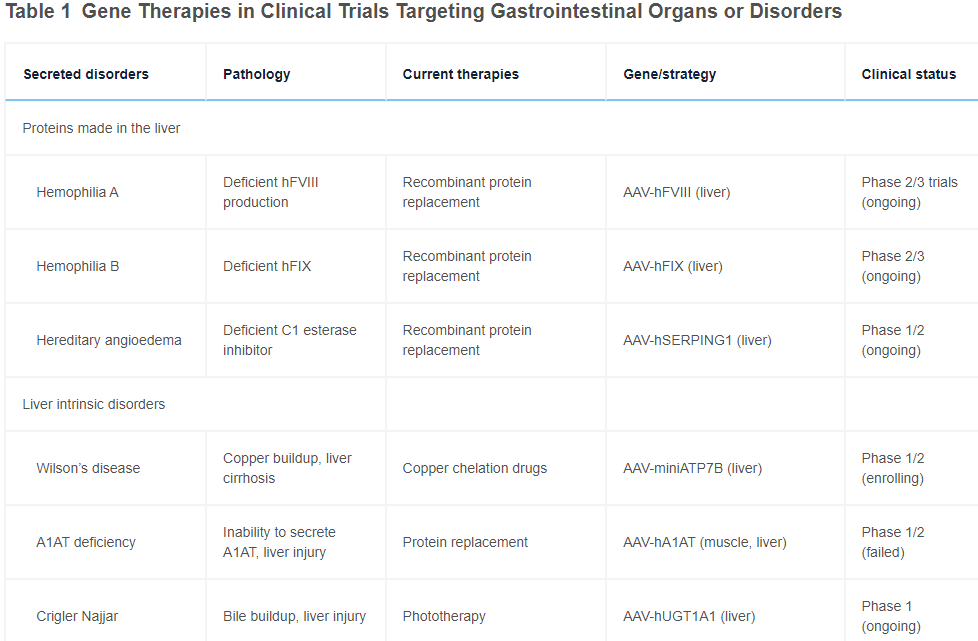
Researcher’s have utilized viruses to introduce exogenous DNA in efforts to correct defects in genetic diseases. Adeno-associated virus (AAV) vectors are the most common vectors used. In addition, AAV have a natural tropism to the liver following intravenous infusion
“Highlighting programs with the most advanced efficacy, hemophilia gene therapies in the liver have advanced into phase 2/3 and have shown promising efficacy based on factor VIII or IX levels achieved and reduction in bleeding events, with the main questions being long-term expression and safety of the approach”
Limitations:
“Integrated AAV have been associated with an increased incidence of hepatocellular carcinoma in mice”
Antibodies to AAV may be present or develop after infusion…” this factor has precluded any redosing in trials because antibodies would neutralize all incoming vectors”
In hemophilia trials, in the liver there has been a slow decrease in the levels of expression over time 6 which indicates that years into the future patients will need to be redosed to maintain efficacy
“Practically, AAV can only achieve delivery in a fraction of cells within an organ”
Newer Approaches for Gene Delivery:
mRNA delivery: mRNA is being explored as a tool for gene therapy, because mRNA only requires cytoplasmic delivery for expression.
“mRNA can also express gene-editing enzymes like Cas9….However, gene editing presents inherent risks of off-targeting cutting or base editing that would occur in millions of hepatocytes, potentially leading to cancer”
“Nonviral approaches of DNA delivery could drop the costs of vector production at least 100-fold versus AAV…delivery of DNA through LNPs [lipid nanoparticles] has largely yielded inefficient gene expression”
“Hydrodynamic injection is a process where fluid pressure is used to deliver naked DNA directly into cell…injection into the biliary system through endoscopic retrograde cholangiopancreatography”
The authors note that gene delivery could be important in modifying more common disorders including nonalcoholic steatohepatitis, diabetes and autoimmune diseases.
My take: While this field of study is quite exciting, to me it is definitely a shiny object, like all of precision medicine, in that it may distract researchers and physicians away from more pressing common problems.
“Issue-attention cycle” problem. “This pattern occurs when initial public alarm over the discovery of a problem and optimism about its quick resolution are replaced by the realization that solving the problem will require some public sacrifice and will displace powerful societal interests.”from Weight of the Nation | gutsandgrowth
This commentary notes that the National Institutes of Health (NIH) spends more than $40 billion each year to fund biomedical research. “We believe that medicines discovered at public expense should be affordable.”
A Few Excerpts:
“Existing laws provide two paths for achieving this result. First, the Bayh–Dole Act of 1980 gives the government a royalty-free license to use patented inventions that were discovered using federal funding. The government has never exercised its Bayh–Dole license”
“Second, 28 U.S. Code §1498, which dates to 1910, gives the government immunity from being sued for patent infringement in federal courts, while giving patent owners the right to receive reasonable compensation when the government makes or uses a patent-protected product”
Case in point: “Recently, the government signed a contract with Merck to purchase molnupiravir (Lagevrio), an oral antiviral drug that reduces the severity of Covid-19. The contract price of $712 per treatment is estimated to be more than 35 times the cost of producing the drug at a reasonable profit. Molnupiravir was discovered at Emory University using government funding, and Emory’s patent applications acknowledge the government’s Bayh–Dole license.5 Molnupiravir payments for Medicare, Medicaid, and VHA patients could cost the government billions in 2022. This amount could be reduced by more than 90% if the government exercised its license and allowed a generic manufacturer to supply the drug for patients in government-supported programs.”
My take: U.S. taxpayers should get a return on their investment when new medications are developed with government funding rather than paying more for these medications than any other country.
“With digital health tools such as telehealth and patient portals becoming prominent components of care delivery, the barriers to digital inclusion have grown increasingly apparent.1 For example, more than 100 studies have revealed disparities in portal use based on age, race, socioeconomic status, English-language proficiency, and other factors”
Barriers: digital redlining (discrimination by internet providers), limited broadband infrastructure/access, costs, and knowledge
“The recently enacted Infrastructure Investment and Jobs Act (IIJA) makes investments that could foster sustainable digital inclusion”
“The IIJA takes much of the responsibility for building digital infrastructure away from individual health care organizations and makes digital inclusion a public concern. The law includes $65 billion for digital-inclusion initiatives. It earmarks $42.5 billion for investment in broadband infrastructure by means of state deployment grants, promotes broadband affordability by providing $14.2 billion for $30-per-month subsidies for Internet costs for underserved people, and allocates $2.8 billion for the creation of digital-literacy programs. It also includes funds to support connectivity in tribal communities and broadband deployment in rural areas”
“The law charges the FCC with adopting rules to prevent “digital discrimination of access based on income level, race, ethnicity, color, religion, or national origin.” These policies are an attempt to overcome structural barriers to digital inclusion, such as redlining”
“By capitalizing on new policies, health care organizations could become a critical part of an environment of community-based players working toward digital inclusion”
Issues Not Addressed by Infrastructure Investment and Jobs Act (IIJA):
“Law doesn’t address changes that are needed to the design of digital health platforms (e.g., language translation) or to make workflows more inclusive (e.g., integration of interpreters into telehealth visits)”
“Simplification of interstate licensing laws for clinicians would also enable digital tools to increase access to care for marginalized populations”
Assuring adequate reimbursement for digital care
My take: Digital health literacy/availability is needed to improve outcomes.







 gutsandgrowth