How Much of a Drug Markup is Reasonable (for hospitals)?

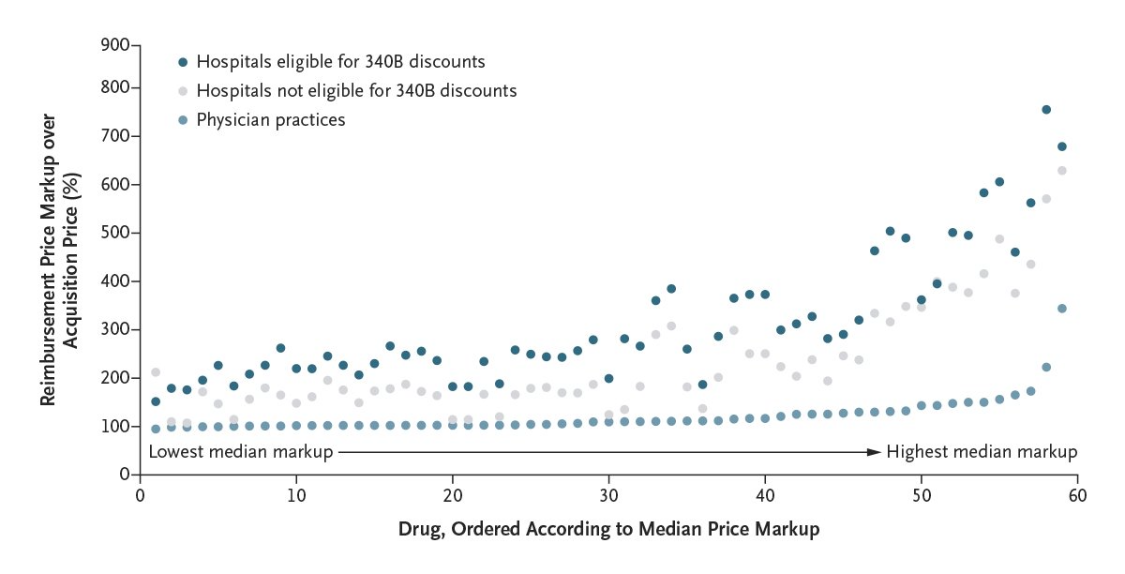
JC Robinson et al. NEJM 2024; 390: 338-345. Hospital Prices for Physician-Administered Drugs for Patients with Private Insurance

In this study, the authors used 2020–2021 national Blue Cross Blue Shield claims data regarding patients in the United States who had drug-infusion visits. This included 404,443 patients in the United States who had 4,727,189 drug-infusion visits.  The authors examined 57 medications which represent the most expensive physician-administered drugs.

Background:

“Approximately one third of hospitals, including all specialized cancer hospitals, are also eligible for large discounts off drug acquisition prices under the federal 340B Drug Pricing Program.Hospitals thus have two means to generate profits from physician-administered drugs. Hospitals can reduce what they pay to manufacturers for the drugs, especially if they are eligible for 340B discounts, and can increase what they are paid for the drugs by imposing markups on the reimbursement prices they charge to insurers.”

Key findings:

  • The median price markup (defined as the ratio of the reimbursement price to the acquisition price) for hospitals eligible for 340B discounts was 3.08
  • After adjustment for drug, patient, and geographic factors, price markups at hospitals eligible for 340B discounts were 6.59 times as high as those in independent physician practices; price markups at noneligible hospitals were 4.34 times as high as those in independent physician practices
  • Hospitals eligible for 340B discounts retained 64.3% of insurer drug expenditures, whereas hospitals not eligible for 340B discounts retained 44.8% and independent physician practices retained 19.1%.
  • When we look at high drug costs, much is due to price markups NOT due to the manufacturers (which is already a lot). In this study, hospitals eligible for 340B discounts “retained almost two thirds of insurer drug expenditures, passing on only one third to the drug companies.”

My take: In my view, the health care market is messed up.

  • Hospitals charge exorbitant amounts for infusions (and other care) and this is worsening with consolidation
  • Insurance companies are difficult to work with and often deny needed care. Patients and physicians have little leverage to get them to fulfill their obligations.
  • Pharmaceutical companies use a myriad of tricks to increase the costs of their medications (see blog posts below) and charge U.S. consumers much more than what patients pay in other countries
  • Physicians are not incentivized to limit costs for patients/insurers. Many worry their reputations will suffer and they will be exposed to legal liability if thorough evaluations are not performed.
               From NEJM Twitter feed

Related issue:

This tweet from Bernie Sanders illustrates the additional costs that U.S. consumers pay for medications and indicates that legislation may be needed as the ‘market’ is not working well to control costs.

Related blog posts:

Complications After Private Equity Takeover

12/26/23 NY Times: Serious Medical Errors Rose After Private Equity Firms Bought Hospitals

An excerpt:

The study, published in JAMA on Tuesday, found that, in the three years after a private equity fund bought a hospital [51 hospitals in study], adverse events including surgical infections and bed sores rose by 25 percent among Medicare patients when compared with similar hospitals that were not bought by such investors. The researchers reported a nearly 38 percent increase in central line infections, a dangerous kind of infection that medical authorities say should never happen, and a 27 percent increase in falls by patients while staying in the hospital…

Although the researchers found a significant rise in medical errors, they also saw a slight decrease (of nearly 5 percent) in the rate of patients who died during their hospital stay. The researchers believe other changes, like a shift toward healthier patients admitted to the hospitals, could explain that decline. And by 30 days after patients were discharged, there was no significant difference in the death rates between hospitals…

The researchers said the most likely explanation for the increased errors was fewer hospital employees, an effect that has been measured in other studies of private equity.

My take: Private equity (PE) investment is likely to result in a lower quality of care in most circumstances. The primary driver of PE is profits not people. In order for PE to achieve their goals, it necessitates either driving up costs (higher profit margin) or reducing costs/staffing.

Related blog posts:

Tile Wall in Lisbon

Unionization of Physicians, Pharmacists and Health Care Workers

NY Times 12/3/23: Why Doctors and Pharmacists Are in Revolt

The reasons for the recent labor actions appear straightforward. Doctors, nurses and pharmacists said they were being asked to do more as staffing dwindles, leading to exhaustion and anxiety about putting patients at risk…the explanation runs deeper: A longer-term consolidation of health care companies has left workers feeling powerless in big bureaucracies. They say the trend has left them with little room to exercise their professional judgment…

Professionals in a variety of fields have protested similar developments in recent years. Schoolteacherscollege instructors and journalists have gone on strike or unionized amid declining budgets and the rise of performance metrics that they feel are more suited to sales representatives than to guardians of certain norms and best practices.

But the trend is particularly pronounced in health care…Over time, however, consolidation and the rise of ever-larger health care corporations left workers with less influence…

Many health systems had increased tensions with doctors and nurses by failing to involve them more in developing and putting in place the system of metrics on which they are judged…

The breaking point came when the height of the pandemic passed, but conditions barely improved, according to many workers…

During an interview in October, while Dr. Smith [a pharmacist] and his colleagues were still awaiting the company’s response, he made clear that his patience had run out. “I’ve been asking and asking and asking for improvements for years,” he said. “Now we’re not asking any more — we’re demanding it.”

Related blog posts:

Pink Street in Lisbon

U.S. Health System: ‘World Leader in Amputations’

NY Times 8/17/23, Nicholas Kristof: How Do We Fix the Scandal That Is American Health Care?

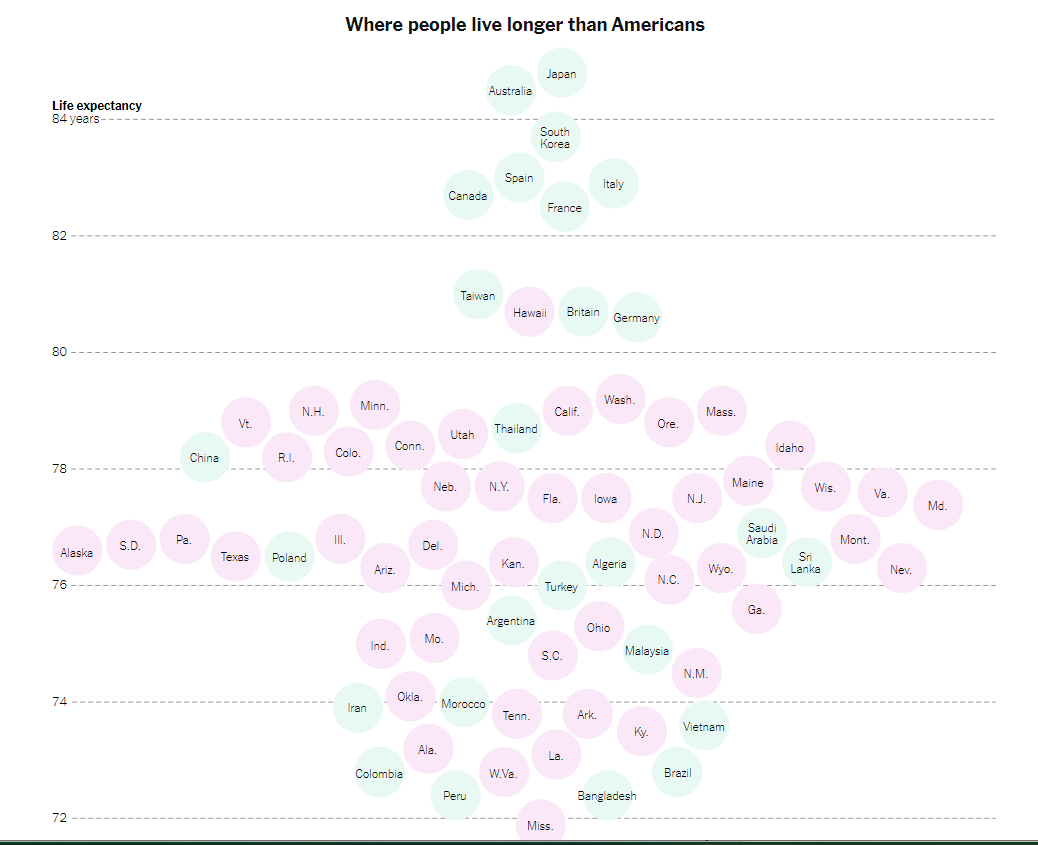
It’s not just that life expectancy in Mississippi (71.9) now appears to be a hair shorter than in Bangladesh (72.4). Nor that an infant is some 70 percent more likely to die in the United States than in other wealthy countries….

All that is tragic and infuriating, but to me the most heart-rending symbol of America’s failure in health care is the avoidable amputations that result from poorly managed diabetes…A toe, foot or leg is cut off by a doctor about 150,000 times a year in America, making the United States a world leader of these amputations.

America’s dismal health care outcomes are a disgrace. They shame us. Partly because of diabetes and other preventable conditions, Americans suffer unnecessarily and often die young. It is unconscionable that newborns in IndiaRwanda and Venezuela have a longer life expectancy than Native American newborns (65) in the United States. And Native American males have a life expectancy of just 61.5 years — shorter than the overall life expectancy in Haiti.

The article recommends

  1. Expanding Access to Health Care
  2. Work on improving health behaviors: “smoking, eating habits and exercise — affect life expectancy even more than access to health care”…
  3. Work on poverty and education: “America’s health dysfunction is rooted in a broader national dysfunction, including deep intergenerational poverty and despair. The medical system can efficiently amputate a foot, but an improvement in self-care of diabetes sometimes requires an injection of hope and improvements in education, job training, earnings and opportunity.”

Related blog posts:

Another Health Insurance Predatory Practice and One Doctor’s Quest to Stop It

C Podkul 8/14/23 Propublica (open access!): The Hidden Fee Costing Doctors Millions Every Year

An excerpt:

A powerful lobbyist convinced a federal agency that doctors can be forced to pay fees on money that health insurers owe them. Big companies rake in profits while doctors are saddled with yet another cost in a burdensome health care system…

In August 2017, a federal agency with sweeping powers over the health care industry posted a notice informing insurance companies that they weren’t allowed to charge physicians a fee when the companies paid the doctors for their work. Six months later, that statement disappeared without explanation.

The vanishing notice was the result of a behind-the-scenes campaign by the insurance industry and its middlemen that has largely escaped public notice — but that has had massive financial consequences that have rippled through the health care universe. The insurers’ invisible victory has tightened the financial vise on doctors and hospitals, nurtured a thriving industry of middlemen and allowed health insurers to do something no other industry does: Take one last cut even as it pays its bills.

Insurers now routinely require doctors to kick back as much as 5% if they want to be paid electronically. Even when physicians ask to be paid by check, doctors say, insurers often resume the electronic payments — and the fees — against their wishes...

Dr. Alex Shteynshlyuger, a urologist who runs his own clinic in New York City, made it his mission to take on both the insurers and the federal bureaucracy. He began filing voluminous public records requests with CMS.

My take: This article shows another layer of a broken health care system where the ‘frauds are legal.’

Related blog posts:

NRocks, Circleville, WV

“Do Nonprofit Hospitals Deserve Their Tax Exemption?”

G Bai et al. NEJM 2023; 389: 196-197. Do Nonprofit Hospitals Deserve Their Tax Exemption?

Excerpts:

Roughly 60% of community hospitals are incorporated as nonprofit institutions, which means that they don’t have shareholders and cannot distribute dividends…Nonprofit status doesn’t automatically confer tax exemption. Section 501(c)(3) of the Internal Revenue Code authorizes tax exemption for nonprofit organizations pursuing charitable, religious, educational, or scientific missions…In 1969, the IRS adopted the community-benefit standard, which required nonprofit hospitals to promote “the health of a class of persons that is broad enough to benefit the community.”…

An analysis by the Kaiser Family Foundation estimated that the value of nonprofit hospitals’ tax exemption was $28.1 billion in 2020…In 2018, for every $100 of expenses incurred, nonprofit hospitals in aggregate spent $2.30 on charity care, as compared with $3.80 spent by for-profit hospitals. And in 2019, nonprofit and for-profit hospitals had similar Medicaid shortfalls as a share of total expenses…

Many nonprofit hospitals also generate substantial profits from the federal 340B Drug Pricing Program. The 340B program… was designed to help safety-net hospitals serve low-income patients…

Some hospitals have also adopted aggressive revenue enhancing activities, such as declining to offer charity care to eligible patients and suing patients and garnishing wages because of unpaid medical bills. These examples make it clear that nonprofit status provides no assurance that hospitals will behave in accordance with their charitable mission or provide sufficient community benefit to justify favored tax status…

Disclosure might not be sufficient to catalyze changes in hospital behavior, but we believe
greater visibility is a prerequisite for policy action…Many nonprofit hospitals face substantial fiscal challenges, so heavy-handed policies — such as eliminating tax-exempt status across the board — are likely to be counterproductive…Mandating increased financial transparency would give stakeholders and policymakers the flexibility to understand, design, and test approaches to encourage nonprofit hospitals to provide meaningful community benefit

My take: This commentary piece makes a strong argument that many nonprofit hospitals do not deserve to be exempt from taxes.

Related blog posts:

Radishes (seen at a Farmer’s market recently)

High Rates of Denying Medical Care for Medicaid Patients Managed by Health Insurers

7/19/23 NY Times: Insurers Deny Medical Care for the Poor at High Rates, Report Says

Some excerpts:

Private health insurance companies paid by Medicaid denied millions of requests for care for low-income Americans with little oversight from federal and state authorities, according to a new report by U.S. investigators published Wednesday.

Medicaid, the federal-state health insurance program for the poor that covers nearly 87 million people, contracts with companies to reimburse hospitals and doctors for treatment and to manage an individual’s medical care. About three-quarters of people enrolled in Medicaid receive health services through private companies, which are typically paid a fixed amount per patient rather than for each procedure or visit.

The report by the inspector general’s office of the U.S. Department of Health and Human Services details how often private insurance plans refused to approve treatment and how states handled the denials.

Doctors and hospitals have increasingly complained about what they consider to be endless paperwork and unjustified refusals of care by the insurers when they fail to authorize costly procedures or medicinesThe investigators also raised concerns about the payment structure that provides lump sums per patient. They worried it would encourage some insurers to maximize their profits by denying medical care and access to services for the poor...

The investigators emphasized the insurers were much more aggressive in refusing to authorize care under Medicaid than under Medicare…Unlike with Medicare, if an insurer refuses to authorize a treatment, patients are not automatically provided with an outside medical opinion as part of their appeal...

The investigators also found that state oversight of coverage denials was lax. Many states do not routinely examine the insurers’ denials nor collect information about how many times a plan denies requests for prior authorization...

The denial rates recorded by the investigators varied widely by insurer and by state.

My take: This is more evidence of the distorted incentives in U.S. healthcare where health insurance companies profit when patients are denied beneficial care.

Related blog posts:

Le Jardin Exotique, Eze France
Narrow walkways in Eze, France

Case Study of Private Equity in Physician Practices: Anesthesia in Colorado

6/29/23 Washington Post: Financiers bought up anesthesia practices, then raised prices

Some excerpts:

The multibillion-dollar private equity firm Welsh, Carson, Anderson & Stowe took less than a year to create, from scratch, Colorado’s biggest and most prominent anesthesiology practice…The company employed 330 anesthesiologists in Colorado at one point…

Typically following the same approach it took in Denver: acquiring the largest anesthesiology firm in a city and growing its reach from there, company officials said. It has issued more than $1.3 billion in dividends to its shareholders…

12 former USAP anesthesiologists cited an array of reasons for leaving.

For starters, their pay declined more than they expected, they said. The company more often required them to work shifts of more than 24 hours, physicians said. Some said they were asked to take on more than 80 hours in a week. Several said that under USAP management, they felt like interchangeable “widgets” with less control over the practice than they previously had…“Their doctors were overworked and paid below market rate for what they do,” Manchon said. “That’s why their doctors were leaving.”

My take: Private equity involvement in medicine is focused on profits not patients. That being said, most other parts of the U.S. healthcare system (hospitals, physicians, insurance companies and pharmaceutical companies) do not provide great value either.

Related blog posts:

Nice, France
War Memorial at Castle Hill in Nice, France

Private Equity in Gastroenterology & More Broadly

JA Busam, EC Shah. Gastroenterology & Hepatology 2023; 19: 264-271. Open Access! The Rise of Private Equity in Gastroenterology Practices

This article provides a good review of the investment of private equity in gastroenterology practices. Key points:

  • “In addition to finding that many gastroenterologists were willing to join a PE-backed practice, PE firms found such an investment attractive because of the returns they could earn through consolidating the market.6,33…Dermatology,39 eye care,40,41 fertility,42  orthopedics,43  urology,44,45  and oncology46 are also showing increased PE activity.”
  • “The effects of PE ownership in gastroenterology are only recently being studied. Notable conclusions include increased costs of services, more visits by new patients, and increased esophagogastroduodenoscopy utilization absent any increase in total number of polyps or tumors removed.50…To increase revenue, one needs to increase either prices or volume of services provided, and it appears as if PE-backed practices are effectively doing both.”
  • “Increased volume could reflect overutilization of profitable services, unnecessary/low-value care, and/or more effective marketing, among other tactics. Higher prices could relate to more efficient charge capture, higher intensity coding, higher negotiated prices, patients being offered higher-priced services, or other causes.”

Related article: NY Times 7/10/23 Who Employs Your Doctor? Increasingly, a Private Equity Firm.

Some excerpts:

A new study finds that private equity firms own more than half of all specialists in certain U.S. markets…The medical groups were associated with higher prices in their respective markets, particularly when they controlled a dominant share, according to a paper by researchers at the Petris Center at the University of California, Berkeley, and the Washington Center for Equitable Growth, a progressive think tank in Washington, D.C. When a firm controlled more than 30 percent of the market, the cost of care in three specialties — gastroenterology, dermatology, and obstetrics and gynecology — increased by double digits...

Nearly 70 percent of all doctors were employed by either a hospital or a corporation in 2021, according to a recent analysis from the Physicians Advocacy Institute...If they could, given their rising costs and how squeezed they feel by insurers, “every independent group would want to increase its fees”

 “This builds the case for strong antitrust tools for these incrementally small but collectively larger consolidation trends,” said Erin Fuse Brown, the director of the Center for Law, Health and Society at Georgia State University.

My take: Private equity’s acquisition of medical practices is likely to drive up healthcare costs without significant improvement in patient outcomes. However, few if any other stakeholders in medical care are incentivized to provide high value care.

Related blog posts:

Watersound, FL

How Insurance Companies Save Millions in Denying Care

3/23/23 Propublica: How Cigna Saves Millions by Having Its Doctors Reject Claims Without Reading Them

A few excerpts:

  • Cigna, one of the country’s largest insurers…has built a system that allows its doctors to instantly reject a claim on medical grounds without opening the patient file, leaving people with unexpected bills…Over a period of two months last year, Cigna doctors denied over 300,000 requests for payments using this method, spending an average of 1.2 seconds on each case, the documents show. 
  • Before health insurers reject claims for medical reasons, company doctors must review them, according to insurance laws and regulations in many states…This process helps avoid unfair denials…Cigna adopted its review system more than a decade ago, but insurance executives say similar systems have existed in various forms throughout the industry…At UnitedHealthcare….built a similar system to let its doctors quickly deny claims in bulk.
  • Cigna eventually designated the list “PXDX” — corporate shorthand for procedure-to-diagnosis. The list saved money in two ways. It allowed Cigna to begin turning down claims that it had once paid. And it made it cheaper to turn down claims, because the company’s doctors never had to open a file or conduct any in-depth review. They simply denied the claims in bulk with an electronic signature.
  • Cigna knows that many patients will pay such bills rather than deal with the hassle of appealing a rejection [for lower cost denials]…In one corporate document, Cigna estimated that only 5% of people would appeal a denial resulting from a PXDX review.

My take: It is a hassle to appeal denials. It is not surprising to me to hear about this reporting; it confirms the fact that insurance companies are focused primarily on cost and not patient care.

Related blog posts:

Ocotillo Cactus on the Sendero -Hugh Norris Trail, Saguaro National Park (Tucson, Az)