JMJ van der Zande et al. J Pediatr Gastroenterol Nutr. 2026;82:980–987. Interrater reliability in pediatric high-resolution anorectal manometry recordings
This study analyzed the interpretation of 10 pediatric high-resolution anorectal manometry (HR-ARM) by 10 pediatric experts in neurogastroenterology, including one of my partners, Dr. Jose Garza.
Key findings:
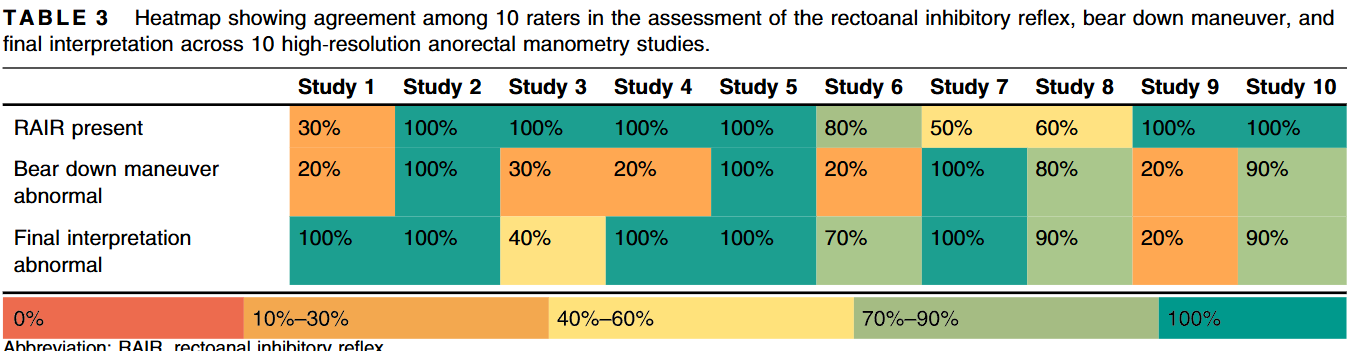
There was only fair agreement among readings with regard to rectoanal inhibitory reflex (κ = 0.35), the bear down maneuver, and the final interpretation of the study either being normal or abnormal (κ = 0.50 and κ = 0.43, respectively).
There was excellent agreement with regard to assessment of the anal canal resting pressure, the squeeze pressure, as well as the squeeze duration
My take: This is a cautionary study indicating a high-rate of variability in the interpretation of key components of HR-ARM; the results are similar to a 2012 study of colonic manometry (see below). Thus, clinical context and supporting data (eg. histology) are quite important as well for clinical decision-making.
In this retrospective review from a tertiary referral center with 34 children.
Background: “The RAIR is an involuntary anal reflex mediated by a complex intramural neuronal plexus that results in a decrease of the internal anal sphincter (IAS) pressure following distension of the rectum. Such distension can be caused by gas, feces, or an inflated balloon during ARM testing (3). In patients with Hirschsprung disease, the RAIR is absent due to an abnormal development of the enteric nervous system resulting in the absence of ganglion cells (4). Additionally, the RAIR is occasionally found to be absent in children with normal presence of ganglion cells who are then diagnosed with internal anal sphincter achalasia (IASA) (5,6). The clinical significance of this diagnosis is still unclear (5).”
Key findings:
In 9 of 34 (26%) children the RAIR was solely identified during ARM under general anesthesia (GA) and not during ARM while awake.
In 4 of 34 (12%) children, assessment of the RAIR was inconclusive during ARM under GA due to too low, or loss of anal canal pressure. In 2 of those children, ARMs while awake showed presence of a RAIR.
In the entire cohort, 2 children were diagnosed with Hirschsprung disease. 1 had an inconclusive study while awake and absence of RAIR while under GA. 1 had absence of RAIR while awake and under GA.
Other findings among the 34 children: 13 (38%) were diagnosed with pelvic floor dyssynergia, 3 (9%) were diagnosed with IASA, 2 (6%) were diagnosed with IASA and pelvic floor dyssynergia
Discussion:
The authors note that in patients with absent RAIR while awake but present while under GA, could result in “incorrect identification of an absent RAIR [and] may result in the unnecessary performance of rectal biopsies and the incorrect diagnosis of IASA…. Still, the ARM while awake more likely represents what they experience when they try to defecate during the day. Therefore, one could argue that these children may experience obstructive symptoms in daily life similar to a child diagnosed with IASA… In our sample, 9 children would have been misdiagnosed with IASA if they would not have undergone a repeat ARM (5).”
My take: It is interesting that about a quarter of children had RAIR identified only while under GA. Given the uncertainty regarding the clinical significance of a IASA diagnosis, in many centers the next step would be arranging a rectal biopsy rather than repeating a study under GA.