The AAP and more than 40 other medical, health and patient advocacy groups also issued a joint statement condemning the change and called on the CDC to “return to its long history of promoting evidence-based information.”
Potential links between vaccines and autism have been studied for decades. More than 40 high-quality studies in seven countries involving over 5.6 million people have found no connection.
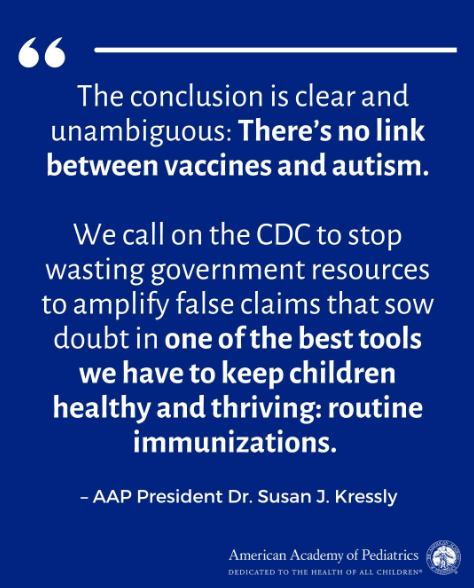
“The conclusion is clear and unambiguous: There’s no link between vaccines and autism,” Dr. Kressly said. “Anyone repeating this harmful myth is misinformed or intentionally trying to mislead parents.”
Scientists believe there is no single root cause of autism. Interactions between genetic changes and environmental influences likely play a role, according to an AAP Fact Checked article. Improved awareness and screening and updated diagnostic criteria have contributed to increases in autism prevalence.
“At this point, it’s not about doing more studies. It’s about being willing to accept what the existing studies clearly show,” said Alison Singer, M.B.A., co-founder and president of the Autism Science Foundation.
She said spending more money on settled science takes funding away from research on genetics and services for autistic people. False claims further stigmatize autistic people and their families…
Sean T. O’Leary, M.D., M.P.H., FAAP, chair of the AAP Committee on Infectious Diseases, called the latest move to put misinformation on the trusted CDC website “madness” and “a tragic moment for this country” and said he does not blame the career CDC scientists.
“For many decades, we (could) rely on CDC to provide the American public with the best available science,” Dr. O’Leary said. “Now our government is using it as an apparatus to spread falsehoods and lies.”
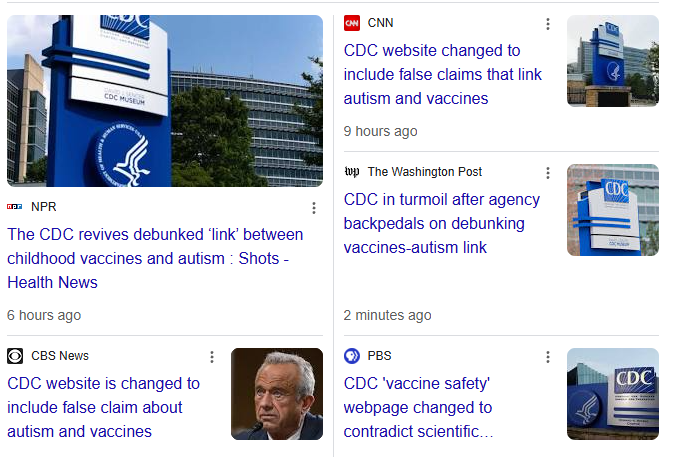
Here is a screenshot on media coverage of this story:
This entire essay is worth reading but may be behind a paywall.
An excerpt:
For most of my colleagues and me, the C.D.C. and the N.I.H. were the medical Mount Olympus, the towering pillars of medical authority. Contrary to right-wing portrayals, these were not dictatorial authorities. These were earned authorities, comprising our best, brightest and most dedicated peers. The formidable talents of these doctors and scientists would have commanded enviable salaries had they taken jobs in industry, but they chose the public sector instead — something that we clinicians were forever grateful for…
While there are some doctors who viewed our public health institutions with disdain — some of them now are running these very organizations — most practicing physicians relied heavily on them to deliver the best care possible to their patients, despite occasional quibbles. What a relief, I always felt, that there were people organizing the things I can’t do — testing new treatments, conducting population studies, keeping tabs on worldwide diseases, issuing guidelines and more.
But now that support is a shell of what it once was. I can no longer automatically rely on these institutions because their scientific North Star, even if imperfect at times, has been replaced by one that seems nakedly political. Remaining staffs are no doubt working valiantly to do their jobs, but they are hobbled by loss of colleagues, resources and reliable leadership. So when I hear that the C.D.C. has changed a vaccine recommendation, I now question whether that’s a recommendation I can trust. When the F.D.A. commissioner says he wants to change how the agency approves or rejects new treatments, I no longer feel sure that science is driving those decisions. It’s hard to convey how profoundly grieved my colleagues and I feel…
Robert F. Kennedy Jr.’s view seems to be that we doctors are shills for corporate interests and government bureaucrats, and that torching our vaunted institutions is the prescription to fix us. Mr. Kennedy’s ire seems oddly directed. I, too, am disgusted by the role of money in health care, but I see it more as a result of the system we’ve set up, rather than the people who labor within it…
Notably missing from Mr. Kennedy’s Make America Healthy Again agenda is any suggestion that we provide universal health care, as most other developed countries do. There is no push to expand Medicare and Medicaid, which help some of our sickest patients. There is no focus on expanding access to early childhood education and supplemental nutrition programs, which offer steep health benefits…[There] is a barely concealed antipathy toward the people who are the engine of these institutions — doctors, scientists, policy wonks…
Every time you go to your doctor or get treated by a nurse, there’s a chorus of researchers, public health workers, policy experts, epidemiologists and advisory panels arrayed behind them, aided by laboratories, databases, websites, early-detection systems and clinical guidelines. Our current government seems determined to wrench this away, handicapping your health care team’s ability to care for you.
My take (borrowed in part from author): Our health care system needs to improve costs, accessibility, and outcomes. Yet, the changes to our healthcare and research under this administration are making matters worse. “So many of our resources are now gone, and those that remain no longer feel trustworthy. Americans’ health will decline at the hands of our federal government. And there’s no vaccine for that.”
CP Duggan, ZA Bhutta. NEJM 2025; DOI: 10.1056/NEJMp2503243. “Putting America First” — Undermining Health for Populations at Home and Abroad
This article initially lays out the historical context of U.S. involvement in global health dating back to aiding famine in Belgium (1917), WHO (1948), USAID (1961). Also, the CDC and NIH have played important roles following WWII. Subsequently, the commentary outlines the impact of dismantling U.S global health efforts. In the two related articles cited afterwards, it is clear that the cuts to foreign aid and other DOGE activities may result in millions of deaths and at the same time expand the federal deficit.
An excerpt:
In the initial months of the Trump administration, numerous executive orders have led to a chaotic dismantling of U.S. foreign-assistance and global health efforts. These orders have already had, and will continue to have, severe adverse effects on vulnerable populations globally. But they also have serious implications for people in the United States…
Often missing from these success stories are the financial and health-related benefits these programs have had in the United States….One of the earliest and most fundamental examples of reciprocal innovation was the discovery and implementation of oral rehydration therapy (ORT)…Widespread use of ORT has helped drive substantial reductions in childhood deaths from diarrhea and has led to a new standard of care for childhood diarrhea in high-income countries and to commercial products in the United States…
Perhaps no program epitomizes these dual advantages better than the President’s Emergency Plan for AIDS Relief (PEPFAR). Early in the HIV epidemic, the NIH promoted multinational scientific collaborations to identify the virus, develop effective treatments, and implement global prevention and treatment programs, which led to PEPFAR’s creation in 2003. PEPFAR has saved 26 million lives, and economic growth in countries with PEPFAR programs has benefited the United States and other trading partners…[and] have contributed enormously to current knowledge about HIV and AIDS.
Another essential initiative, the FIC — the NIH institute responsible for supporting research training and partnerships in global health — has …directly benefited health in the United States by advancing early cancer detection and the development of sickle cell disease therapies, point-of-care diagnostics for infectious diseases, and treatments for child malnutrition. More than three quarters of FIC grants involve a U.S. grantee or investigator, which further emphasizes the institute’s direct benefits to the U.S. economy…
Since U.S. foreign assistance accounts for about 1% of the federal budget, we are skeptical of cost-savings–based arguments for its elimination…
The Trump administration’s gutting of USAID and other foreign-assistance programs marks a break from decades of evidence-based practices that have improved lives throughout the world. In addition to pushing millions of people into poverty and leading to an estimated 160,000 or more avoidable child deaths each year,4 these reforms will undermine health and the economy in the United States…
Withdrawal from the WHO reduces the United States’ ability to influence reform and restructuring of the world’s global health coordinating body. The elimination of U.S. funding for Gavi, the Vaccine Alliance, also endangers the health of vulnerable populations internationally and in the United States…
Critical to the success of advocacy efforts will be evidence of the ways in which the withdrawal of foreign aid and global disengagement undermine health and economic well-being in the United States and threaten global health and economic security.
My take: By the time the extent of the damage is understood, it will be too late to fix what this administration has destroyed. The toll in terms of death and suffering both in the U.S. and abroad will be hard to justify and not further the aim of making ‘America First.’
Related articles:
D Wallace-Wells, NY Times 5/8/25: The $200 Billion Gamble: Bill Gates’s Plan to Wind Down His Foundation “He is committing the foundation to 20 more years of generous aid, more than $200 billion in total, targeting health and human development…The news comes at a time that will seem to many as a perilous one, given the Trump administration’s recent assault on foreign aid and indeed on the idea of global generosity itself….The journal Nature suggested that an overall cessation of U.S. aid funding could result in roughly 25 million additional deaths over 15 years.”
J Riedl, The Atlantic 5/8/25: The Actual Math Behind DOGE’s Cuts “As an effort to meaningfully reduce federal spending, however, DOGE remains wholly unserious…The DOGE website now claims $165 billion in savings. However, it still details only a fraction of the supposed cuts, and earlier accounting errors have given way to new ones…Even assuming that the website’s stated savings have become twice as accurate as they were in February, annual savings would reach perhaps $15 billion, or 0.2 percent of federal spending…Total federal outlays in February and March were $86 billion (or 7 percent) higher than the levels from the same months a year ago, when adjusted for timing shifts. This spending growth—approximately $500 billion at an annualized rate—continues to be driven by the three-quarters of federal spending allocated to Social Security, Medicare, Medicaid, defense, veterans’ benefits, and interest costs. These massive expenses have been untouched by DOGE’s focus on small but controversial targets such as DEI contracts and Politico subscriptions…The bad news is that the project seems quite likely to expand long-term budget deficits. Slashing IRS enforcement will embolden tax evasion and reduce revenues by hundreds of billions of dollars over the decade. Laying off Department of Education employees who ensure collection of student-loan repayments will increase the deficit. Illegally terminated federal employees are already being reinstated with full back pay, leaving the government with little to show for its trouble besides mounting legal fees…None of this is to say that DOGE has failed. Musk might not have followed through on his unfocused and evolving promises to eliminate payment errors, balance the entire budget, and implement regulatory reform. But he has successfully given the White House cover to purge and intimidate the civil service, helped Congress justify exorbitant tax cuts, rewarded MAGA voters with revenge against their perceived enemies, and granted himself the ability to access sensitive government data and possibly ensure his companies’ continued government contracts. Sure, annual budget deficits remain on track to double over the next decade. But if you thought DOGE was really about cutting costs, you were never in on the joke.”
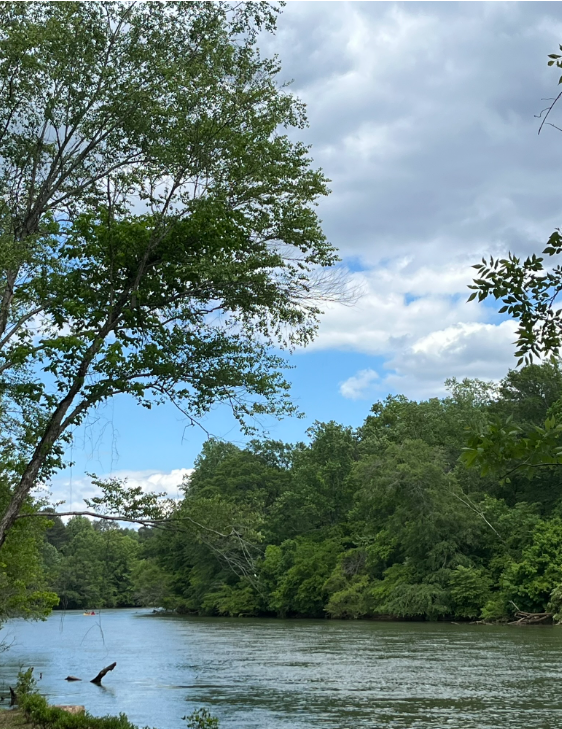
View of the Chattahoochee River from Don While Memorial Park, Sandy Springs, Ga
Briefly noted: An highly detailed but concise review of “Medical Considerations before International Travel” DO Freedman et al. NEJM 2016; 375: 247-60.
Figure 1:
Risk assessment: medical history, prior travel experience, specific itinerary (region, season), type of accommodations, risk tolerance, financial challenges
Standard Interventions: Immunizations, Malaria prophylaxis (if risk), Traveler’s diarrhea strategy
Focused education: vectorborne diseases, altitude illness, thrombosis risk, STDs/bloodborne infections, transportation risks (eg no car seats), respiratory infections, medical kit, medical insurance
Tables:
Table 1: Practices for reducing disease risk (too many to summarize)




 gutsandgrowth