The Politicization of Science and Outcomes for Health Care

Yesterday’s blog post highlighted how the current policies are leading to a brain drain, undermining economic advangages and harming our ability to improve outcomes for patients.

Today’s post summarizes a recent editorial by the NEJM editors (NEJM 2026; 395: 187-188. The OMB and the Politicization of Science) that drills down on three specific proposals by the OMD to change research policy.

An excerpt:

“For decades, the Soviet Union promoted the unorthodox views of Trofim Lysenko, an agronomist who used his close ties to the political leadership to spread misinformation denying Mendelian genetics. What followed was a disaster: many years of poor harvests based on unsupported science and suppression of the teaching and practice of modern genetics throughout the Soviet bloc. A similar threat now hangs over U.S. science…

The rule changes that the White House Office of Management and Budget (OMB) recently proposed to the Health and Human Services (HHS) grant process would drastically change this process. There are too many objectionable aspects of these proposals to discuss here. But three are particularly striking. Political appointees would be able to make funding decisions and could ignore the advice of independent scientists. They could also stop funding midway through the promised grant period. And they would institute new rules, including rules severely limiting foreign interactions…

Expert, independent peer review of grant applications is essential for directing NIH dollars to research that has the greatest potential for advancing science and improving health. Selecting the most promising research is an enormously complex and challenging undertaking…

The OMB proposal to permit political appointees to discontinue funding of ongoing grants at any time, without cause, would have serious adverse consequences for the research enterprise and for patients…the gold standard of evidence is the randomized, controlled trial (RCT). The RCT’s methods minimize the influence of bias and preconceived notions. However, this type of trial often takes years to conduct…If a decision to stop funding the trial occurred at year 4 for political rather than scientific reasons, what would happen to patients who were enrolled in the study at that time? How would longer-term safety and efficacy observations be made?…Can physician–investigators ethically enroll a patient in a trial if ongoing funding for the trial is uncertain?

There would be substantial adverse effects on researchers as well as patients. Why would a basic science investigator start a line of investigation that might take years to complete if the funding for it could be cut at any moment, without cause?…A corrosive consequence of such an arbitrary funding process would be the diminishment of the U.S. workforce of clinical and basic science investigators — and it would ultimately harm biomedical innovation and cutting-edge patient care…

The proposed rules would also severely limit foreign research partnerships, requiring political approval of international collaborations…Broad global collaboration has led to…studies [which] can be completed years earlier than they would be otherwise, at a fraction of the cost, bringing earlier and greater benefits to all affected people, including people in the United States. Aren’t we better off addressing Ebola, tuberculosis, or screwworm before they spread to additional communities?” 

My take: Allowing politicians to arbitrarily choose which research to fund rather than those with the greatest merit will lead to a poor harvest of scientific advances for all of us. This would, however, enable a select few to benefit from their corrupt connections to steer more money into their greedy pockets.

Boardwalk at Arablia Mountain Trail

Scientific Excellence Leaving U.S.

Numerous articles have documented the abrupt changes to research funding by this administration.

I will focus on the first article but the others provide additional insight into this issue.

An excerpt:

Omar Yaghi, an immigrant to the United States who shared last year’s Nobel Prize in Chemistry, has left his faculty post at the University of California, Berkeley, for one in China, where he will lead an institute using artificial intelligence to accelerate the discovery of new materials…

Last year, three of America’s six winners of science Nobels were born outside the country. In this century, overall, the émigré fraction for U.S. Nobels in physics, chemistry and medicine now stands at 40 percent

Last year, before flying to Stockholm to receive his Nobel Prize, Dr. Yaghi in an interview with The New York Times voiced concern about Mr. Trump’s immigration policies, saying that they endanger the nation’s system of universities, companies and governments that promote scientific excellence…

My take: The arbitrary cuts and policy shifts have undermined an engine for American prosperity, stalled the development of medications for numerous disorders, imperiled thousands of patients enrolled in clinical trials. and resulted inthe loss of enormous scientific/medical talent.

Related blog posts:

Effects of NIH Funding Cuts on Clinical Trials

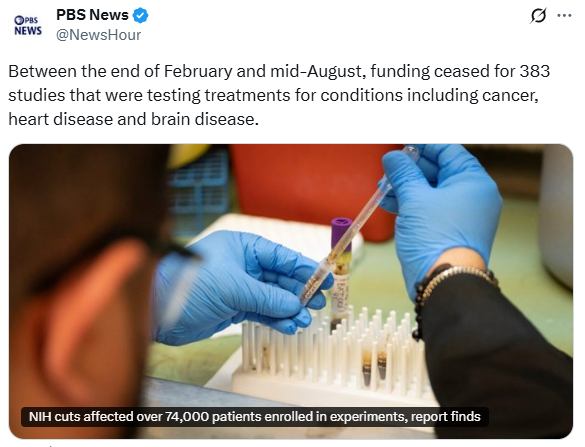
PBS News 11/17/25: NIH cuts affected over 74,000 patients enrolled in experiments, report finds

An excerpt:

Between the end of February and mid-August, funding ceased for 383 studies that were testing treatments for conditions including cancer, heart disease and brain disease. The cuts disproportionately impacted efforts to tackle infectious diseases like the flu, pneumonia and COVID-19, researchers found…

More broadly, the lost research harms patients who could have benefited from a possible new treatment, researchers said in the report published Monday in the journal JAMA Internal Medicine…

“The whole purpose of these clinical trials is to generate evidence on what works and doesn’t work in medicine,” said study co-author Anupam B. Jena with Harvard Medical School. Researchers counted 11,008 NIH-funded studies during the study period. Of those, 1 in 30 lost funding.

Related blog posts:

‘What Happens When the Doctors Can’t Trust the Government?’

Danielle Ofri, NY Times 7/28/25: Doctors Have Lost Their Mount Olympus of Medicine

This entire essay is worth reading but may be behind a paywall.

An excerpt:

For most of my colleagues and me, the C.D.C. and the N.I.H. were the medical Mount Olympus, the towering pillars of medical authority. Contrary to right-wing portrayals, these were not dictatorial authorities. These were earned authorities, comprising our best, brightest and most dedicated peers. The formidable talents of these doctors and scientists would have commanded enviable salaries had they taken jobs in industry, but they chose the public sector instead — something that we clinicians were forever grateful for… 

While there are some doctors who viewed our public health institutions with disdain — some of them now are running these very organizations — most practicing physicians relied heavily on them to deliver the best care possible to their patients, despite occasional quibbles. What a relief, I always felt, that there were people organizing the things I can’t do — testing new treatments, conducting population studies, keeping tabs on worldwide diseases, issuing guidelines and more.

But now that support is a shell of what it once was. I can no longer automatically rely on these institutions because their scientific North Star, even if imperfect at times, has been replaced by one that seems nakedly political. Remaining staffs are no doubt working valiantly to do their jobs, but they are hobbled by loss of colleaguesresources and reliable leadership. So when I hear that the C.D.C. has changed a vaccine recommendation, I now question whether that’s a recommendation I can trust. When the F.D.A. commissioner says he wants to change how the agency approves or rejects new treatments, I no longer feel sure that science is driving those decisions. It’s hard to convey how profoundly grieved my colleagues and I feel…

Robert F. Kennedy Jr.’s view seems to be that we doctors are shills for corporate interests and government bureaucrats, and that torching our vaunted institutions is the prescription to fix us. Mr. Kennedy’s ire seems oddly directed. I, too, am disgusted by the role of money in health care, but I see it more as a result of the system we’ve set up, rather than the people who labor within it…

Notably missing from Mr. Kennedy’s Make America Healthy Again agenda is any suggestion that we provide universal health care, as most other developed countries do. There is no push to expand Medicare and Medicaid, which help some of our sickest patients. There is no focus on expanding access to early childhood education and supplemental nutrition programs, which offer steep health benefits…[There] is a barely concealed antipathy toward the people who are the engine of these institutions — doctors, scientists, policy wonks…

Cuts to infectious-disease surveillance means that outbreaks will almost certainly creep up more stealthily on our patients. Cuts to the National Center for Chronic Disease Prevention and Health Promotion means fewer resources for prevention of cancer, heart disease and diabetes — some of the leading causes of death. Cuts to the N.I.H and the F.D.A. could drastically reduce the development and approval of new medical treatments. Add in cuts to injury-prevention research and patient safety programs, and it’s a prescription to make America sick again.

Every time you go to your doctor or get treated by a nurse, there’s a chorus of researchers, public health workers, policy experts, epidemiologists and advisory panels arrayed behind them, aided by laboratories, databases, websites, early-detection systems and clinical guidelines. Our current government seems determined to wrench this away, handicapping your health care team’s ability to care for you.

My take (borrowed in part from author): Our health care system needs to improve costs, accessibility, and outcomes. Yet, the changes to our healthcare and research under this administration are making matters worse. “So many of our resources are now gone, and those that remain no longer feel trustworthy. Americans’ health will decline at the hands of our federal government. And there’s no vaccine for that.”

Related blog posts:

Giant Lily Pads in Oxford, UK

How Putting America First is Undermining Health Outcomes Here and Globally

CP Duggan, ZA Bhutta. NEJM 2025; DOI: 10.1056/NEJMp2503243. “Putting America First” — Undermining Health for Populations at Home and Abroad

This article initially lays out the historical context of U.S. involvement in global health dating back to aiding famine in Belgium (1917), WHO (1948), USAID (1961). Also, the CDC and NIH have played important roles following WWII. Subsequently, the commentary outlines the impact of dismantling U.S global health efforts. In the two related articles cited afterwards, it is clear that the cuts to foreign aid and other DOGE activities may result in millions of deaths and at the same time expand the federal deficit.

An excerpt:

In the initial months of the Trump administration, numerous executive orders have led to a chaotic dismantling of U.S. foreign-assistance and global health efforts. These orders have already had, and will continue to have, severe adverse effects on vulnerable populations globally. But they also have serious implications for people in the United States…

Often missing from these success stories are the financial and health-related benefits these programs have had in the United States….One of the earliest and most fundamental examples of reciprocal innovation was the discovery and implementation of oral rehydration therapy (ORT)…Widespread use of ORT has helped drive substantial reductions in childhood deaths from diarrhea and has led to a new standard of care for childhood diarrhea in high-income countries and to commercial products in the United States…

Perhaps no program epitomizes these dual advantages better than the President’s Emergency Plan for AIDS Relief (PEPFAR). Early in the HIV epidemic, the NIH promoted multinational scientific collaborations to identify the virus, develop effective treatments, and implement global prevention and treatment programs, which led to PEPFAR’s creation in 2003. PEPFAR has saved 26 million lives, and economic growth in countries with PEPFAR programs has benefited the United States and other trading partners…[and] have contributed enormously to current knowledge about HIV and AIDS.

Another essential initiative, the FIC — the NIH institute responsible for supporting research training and partnerships in global health — has …directly benefited health in the United States by advancing early cancer detection and the development of sickle cell disease therapies, point-of-care diagnostics for infectious diseases, and treatments for child malnutrition. More than three quarters of FIC grants involve a U.S. grantee or investigator, which further emphasizes the institute’s direct benefits to the U.S. economy…

Since U.S. foreign assistance accounts for about 1% of the federal budget, we are skeptical of cost-savings–based arguments for its elimination…

The Trump administration’s gutting of USAID and other foreign-assistance programs marks a break from decades of evidence-based practices that have improved lives throughout the world. In addition to pushing millions of people into poverty and leading to an estimated 160,000 or more avoidable child deaths each year,4 these reforms will undermine health and the economy in the United States…

Withdrawal from the WHO reduces the United States’ ability to influence reform and restructuring of the world’s global health coordinating body. The elimination of U.S. funding for Gavi, the Vaccine Alliance, also endangers the health of vulnerable populations internationally and in the United States…

Critical to the success of advocacy efforts will be evidence of the ways in which the withdrawal of foreign aid and global disengagement undermine health and economic well-being in the United States and threaten global health and economic security.

My take: By the time the extent of the damage is understood, it will be too late to fix what this administration has destroyed. The toll in terms of death and suffering both in the U.S. and abroad will be hard to justify and not further the aim of making ‘America First.’

Related articles:

  1. D Wallace-Wells, NY Times 5/8/25: The $200 Billion Gamble: Bill Gates’s Plan to Wind Down His Foundation “He is committing the foundation to 20 more years of generous aid, more than $200 billion in total, targeting health and human development…The news comes at a time that will seem to many as a perilous one, given the Trump administration’s recent assault on foreign aid and indeed on the idea of global generosity itself….The journal Nature suggested that an overall cessation of U.S. aid funding could result in roughly 25 million additional deaths over 15 years.”
  2. J Riedl, The Atlantic 5/8/25: The Actual Math Behind DOGE’s Cuts “As an effort to meaningfully reduce federal spending, however, DOGE remains wholly unserious…The DOGE website now claims $165 billion in savings. However, it still details only a fraction of the supposed cuts, and earlier accounting errors have given way to new ones…Even assuming that the website’s stated savings have become twice as accurate as they were in February, annual savings would reach perhaps $15 billion, or 0.2 percent of federal spending…Total federal outlays in February and March were $86 billion (or 7 percent) higher than the levels from the same months a year ago, when adjusted for timing shifts. This spending growth—approximately $500 billion at an annualized rate—continues to be driven by the three-quarters of federal spending allocated to Social Security, Medicare, Medicaid, defense, veterans’ benefits, and interest costs. These massive expenses have been untouched by DOGE’s focus on small but controversial targets such as DEI contracts and Politico subscriptions…The bad news is that the project seems quite likely to expand long-term budget deficits. Slashing IRS enforcement will embolden tax evasion and reduce revenues by hundreds of billions of dollars over the decade. Laying off Department of Education employees who ensure collection of student-loan repayments will increase the deficit. Illegally terminated federal employees are already being reinstated with full back pay, leaving the government with little to show for its trouble besides mounting legal fees…None of this is to say that DOGE has failed. Musk might not have followed through on his unfocused and evolving promises to eliminate payment errors, balance the entire budget, and implement regulatory reform. But he has successfully given the White House cover to purge and intimidate the civil service, helped Congress justify exorbitant tax cuts, rewarded MAGA voters with revenge against their perceived enemies, and granted himself the ability to access sensitive government data and possibly ensure his companies’ continued government contracts. Sure, annual budget deficits remain on track to double over the next decade. But if you thought DOGE was really about cutting costs, you were never in on the joke.”
View of the Chattahoochee River from Don While Memorial Park, Sandy Springs, Ga