Position Paper: Pediatric Refractory Constipation Management

AL Kilgore et al. JPGN 2024; https://doi.org/10.1002/jpn3.12390. Open Access! Evaluation and management of pediatric refractory constipation: Recommendations from the NASPGHAN neurogastroenterology and motility committee
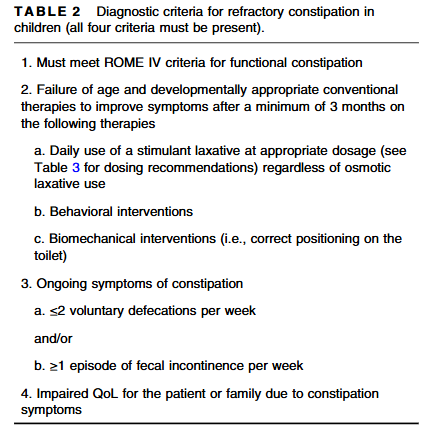
Selected Recommendations:

Evaluations:

  • Screen for thyroid disease and celiac disease (though acknowledges that the data regarding an association between celiac disease and constipation are inconsistent)
  • The use of an AXR in RC should be reserved for those patients unable to provide a reliable medical history and/or unable to allow for a physical exam (including a DRE), or to evaluate for mechanical obstruction or colonic distention when considering surgical interventions
  • A contrast enema (CE) can be used to screen for HD or to assess colorectal anatomy
  • There is no evidence to recommend the routine use of defecography in children
  • Abdominal ultrasound has a good agreement with digital rectal exam (DRE) to evaluate for fecal impaction but should not be performed in place of DRE
  • ARM should be used to screen for the presence of a RAIR. If anal spasms and prolonged sphincter relaxation are detected during ARM, an assessment for spinal abnormalities can be considered
  • An LS MRI should be performed in pediatric patients with RC associated with physical or neurological signs of spinal anomalies, signs of neurogenic bladder on urodynamics, or when the anorectal manometry (ARM) is abnormal suggesting spinal cord abnormalities
  • Colonic transit time (CTT) via radiopaque markers should be completed for patients with RC with equivocal medical history and to screen for the need to perform colonic manometry (CM)
  • Colonic manometry (CM) should be performed only after medical therapy has been exhausted and surgical therapy is being considered. CM should be used to guide the timing and type of surgery to address RC. CM should be used to guide when to perform an ostomy takedown
  • Rectal biopsies should not be used routinely in patients with RC and are indicated exclusively in patients with a suspected diagnosis of HD

Pharmaceuticals:

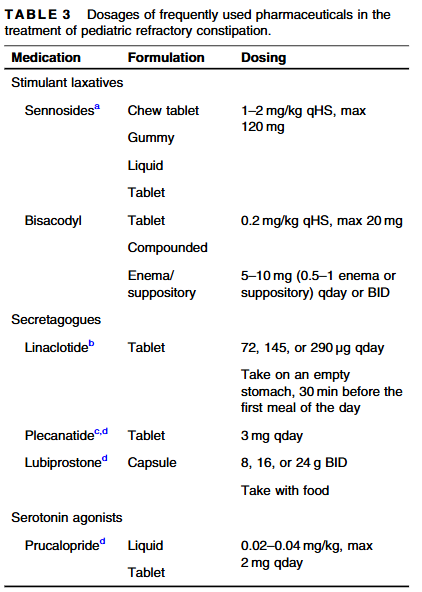
  • High-dose sennoside (or Bisacodyl) is a mainstay of management of RC and should be optimized for the individual patient before considering further management options
  • A secretagogue (or prucalopride) should be considered as an adjunct to a high-dose stimulant laxative when treating RC with poor response to optimized high-dose stimulant laxatives or when high-dose stimulant laxatives are not tolerated
  • There is no clear role of anal botox in the treatment of patients with RC without a diagnosis of IAS achalasia
  • Early intervention with daily stimulant laxatives in the treatment of FC is encouraged to try to prevent the disease progression from functional constipation (FC) to RC
  • Antegrade and Retrograde Treatments:
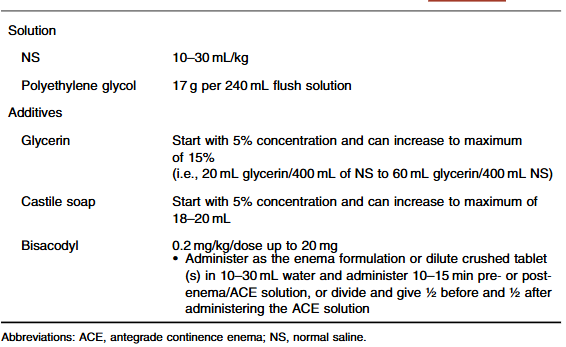
Routine dosages of frequently used antegrade and retrograde solutions and additives
  • The last part of the recommendations include antegrade continence enemas, surgical approaches, and complicated algorithms (see Figure 1 and Figure 2)

My take: These recommendations address a widespread problem for pediatric gastroenterologists and are useful for those with and without an interest in motility disorders.

Related blog posts:

Disclaimer: This blog, gutsandgrowth, assumes no responsibility for any use or operation of any method, product, instruction, concept or idea contained in the material herein or for any injury or damage to persons or property (whether products liability, negligence or otherwise) resulting from such use or operation. These blog posts are for educational purposes only. Specific dosing of medications (along with potential adverse effects) should be confirmed by prescribing physician.  Because of rapid advances in the medical sciences, the gutsandgrowth blog cautions that independent verification should be made of diagnosis and drug dosages. The reader is solely responsible for the conduct of any suggested test or procedure.  This content is not a substitute for medical advice, diagnosis or treatment provided by a qualified healthcare provider. Always seek the advice of your physician or other qualified health provider with any questions you may have regarding a condition.


Is There a Residual Impact of a Tethered Cord on Colonic Motility

JM van der Zande et al. JPGN 2024; 79:976–982. Open Access! Anorectal physiology and colonic motility in children with a history of tethered cord syndrome

This retrospective review of 24 children with tethered cord syndrome (TCS) (50% female) who had ARM testing (median age at ARM 6.0 years). 19 children had prior TCS repair.

Key findings:

  •  No significant differences in ARM parameters were found between children who had detethering surgery before ARM and children with functional constipation (FC). The children with TCS did have lower resting pressures though this was attributed to most having their ARM while under GA for concurrent procedures. The resting pressures were still normal.
  • Among the 14 children who also had a colonic manometry (CM) performed (13/14 after detethering surgery), there were no significant differences in colonic motility were found between children with a history of TCS and children with FC.

My take: The vast majority of children with a history of TCS (following detethering) should be treated akin to children with functional constipation.

Impression, Sunrise by Claude Monet at National Gallery of Art (Washington, D.C.)

Related blog posts:

Is It a ‘Waste’ to Do Colonic Manometry in Kids with Autism?

A Coe et al. JPGN 2023; 76: 154-159. Evaluation of Chronic Constipation in Children With Autism Spectrum Disorder

In this retrospective study with 56 patients with autism spectrum disorder (ASD) and 123 controls underwent colonic manometry (CM). Key findings:

  • The rate of abnormal CM findings between ASD and matched controls (24% vs 20%, P = 0.78) did not differ significantly
  • The authors noted that higher rates of abnormal CM with duration of constipation and with soiling in children with ASD. However, “even in the minority of cases with abnormal colonic motility, chronic stool retention due to functional constipation over time likely caused impaired motility in the majority of these cases. In 6 of the 8 ASD cases with abnormal CM finding, impaired motility was isolated to the distal colon while normal motility occurred in the proximal colon.”

My take: In this highly-selected group of patients with ASD from specialized motility centers, only 2 had abnormal colonic motility affecting the entire colon. Overall, patients with ASD did NOT have higher rates of abnormal CM studies. Hence, for most children with ASD, CM has little value.

Related blog posts:

Updated Pediatric Expert Constipation Guidelines

Updated guidelines for the diagnosis and treatment of constipation by NASPGHAN and ESPGHAN have undergone formal peer review are likely to be published soon (available online with the following link: bit.ly/1geLxrk).  “Evidence-Based Recommendations from ESPGHAN and NASPGHAN for Evaluation and Treatment of Functional Constipation in Infants and Children” by Merti Tabbers, Carlo DiLorenzo et al. The following are some of their recommendations.

Diagnostic recommendations:

  • The ROME III criteria are recommended for the definition of functional constipation for all age  groups.
  • Diagnosis of functional constipation is based on history and physical examination.
  • There is no role for the routine use of an abdominal X-ray to diagnose functional constipation.
  • A plain abdominal  radiography may be used in a child in whom fecal impaction is  suspected but in whom physical examination is unreliable/not possible.
  • Based on expert opinion, a 2-4 weeks trial of avoidance of cow’s milk protein may be indicated in the child with intractable constipation.
  • Routine laboratory testing to screen for hypothyroidism, celiac disease and hypercalcemia is not recommended in children with constipation in the absence of alarm symptoms. 

Treatment Recommendations:

  • We do not recommend the use of biofeedback as additional treatment in childhood constipation.
  • Polyethylene glycol (PEG) with or without electrolytes orally 1-1.5 gr/kg/day for 3-6 days is recommended as first-line treatment for children presenting with fecal impaction
  • An enema once a day for 3-6 days is recommended for children with fecal impaction if PEG is not available.
  • PEG with or without electrolytes is recommended as first-line maintenance treatment. A starting dose of 0.4 gr/kg/day is recommended and the dose should be adjusted according to the clinical response.
  • Addition of enemas to the chronic use of PEG is not recommended.
  • Based on expert opinion, use of milk of magnesia, mineral oil and stimulant laxatives may be considered as additional or second line treatment.
  • Antegrade enemas are recommended in the treatment of selected children with intractable constipation.

Related blog posts:

Feeling the urge and stopping the shame

So many parents misinterpret withholding behavior in children.  Many indicate that their child is trying to go but cannot and others indicate that their child does not feel an urge to defecate.  Now more insight into this common issue has emerged (JPGN 2013; 56: 19-22).

The authors reviewed their experience with colonic manometry (n=410).  150 patients were identifed as having functional constipation.  Among this group, 56 patients volunteered that they had no urge to defecate.

Yet, during colonic manometry, when the first high-amplitude propagating colonic contraction (HAPC) occurred, this was associated with retentive posturing, grimacing or denial of sensation.  When the HAPC occurred, the examiner would explain that it was causing pain that would improve if the child defecated.  Ultimately, “every patient acknowledged an urge to defecate and successfully defecated.”

One other interesting part of this publication is the discussion of psychological aspects.  Do you remember Erikson’s stages (Erik Erikson – Wikipedia, the free encyclopedia)?  The authors note, “if toilet training is not achieved or the process involves negative experiences including being shamed into the process, shame and doubt will persist.  Shame, according to Erikson, is an infantile emotion and leads to secretive behavior.  Therefore, children who failed toilet learning may deny sensations of the urge to defecate…all the while having shame and embarrassment.”

These psychological issues are important in the propagation of constipation. The authors note that, even in children with rectal distention due to chronic constipation which could result in decreased sensation, studies have shown rectal compliance was not associated with treatment failure.  Therefore, constipation and soiling are not simply due to a mechanical issue of not knowing when to go.

Related posts:

It’s worth the cost

Recently the cost of Sitzmarks® increased to $175 (for 12)–it’s worth the cost.  According to one study, the use of a transit study helps determine which patients will benefit from colonic manometry (JPGN 2012; 54: 258-62).  A retrospective review of 24 children showed that all five children with normal oral-anal transit (OTT) studies had normal colonic manometry.  In contrast, 9/19 (47%) with abnormal (slow OTT) had abnormal colonic manometry.

The authors define their approach to OTT which is helpful.

  • In patients with a fecal impaction, this was cleared prior to starting study
  • If patients had difficulty with capsule ingestion, markers were administered by embedding in part of a banana or mixed with applesauce
  • Stimulant laxatives withheld for 72hrs prior to study
  • AXR obtained on days 3 and 5
  • Slow OTT (abnormal) defined as >6 markers proximal to rectum on day 5

Of those with abnormal colonic manometry, two-thirds (6) were referred for surgical intervention; one patient with normal OTT had surgery.  Surgeries:  3 cecostomy, 4 subtotal colectomy.

Additional references:

  • -JPGN 2004; 38: 75. Colostomy in 10 children with intractable constipation.
  • -Arch Dis Child. 2004 Jan;89(1):13-6. Benninga MA, Voskuijl WP, Akkerhuis GW, Taminiau JA, Buller HA. Related Articles,  Colonic transit times and behaviour profiles in children with defecation disorders.
  • -J Pediatr Surg. 2004 Jan;39(1):73-7. Youssef NN, Pensabene L, Barksdale E Jr, Di Lorenzo C.  Is there a role for surgery beyond colonic aganglionosis and anorectal malformations in children with intractable constipation?
  • -Am J Gastroenterol. 2003 May;98(5):1052-7.  Pensabene L, Youssef NN, Griffiths JM, Di Lorenzo C. Related Articles, Colonic manometry in children with defecatory disorders. role in diagnosis and management.
  • -JPGN 2002 Jul;35(1):31-8. Gutierrez C, Marco A, Nogales A, Tebar R. Total and segmental colonic transit time and anorectal manometry in children with chronic idiopathic constipation.
  • -JPGN 2001 Nov;33(5):588-91.  Villarreal J, Sood M, Zangen T, Flores A, Michel R, Reddy N, Di Lorenzo C, Hyman PE.  Colonic diversion for intractable constipation in children: colonic manometry helps guide clinical decisions.
  • -http://www.sitzmarks.com/buyonline.aspx