Triple Therapy for Cystic Fibrosis May Improve Liver Damage

S Diemer et al. JPGN 2025; DOI: 10.1002/jpn3.70050. Open Access! The effect of elexacaftor–tezacaftor–ivacaftor on liver stiffness in children with cystic fibrosis

In this retrospective study, 12 of 21 patients had cystic fibrosis hepato-biliary involvement (CFHBI). The authors examined the liver stiffness after administration of the new and highly potent CF transmembrane conductance regulator modulator therapy, elexacaftor–tezacaftor–ivacaftor (ETI). All of the patients in this cohort had normal liver enzymes.

Key findings:

  • Analyzing liver stiffness in CwCF with CFHBI showed a decline to 5.7 kPa median (IQR: 3.9–7.1) during ETI treatment, and this decline was statistically significant (W = −60, n = 12, p = 0.0161) (Figure 3B) (after at least 3 months of ETI treatment)
Liver stiffness over time in patients with CFHBI

Discussion Points:

“Our findings of a clear improvement of liver stiffness in CwCF and CFHBI during ETI treatment is in line with the recently published study by Terlizzi et al.28  Calvo et al. prospectively investigated liver stiffness and liver enzyme development in a single-centre cohort with a starting point before ETI and a follow-up at 1, 3 and 6 months on ETI…A significant overall reduction in mean liver stiffness was found at 6 months, and already after 1 month of ETI, a decline in liver stiffness was observed in those with values ≥5 kPa.29

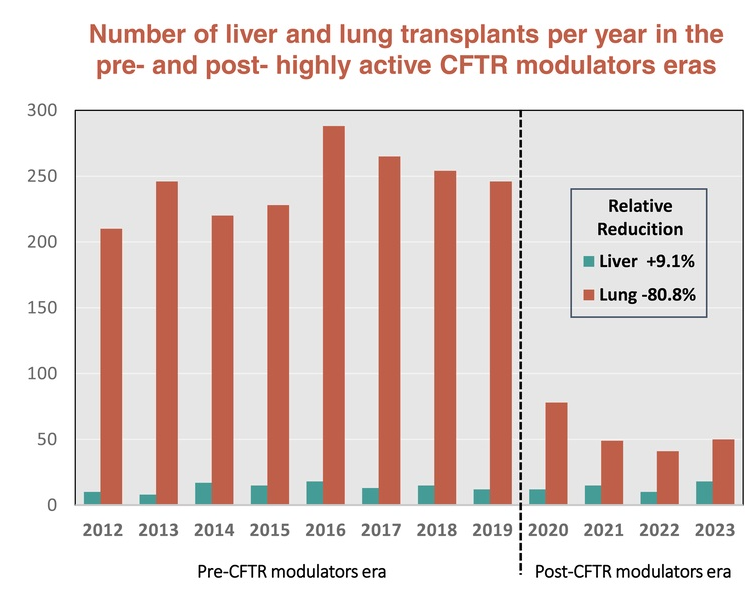
My take: Liver stiffness is a biomarker for chronic liver damage. Longer term studies will be needed to determine how important triple therapy is for liver health in persons with cystic fibrosis. Thus far, there has not been improvement in the number of patients with CF needing a liver transplant; however, there has been a marked improvement in the need for lung transplantation.

Related blog posts:

Impact of CFTR Modulators on the Need for Liver and Lung Transplantation in Patients with Cystic Fibrosis

M Mendizabal et al. Liver Transplantation 2025; 31: 412-416. Have CFTR modulators changed the need for liver and lung transplantation among patients with cystic fibrosis? An analysis of the UNOS database

This article notes that there have been 146,851 waitlistings and 95,254 liver transplants in the U.S. between 2012 and 2023. This includes 194 waitlistings and 138 transplants in patients with cystic fibrosis.

Key finding:

My take: This is great news for patients with cystic fibrosis. The drop in lung transplants is surely the tip of the iceberg. Think about your next breath! For patients with cystic fibrosis, these new medications make every single breath better. Longer followup is needed to determine if the long-term use of these agents may lower the rate of end-stage liver disease as well.

Related blog posts:

Liver Briefs: Hereditary Angioedema/Liver Transplantation, Bulevirtide/PEG for HDV, and AASLD Cystic Fibrosis Guidance

NE Peters et al. NEJM 2024; 391; 56-59. Normalization of C1 Inhibitor in a Patient with Hereditary Angioedema

“An infant with genetically confirmed hereditary angioedema and low C1 inhibitor levels (but without previous episodes of angioedema) underwent liver transplantation for biliary atresia, an unrelated condition. Liver transplantation led to normalization of the C1 inhibitor level and function. To our knowledge, this represents the first patient to be potentially cured of hereditary angioedema.” This case report shows that liver-directed therapy can reverse hereditary angioedema.

Related blog posts:

T Asselah et al. NEJM 2024; 391:133-143. Bulevirtide Combined with Pegylated Interferon for Chronic Hepatitis D

Key finding: At 24 weeks after the end of treatment, HDV RNA was undetectable in 17% of the patients in the peginterferon alfa-2a group, in 32% of those in the 2-mg bulevirtide plus peginterferon alfa-2a group, in 46% of those in the 10-mg bulevirtide plus peginterferon alfa-2a group, and in 12% of those in the 10-mg bulevirtide group. 

My take: This is a long (48 weeks) and difficult treatment (2 injection meds and lots of peginterferon side effects). However, there is a fairly good response rate.

Related blog post: Image Only: World Hepatitis Day Infographic

ZM Sellers et al. Hepatology 2024; 79(5):p 1220-1238, May 2024. Open Access! Cystic fibrosis screening, evaluation, and management of hepatobiliary disease consensus recommendations

This link to the article also has links to related AASLD guidelines (eg. management of portal hypertension). Table 2 summarizes the ~34 recommendations which include yearly evaluation with labs, ultrasound at least every 2 years in pediatric patients (age 3 yrs and older) and against routine use of ursodeoxycholic acid.

Aspen Webinar 2021 Part 7 -Cystic Fibrosis Liver Disease

More from Aspen Webinar 2021. This blog entry has abbreviated/summarized several presentations. Though not intentional, some important material is likely to have been omitted; in addition, transcription errors are possible as well. Great lecture from Jim Squires.

Key points:

  • Cystic Fibrosis Liver Disease (CFLD) is variably defined
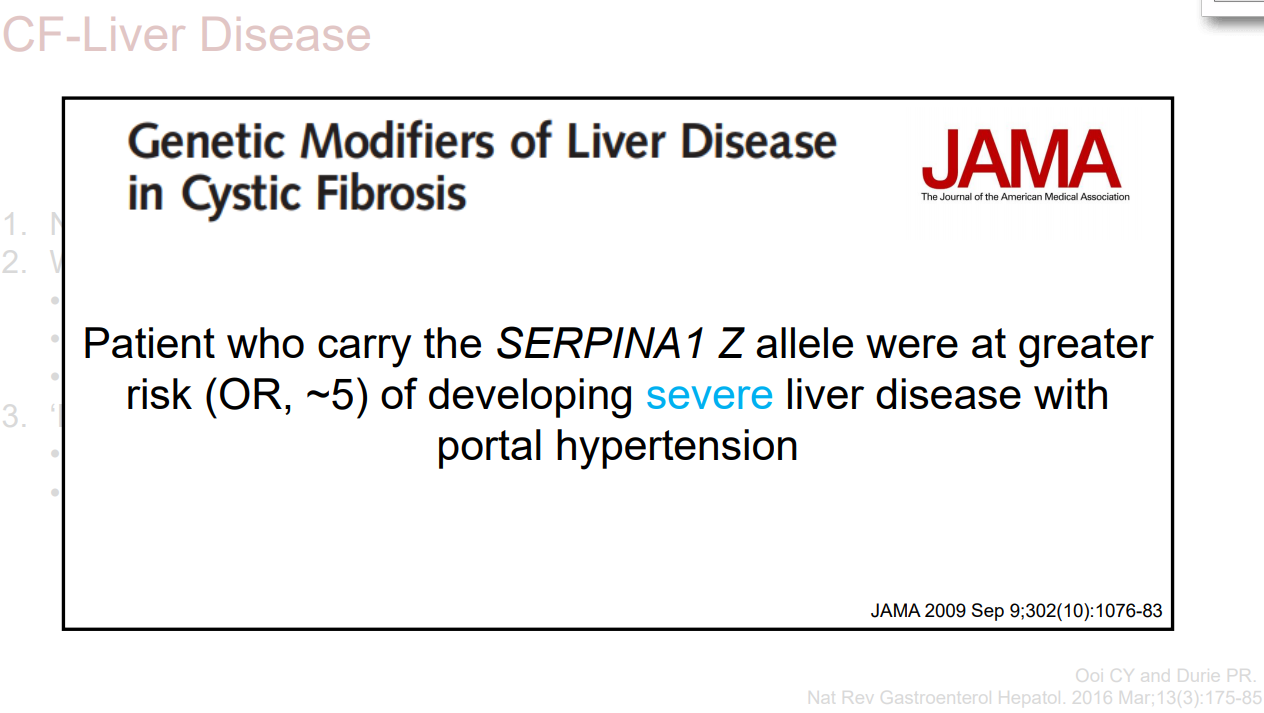
  • Risk factors include male patients, DeltaF508 mutations, meconium ileus and SERPINA1 Z allele
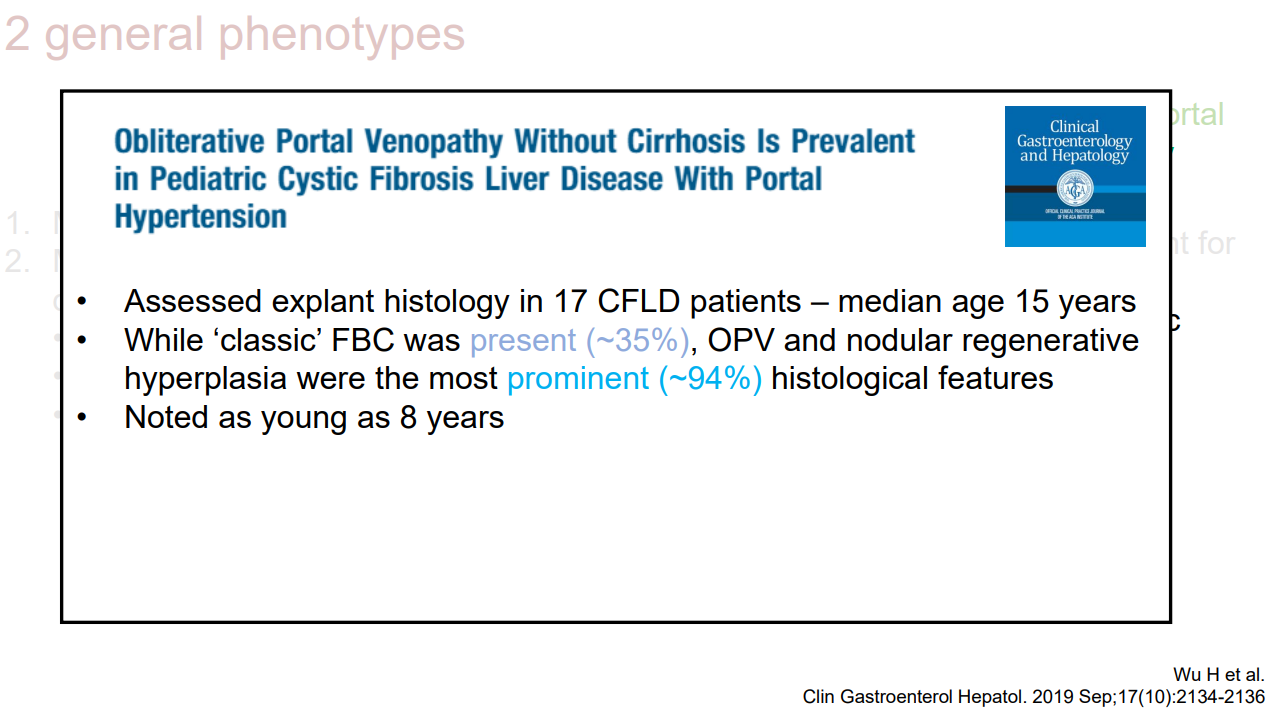
  • Two main phenotypes: Classic “Focal Biliary Cirrhosis” and Obliterative Portal Venopathy (increasingly recognized)
  • Intestinal microbiome and gut permeability/endotoxins may influence liver disease
  • Treatments: ursodeoxycholic acid may be helpful but overall evidence is low quality. Cochrane review does NOT recommend its routine use
  • Treatments: liver transplant (thorough review: Freeman et al. Liver Transpl 2019; 25: 640-657)
  • Treatments: CF Modulators: potentiators (Ivacaftor), correctors (Lumacaftor, Elexacaftor, Tezacaftor)
  • Treatment: Trikafta has been a game changer for CF lung disease. Its effects on the liver are not clear yet

Some of the slides:

Related blog posts:

SAVE THE DATE for next year’s conference: July 11-15, 2022 in Snowmass Village, CO

Outcomes and Risk Factors in Cystic Fibrosis Liver Disease

A recent retrospective study (P-Y Boelle et al. Hepatology 2019; 69: 1648-56, associated editorial 1379-81) examines a large cohort of 3,328 patients with cystic fibrosis and pancreatic insufficiency (born after 1985) who were followed into a longitudinal “French CF Modifier Gene Study.”

Background from editorial:

  • Cystic fibrosis liver disease (CFLD) has been thought to occur mainly before puberty with ~40% of patients developing biochemical or ultrasonographic signs of liver involvement by age 12 years.
  • Registry studies have shown slow progression of liver disease with the development of cirrhosis and portal hypertension in 5-10% of patients.  Due to difficulty identifying those at high risk for disease progression and the long time course, it has been impractical to complete definitive clinical trials to establish whether any therapies alter the natural history.
  • Ursodeoxycholic acid (UDCA) is the only current treatment available for CFLD; UDCA has been shown to have beneficial effects on biochemistries and liver stiffness, but effects on survival or need for transplantation are unknown.
  • Concerns have been raised about the potential for toxic UDCA metabolites (eg. lithocholic acid) in part based on unfavorable results of high-dose UDCA with primary sclerosing cholangitis

Key findings of this current study:

  • The incidence of CFLD increased “by approximately 1% every year, reaching 32.2% by age 25”
  • The incidence of severe CFLD increased “only after age 5, reaching 10% by age 30.”
  • Risk factors for CFLD and severe CFLD: male sex, CFTR F508del homozygosity, and history of meconium ileus.
  • Earlier introduction of UDCA (over the last 20 years) “did not change the incidence of severe CFLD.”

My take: This study confirms a previous study showing that CFLD occurs also in adulthood (Koh C et al. Hepatology 2017; 66:591-601) and adds further doubt about whether UDCA is beneficial.

Related article: AJ Freeman et al. “A Multidisciplinary Approach to Pretransplant and Posttransplant Management of Cystic Fibrosis-Associated Liver Disease” Liver Transplantation 2019; 25: 640-57.

Related blog posts:

Peonie in Sandy Springs