
Advancements in Pediatric Cholestatic Liver Disease Management

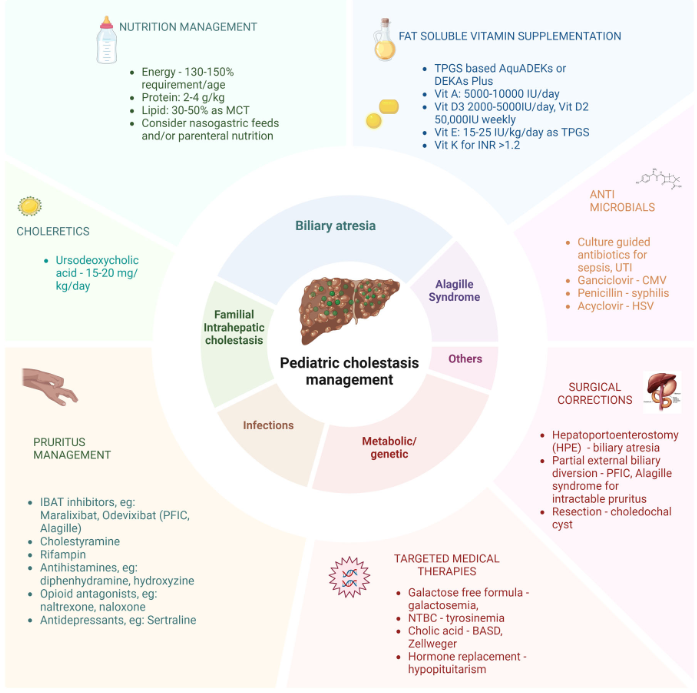
KR Mysore et al. J Pediatr Gastroenterol Nutr. 2025;80:549–558. Recent advances in the management of pediatric cholestatic liver diseases

This is a useful review summarizing advances in the management of cholestatic diseases.

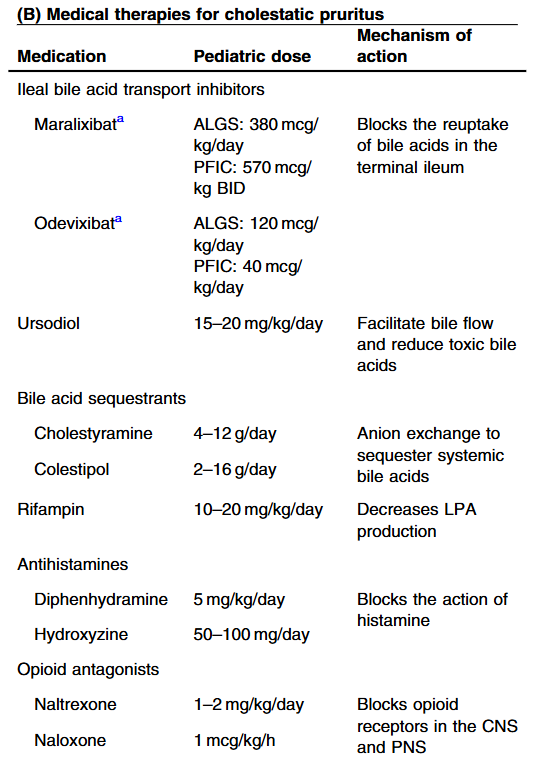
Treatment with IBAT inhibitors:

“Improvement in both pruritus and serum BAs/bilirubin levels has been associated with improved event‐free survival and 6‐year transplant‐free survival in ALGS patients treated with maralixibat. Additionally, this class of medication improved overall growth of the patient by improving mean height and weight Z scores that may be related to reduced impact of high serum bile acid levels on the growth axis although further studies are needed to better define the mechanism responsible for this out-come. This finding suggests these parameters could be used as surrogate end‐points for disease severity in diseases like ALGS or PFIC, where the time course to develop the need for LT commonly occurs over many years.”
Related blog posts:

Disclaimer: This blog, gutsandgrowth, assumes no responsibility for any use or operation of any method, product, instruction, concept or idea contained in the material herein or for any injury or damage to persons or property (whether products liability, negligence or otherwise) resulting from such use or operation. These blog posts are for educational purposes only. Specific dosing of medications (along with potential adverse effects) should be confirmed by prescribing physician.  Because of rapid advances in the medical sciences, the gutsandgrowth blog cautions that independent verification should be made of diagnosis and drug dosages. The reader is solely responsible for the conduct of any suggested test or procedure.  This content is not a substitute for medical advice, diagnosis or treatment provided by a qualified healthcare provider. Always seek the advice of your physician or other qualified health provider with any questions you may have regarding a condition.

Fat soluble vitamin deficiency -sometimes the rule rather than the exception

While it is well-known that cholestasis predisposes individuals to develop fat-soluble vitamin (FSV) deficiencies, the exact frequency is not clear.

A recent prospective multi center study of infants with biliary atresia (BA) indicates that FSV deficiency is quite frequent –thanks to Kipp Ellsworth for forwarding this article (DOI: 10.1542/peds.2011-1423; http://pediatrics.aappublications.org/content/early/2012/08/08/peds.2011-1423).  “Infants with BA are at risk for malabsorption of dietary lipid and fat-soluble vitamins (FSVs) due to insufficient intraluminal bile acid concentrations.”

To determine the frequency of FSV deficiencies, this study examined 92 infants with BA who were enrolled in a randomized double-blinded, placebo-controlled trial of corticosteroid therapy after hepatoportoenterostomy (HPE).  This study was conducted by the Biliary Atresia Research Consortium (BARC) between 2005-2008.

All infants were treated with a standardized dose of a liquid multiple FSV/d-α tocopheryl polyethylene glycol-1000 succinate (TPGS; a micelle forming water-soluble form of vitamin E).  Infants received initially ADEKs; later in the study, ∼32 months after start, participants were changed to AquADEKs due to a manufacturer’s change.  In addition, all infants received supplemental vitamin K, initially 2.5 mg three times per week.  As noted in supplement to article, the two study multivitamins have particularly low amounts of vitamin D (800 units) and vitamin E (80-100 units) compared to frequent dosing in clinical practice for severe cholestasis (see below).

TABLE 1 from study: Target FSV Levels and Replacement Regimens

  • Vitamin A (retinol)

Target:  19–77 mg/dL retinol:RBP molar ratio >0.8

Supplement strategy:  Increments of 5000 IU (up to 25–50 000 IU/d) orally or monthly intramuscular administration of 50 000 IU

  • D (25-hydroxy vitamin D)

Target: 15–45 ng/mL

Supplement: Increments of 1200 to 8000 IU orally daily of cholecalciferol or ergocalciferol; alternatively calcitriol at 0.05 to 0.20 mg/kg per day

  • E (α tocopherol) 

Target: 3.8–20.3 mg/mL & vitamin E:total serum lipids ratio >0.6 mg/g

Supplement: Increments of 25 IU/kg of TPGS orally daily (to 100 IU/kg per d)

  • K (phytonadione)

Target: INR ≤1.2

Supplementation Strategy:

  • <1.2-1.5  INR:  2.5 mg vitamin K orally daily
  • 1.5-1.8  INR: 1.8  2.0–5.0 mg vitamin K intramuscular and 2.5 mg vitamin K orally daily
  • >1.8 INR:  2.0–5.0 mg vitamin K intramuscular and 5.0 mg vitamin K orally daily

Results: FSV was common in infants with total bilirubin (TB) ≥2 mg/dL. At three months post HPE, only 3 infants with this degree of cholestasis were sufficient for all four vitamins.; at 6 months post HPE, all 24 infants with TB ≥2 mg/dL had at least one FSV deficiency: “100%, 79%, 50%, and 46%, respectively, for vitamins A, D, E, and K .”   Also, the incidence of vitamin D deficiency would be higher if the authors had chosen a higher target.

Take-home points:

  • FSV deficiencies are common particularly in patients with TB > 2mg/dL; thus careful monitoring is worthwhile
  • There is no current multivitamin that is adequate.  A better strategy is to individualize the dosing for each vitamin and consider injection (except for vitamin E) if needed

Initial individualized dosing of FSV supplementation in clinical practice for severe cholestasis (prior to deficiencies):

Vitamin A: start with ~5000 units daily.

Vitamin D: See previous posts for more information on dosing.  Two options include: Drisdol® (8000 IU/ml) 0.125ml/kg/day (=1000 IU/kg/day) and Bio-D-Mulsion Forte® http://www.bioticsresearch.com/node/1570 -each drop = 2,000 IU (also inexpensive)

Vitamin E (Liqui-E®/Nutr-E sol®26.6 IU/ml) 1ml/kg/day
with tocopherol polyethylene glycol succinate.  Alternative is AquaE®(Yasoo -www.yasooproducts.com/aqua-e/).

Vitamin K (phytonadione) 2.5mg QOD

Related posts:

Diagnosing biliary atresia earlier

Common to be “D-ficient”

Outcomes of Biliary Atresia

MicroRNAs and biliary atresia

Bleeding due to vitamin K deficiency
