
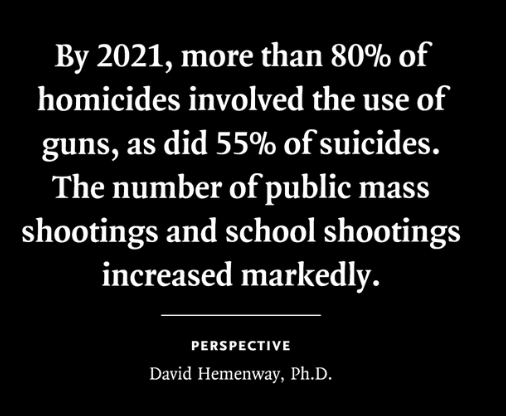
D Hemenway. NEJM 2024; 390:1352-1353 Twenty-Five Years after Columbine — Firearms and Public Health in the United States
This commentary notes that in the aftermath of Columbine, Smith and Weston had agreed “to upgrade its products and practices to help reduce the harms caused by its guns. Since a common cause of unintentional shootings is incorrectly believing that the gun is unloaded, its pistols would have chamber load indicators, and magazine disconnects would be available. The company would provide “ballistic fingerprints” on new firearms to help law-enforcement agencies trace guns. It would sell its guns only to dealers who had a plan for preventing gun theft and — to reduce gun trafficking — would agree to limit multiple-handgun sales to any individual buyer. The dealers would also have to agree not to sell large-capacity magazines.1 But the firearms industry immediately began boycotting the company, and its chief executive officer was forced to retire.”
This article offers the following advice to reduce firearm mortality, the number one killer of children:
- “The Surgeon General could provide biannual reports on guns and suicide; the federal government could both conduct and fund research into smart guns and safer means of home protection than owning a handgun”
- “Police could have social workers embedded in precincts”
- “The faith community could make it clear that it is a cardinal sin to sell a gun to a stranger without a background check”
- “Probably the most important thing our country can do is to elect more officials who will help make changes where the effect will be greatest — in the gun industry and the gun culture”
- “To achieve a huge reduction in gun deaths will probably require mandating what is common for car drivers in the United States and for gun owners in other high-income countries: gun licensing, gun training, and handgun registration, along with universal background checks. These requirements are supported by most Americans”
- “PLCAA (Protection of Lawful Commerce in Arms Act) protections should be eliminated, and the gun industry treated like other industries”
- “And just as car manufacturers had to be forced to put seat belts, airbags, collapsible steering columns, and safety glass into their vehicles, the gun industry should be forced to take the types of steps that Smith and Wesson was willing to take 25 years ago”
Related blog posts:
- Firearms: #1 Cause of Pediatric Deaths & Households with Guns =More Deaths
- “Crossing Lines” and Why Firearm Deaths are The Leading Cause of Death in Children
No Exaggeration: Too Many Children Are Dying in the U.S. “The sad fact is that a child or adolescent in the United States is 57% more likely to die by the age of 19 years than those in other wealthy nations.” This is due mainly to more deaths from MVAs and from gun violence.- Shush -Let’s Not Talk About Firearm Safety
- Firearm Mortality -Tragic Inertia
- Another Day in the US: School Deaths Related to Firearms
- Is It OK for Pediatricians to try to Prevent Firearm Injuries? Focus on Child Safety –Not on Gun Safety “We know that nearly 1 in 10 families with guns admit to keeping at least 1 gun loaded and unlocked, and nearly one-half keep at least 1 gun unlocked.
- ”Physician narrative on gun control | gutsandgrowth
- NY Times: End the Gun Epidemic in America |gutsandgrowthA Call to Arms for Health Care Professionals




 gutsandgrowth