Gene Therapy for Alpha-One Antitrypsin Deficiency

An excerpt from NY Times:

Researchers have corrected a disease-causing gene mutation with a single infusion carrying a treatment that precisely targeted the errant gene.This was the first time a mutated gene has been restored to normal….

The study involved patients who have alpha-1 antitrypsin deficiency, or AATD, a genetic disease that affects an estimated 100,000 Americans…

When the nanoparticles reached the liver, the lipid layer peeled off, releasing the editor — a disabled CRISPR molecule that acted like a GPS for the genome and an enzyme to fix the mutation. The CRISPR molecule crawled along the patient’s DNA until it found the one incorrect letter that needed to be repaired among the three billion DNA letters in the genome. Then the editing enzyme replaced that letter with the correct one… Those who got the highest dose made enough normal alpha-1 antitrypsin to be in a range where no more damage should occur. 

My take: This is exciting news, though, long-term data is needed to determine if this will be a durable cure. Cost/availability will be an important consideration if effective.

Related blog posts:

A “Swell Diagnosis” (part 2)

Recently, this blog post reviewed a case presentation of hereditary angioedema which often presents with bouts of severe abdominal pain: “A Swell Diagnosis”

Now, a study has shown how this can be effectively treated with CRISPR gene editing:

  • HJ Longhurst et al. N Engl J Med 2024; 390:432-441. CRISPR-Cas9 In Vivo Gene Editing of KLKB1 for Hereditary Angioedema.

My take: Gene therapies have been very expensive. If this therapy is approved for hereditary angioedema it will be too. However, some of the current treatments for preventing hereditary angioedema are also quite costly.

Related blog posts:

Shiny New Object: Gene Therapy in Gastroenterology

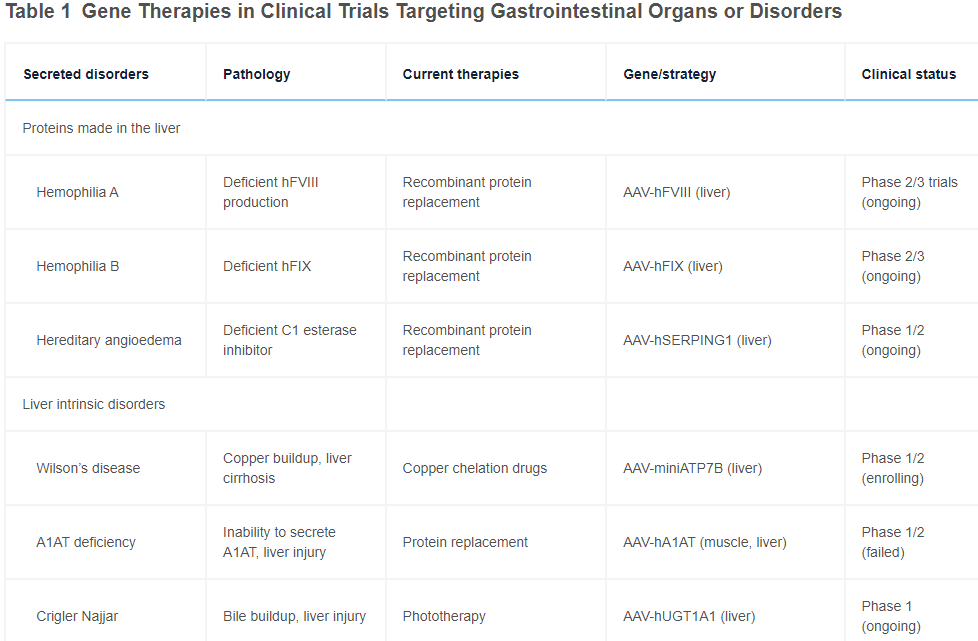
It’s hard not to be fascinated by the emerging treatments in gene therapy. A great summary of this topic as it relates to gastroenterology:

RL Kruse et al. Gastroenterol 2022; 162: 1019-1023. Open Access: How to Embrace Gene Therapy in Gastroenterology

Key points:

  • Researcher’s have utilized viruses to introduce exogenous DNA in efforts to correct defects in genetic diseases. Adeno-associated virus (AAV) vectors are the most common vectors used. In addition, AAV have a natural tropism to the liver following intravenous infusion
  • “Highlighting programs with the most advanced efficacy, hemophilia gene therapies in the liver have advanced into phase 2/3 and have shown promising efficacy based on factor VIII or IX levels achieved and reduction in bleeding events, with the main questions being long-term expression and safety of the approach”

Limitations:

  • “Integrated AAV have been associated with an increased incidence of hepatocellular carcinoma in mice”
  • Antibodies to AAV may be present or develop after infusion…” this factor has precluded any redosing in trials because antibodies would neutralize all incoming vectors”
  • In hemophilia trials, in the liver there has been a slow decrease in the levels of expression over time 6 which indicates that years into the future patients will need to be redosed to maintain efficacy
  • “Practically, AAV can only achieve delivery in a fraction of cells within an organ”

Newer Approaches for Gene Delivery:

  • mRNA delivery: mRNA is being explored as a tool for gene therapy, because mRNA only requires cytoplasmic delivery for expression.
  • “mRNA can also express gene-editing enzymes like Cas9….However, gene editing presents inherent risks of off-targeting cutting or base editing that would occur in millions of hepatocytes, potentially leading to cancer”
  • “Nonviral approaches of DNA delivery could drop the costs of vector production at least 100-fold versus AAV…delivery of DNA through LNPs [lipid nanoparticles] has largely yielded inefficient gene expression”
  • “Hydrodynamic injection is a process where fluid pressure is used to deliver naked DNA directly into cell…injection into the biliary system through endoscopic retrograde cholangiopancreatography”

The authors note that gene delivery could be important in modifying more common disorders including nonalcoholic steatohepatitis, diabetes and autoimmune diseases.

My take: While this field of study is quite exciting, to me it is definitely a shiny object, like all of precision medicine, in that it may distract researchers and physicians away from more pressing common problems.

Related blog posts:

Briefly noted: Can We Afford (Multi) Million Dollar New Therapies?

New Gene Therapy: NPR: Zolgensma From Novartis -Most Expensive Medication Ever Approved

An excerpt:

The federal Food and Drug Administration has approved a gene therapy for a rare childhood disorder that is now the most expensive drug on the market. It costs $2.125 million per patient….

Zolgensma’s price tag, he says, is just the most extreme example of how drug prices are draining resources from society. The first gene therapy for an inherited disease was approved in 2017 for a genetic form of blindness. It is also very expensive — $425,000 for each eye.