Therapeutic Endoscopy Rarely Beneficial in Infants with Gastrointestinal Bleeding

P Bose et al. JPGN 2022; 75: 514-520. Endoscopy in Infants With Gastrointestinal Bleeding Has Limited Diagnostic or Therapeutic Benefit

I read this article shortly after convincing a surgical colleague to explore a well-appearing 6 month old with gastrointestinal bleeding for a Meckel’s diverticulum rather than undergo endoscopy.

In this retrospective cohort study of hospitalized infants (n=56, =/< 12 months) with gastrointestinal bleeding, the authors reviewed endoscopic procedures (EGD, Colonoscopy, Flexible Sigmoidoscopy) with respect to identifying diagnosis and in terms of outcomes.

Key points:

  • Seven endoscopies identified sources of GIB: gastric ulcers, a duodenal ulcer, gastric angiodysplasia, esophageal varices, and an anastomotic ulcer.
  • Intervention for bleeding control occurred in just 3 cases (5.4%); two of these had liver disease.
  • Most (55%) had no abnormalities on endoscopy
  • The authors detail two fatal cases in which GIB started in the first week of life. Both had complications occurring within 3 hours of endoscopy, one with a gastric perforation and one with necrotizing enterocolitis.

My take: Endoscopy in infants with GIB is rarely beneficial. Supportive care and surgical interventions should be considered, especially in those without underlying liver disease.

Related blog posts:

Savage Alpine Trail at Denali National Park. Parts of Denali can be seen in the background

Disclaimer: This blog, gutsandgrowth, assumes no responsibility for any use or operation of any method, product, instruction, concept or idea contained in the material herein or for any injury or damage to persons or property (whether products liability, negligence or otherwise) resulting from such use or operation. These blog posts are for educational purposes only. Specific dosing of medications (along with potential adverse effects) should be confirmed by prescribing physician.  Because of rapid advances in the medical sciences, the gutsandgrowth blog cautions that independent verification should be made of diagnosis and drug dosages. The reader is solely responsible for the conduct of any suggested test or procedure.  This content is not a substitute for medical advice, diagnosis or treatment provided by a qualified healthcare provider. Always seek the advice of your physician or other qualified health provider with any questions you may have regarding a condition.

Hemospray Efficacy and Rebleeding

A Ofusu et al. J Clin Gastroenterol 2020. doi:10.1097/MCG.0000000000001379. The Efficacy and Safety of Hemospray for the Management of Gastrointestinal Bleeding

This systematic review and meta-analysis included 19 studies and 814 patients.

  • 212 patients were treated with Hemospray as monotherapy
  • 602 patients were treated with Hemospray with conventional hemostatic techniques.

Key findings:

  • Overall pooled clinical success after the application of Hemospray was 92%
  • Overall pooled early rebleeding rates (<7 days) after application of Hemospray was 20%
  • Overall pooled delayed rebleeding rates after the application of Hemospray was 23% (<30 days)
  • There was no statistical difference in clinical success (RR, 1.02; 95% CI, 0.96-1.08; P=0.34) and early rebleeding (RR, 0.89; 95% CI, 0.75-1.07; P=0.214) in studies that compared the use of Hemospray as monotherapy versus combination therapy with conventional therapy.

Related study: D Chahal et al. Dig Liver Dis 2020. DOI: https://doi.org/10.1016/j.dld.2020.01.009 Full text: High rate of re-bleeding after application of Hemospray for upper and lower gastrointestinal bleeds Findings (n=86): Immediate hemostasis rate was 88.4%, but there was a high rate of re-bleeding (33.7%). Most re-bleeds occurred within 7 days (86.2%)

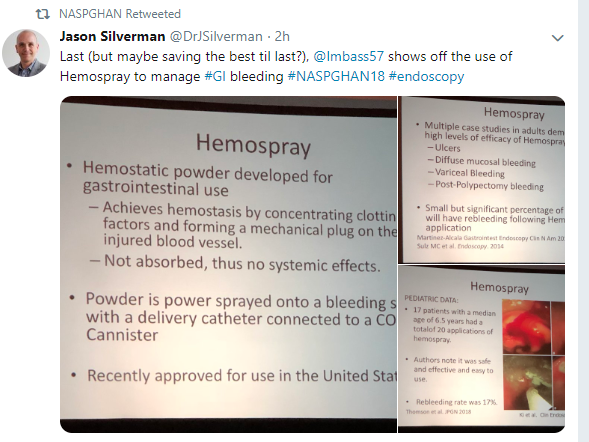
My take: Hemospray is effective in achieving immediate hemostasis but there are high rates of rebleeding. It may be eliminated by GI tract in as few as 24 hours after use.  Thus, for lesions at high risk for bleeding, hemospray is likely more of a last resort endoscopic option.

Related blog posts:

Endoscopic Experts Needed In Pediatrics

A recent study (A Schmidt et al. Gastroenterol 2018; 155: 674-86) shows how a new endoscopic technique, over-the-scope clips (OTSC), are more effective than standard endoscopic therapy for patients with recurrent bleeding of peptic ulcers.

Key finding: A multicenter prospective randomized unblinded study with 66 patients (33 in each arm) with found that hemostasis with OTSC had a failure rate (further bleeding) of 15.2% compared with 57.6% in those with standard therapy.

The authors note that standard endoscopic techniques are effective in more than 90% with rebleeding rates of 2-10%.  In those with rebleeding, followup endoscopy has a much lower success rate.

My take:

  • This study highlights a problem in pediatric endoscopy –the lack of expertise in these rare cases.  To learn even ‘standard’ endoscopic therapy, most pediatric GI fellows will need to collaborate with adult gastroenterologists in order to have exposure to a sufficient number of cases.
  • The development of alternatives like hemospray (Hemospray for GI Bleeding) which is technically-easy should be helpful for pediatric endoscopists with less endoscopic training.

Related article: 

P Tran et al. JPGN 2018; 67: 458-63.  This retrospective analysis of 11 pediatric cases (median age 14.7 yrs) reported technical success in all cases, though 2 patients with anastomotic ulcers requred additional medical intervention. The article has some pretty cool pictures.

Related blog posts:


Lake Agnes, Banff

Lake Agnes Teahouse Menu


NASPGHAN Postgraduate Course 2017 (Part 1): Strictures, GI Bleeding, Pancreatic Fluid Collections

Over the next 2 weeks or so, I am posting my notes/pictures from this year’s annual meeting.  The first few days will review the postgraduate course.  For the most part, I find the postgraduate course reassuring that I have kept up with current approaches; there is usually not a lot of new information but a solid review of the topics.

Here is a link to postgraduate course syllabus: NASPGHAN PG Syllabus – 2017

This blog entry has abbreviated/summarized these presentations. Though not intentional, some important material is likely to have been omitted; in addition, transcription errors are possible as well.

Strictures beyond the esophagus

Petar Mamula, Children’s Hospital of Philadelphia

Some useful points:

  • Fluoroscopy very useful with most strictures –may improve safety and effectiveness. Helps define anatomy
  • Reviewed strictures in stomach –rare. May be due to caustic ingestion, Crohn’s disease or chronic granulomatous disease
  • Intestinal/colonic strictures (or narrowing): duodenal webs -can be treated with needle knife, Crohn’s disease strictures -can be balloon dilated, Short gut syndrome, Graft versus host disease

GI Bleeding Update

Diana Lerner  Medical College of Wisconsin

Useful points

Upper GI Bleeding:

  • IV PPIs reduce risk of transfusion and reduce risk of re-bleeding
  • IV PPI BID treatment has been shown to be noninferior to continuous drip
  • Conservative transfusion therapy
  • Erythromycin can be helpful
  • Lecture had good videos with review of techniques: clipping, heater probe, epinephrine injection (not recommended as monotherapy), argon plasma coagulation, and bipolar electrocautery

Cleveland et al. World J Pediatr 2012

Lower GI Bleeding:

  • Etiologies include the followiing: Post-polypectomy, Solitary Rectal Ulcer syndrome, Blue Rubber Bleb syndrome, anastomotic ulcer bleeding, Meckel’s diverticulum
  • Lower GI evaluation is best after prep –much higher yield

Management of Pancreatic Fluid Collections

Matt Giefer Seattle Children’s Hospital

Key points:

  • Imaging in first 7 days of diagnosis may miss the development of fluid collections
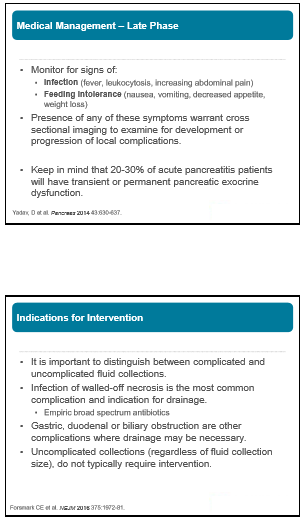
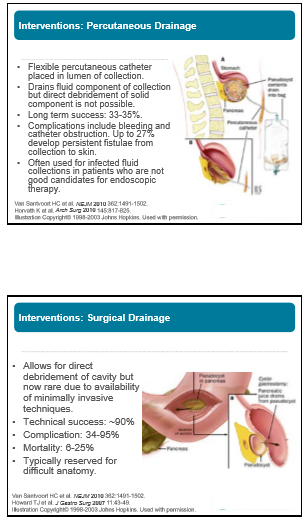
  • With necrotizing pancreatitis, fluid collections are either ANC: acute necrotic collection (<4 weeks) or WON: walled off necrosis (>4 weeks); Bryan et al. Radiographics 2016; 36: 675
  • With interstitial edematous pancreatitis, fluid collections are either acute peripancreatic fluid collection (<4 weeks) or Pseudocyst: >4 weeks,
  • Fluid collections do not preclude feeding patients
  • Drainage often needed if fluid collection becomes infected or if fluid collection causes obstruction
  • Endoscopic drainage is first-line approach: equally effective as surgery, fewer complications, equal efficacy, and lower cost


Cutting Edge for Endoscopic Control of Bleeding

A recent review elaborates on the newest methods for endoscopic control of bleeding. Topics included caplock clips, endoscopic suturing, and hemostatic sprays.

Full text: New Endoscopic Technologies and Procedureal Advances for Endoscopic Hemostasis (from Clinical Gastroenterology and Hepatology)

Related blog posts:


Many Glacier Hotel

Many Glacier Hotel