Clever Study: Hepatic Steatosis is Common in Overweight/Obese Children in First Four Years of Life

AO Glenn et al. JPGN 2025;81:679–682. Sonographic evidence of hepatic steatosis is highly prevalent in at-risk children under 4 years of age

This study had a clever design: the authors examined the liver findings from overweight/obese children (n=168) who underwent renal ultrasounds to help determine the frequency of hepatic steatosis. Quantification of the hepatorenal index (HRI) by ultrasound has been shown to provide moderate diagnostic performance for detecting hepatic steatosis in children. (Ref: Frankland MP et al. Diagnostic performance of ultrasound hepatorenal index for the diagnosis of hepatic steatosis in children. Pediatr Radiol. 2022; 52(7): 1306-1313)

This design helped avoid a selection bias present in most studies which have examined ultrasonography in children with elevated liver enzymes. The authors did try to correlate the imaging findings with blood tests. Serum laboratory data were available for 50 patients at a mean interval of 115 days (0–366) from the ultrasound examination.

Key findings:

  • 91 (54%) patients had an abnormally elevated HRI (>1.75). An abnormally elevated HRI was present in 58% (50/86) of patients with overweight and 50% (41/82) of patients with obesity
  • Of the 12 patients with abnormal ALT, 5 (42%) had an abnormal ultrasound HRI and 7 (58%) had a normal ultrasound HRI

Discussion points:

“MASLD can occur at a very young age and should be considered in at-risk patients. Importantly, only 21% (5/24) of the patients with imaging evidence of steatosis and available labs had elevated ALT and 58% (7/12) of patients with an elevated ALT did not have imaging evidence of steatosis, suggesting that ALT may not be a useful biomarker for MASLD screening at this age.”

My take: Hepatic steatosis is likely present in about half of children with early onset overweight/obesity. ALT values are often normal in this cohort.

Related blog posts:

The Rocky Mountains, Landers Peak by Albert Bierstadt at the Metropolitan Museum of rt

Hepatic Steatosis as an Incidental Finding

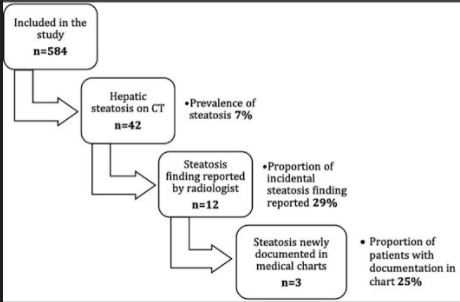
A recent report (H Okura et al. J Pediatr 2021; 234: 92-98. Under-reporting of Hepatic Steatosis in Children: A Missed Opportunity for Early Detection) showed that hepatic steatosis is under-reported as an incidental finding on CT scans which were ordered for nephrolithiasis.

Key findings:

  • Using absolute liver attenuation <48 Hounsfield units (HU), the prevalence was 7% (n = 42/584). Steatosis was reported for only 12 of 42 (28%) of these patients and was documented in clinical notes in only 3 of those cases
  • 232 (40%) had liver enzymes available within 24 hrs of CT scan. 79 had elevated ALT values; steatosis accounted for only 22% of those with elevated ALT values
  • In those with liver attenuation < 48 HU, nearly all had abnormal ALT values and the median was 52 U/L
  • Patients with steatosis had an 8-fold likelihood of overweight/obesity

Discussion:

  • These findings are similar to an adult study of 1290 patients in which 26% had steatosis but only 5% had those findings identified and documented beyond the radiology report. (N Kutaiba et al. J Med Imaging Radiat Oncol 2019; 3: 431-8)
  • CT findings are considered much more accurate than ultrasonography.
  • The authors argue that identification of NAFLD is “crucial” to allow for further specialty evaluation and to exclude secondary causes of steatosis.

My take: This study shows that there is an opportunity to improve identification of incidental steatosis. If identified, this can/should be addressed by their primary care team to emphasize improved diet choices and physical activity.

Related blog posts:

From Journal of Pediatrics Twitter Feed

Assessment of Organ Donation –MRI Often Precludes Need for a Liver Biopsy

A recent retrospective single-center study (J Satkunasingham et al. Liver Transplantation 2018; 24: 470-77) shows that MRI is a good tool to assess hepatic steatosis.  In total there were 144 liver donor candidates; a subset of 32 underwent liver biopsy.

When examining magnetic resonance spectroscopy (MRS) and MRI -proton pump density fat fraction (PDFF), the authors found that MRS-PDFF and MRI-PDFF had 95% and 100% negative predictive value in identifying patients with clinically  significant histologic steatosis (≥10%).

The associated editorial by James Trotter (pg 457-58) makes several important points:

  • Currently living donor transplantation in the U.S. accounts for 4% of all transplants
  • In his center (and most centers), protocol biopsy are not required prior to liver donation.  The main indications for donor liver biopsy are biochemical dysfunction or steatosis on imaging studies.

My take (borrowed from editorial): “Noninvasive estimation of hepatic steatosis is sufficiently accurate to forgo liver biopsy in most donors, although ultimately this decision will continue to rest with the individual center.”


When Will MRI Obviate the Need for a Liver Biopsy in Pediatric NAFLD?

A recent study (JB Schwimmer et al. Hepatology 2015; 1887-95, editorial Vos MB, pages 1779-80) examines the accuracy of magnetic resonance imaging (MRI) compared with liver histology in children with nonalcoholic fatty liver disease.

This prospective validation study enrolled 174 children with a mean age of 14 years.  The MRI estimated the liver proton density fat fraction (PDFF).

Key findings:

  • Liver MRI-PDFF correlated with steatosis grade; the correlation was particularly strong at high and low end values.  Thus, a very low MRI-PDFF was highly likely to predict a steatosis grade 0 or 1 while a very high value corresponded to high steatosis levels.
  • Liver MRI-PDFF was weaker in children with stage 2-4 fibrosis than in children with no fibrosis

The editorial notes that this study “is one of hundreds now published in the literature on MRI and NAFLD…The superiority of MR-based methods…over ultrasound is clear.  The question is why are we still ordering abdominal ultrasounds to diagnose NAFLD in children?”  The barriers for usage of MRI include cost, potential sedation, and nonuniform methods for MRI usage.

The paper conclude that “MRI is not yet sufficient to replace liver biopsy in children.”  The editorial also indicates that the MRI era is fast approaching but not viable today.

Take-home point: Due to the huge numbers of patients with pediatric NAFLD, MRI remains a terrific area for research but remains problematic in clinical practice.  Given the expense of MRI, until its use can reduce liver biopsies or improve management, its role is likely to remain limited.

Turner Field

Turner Field


Fatty Liver at Birth

A provocative study (Patel KR, White FV, Deutsh GH. JPGN 2015; 60: 152-58) shows that hepatic steatosis/fatty liver is prevalent at birth in at-risk stillborns.

The authors retrospectively examined autospy results from 33 stillborns (20-40 weeks) delivered to women with diabetes (pregestational or gestational) along with 48 age-matched controls.  The majority of women (54%) were African American women; 27% were white and 9% were hispanic.

Key findings:

  • Hepatic steatosis was common and severe in the stillborns of diabetic women.  Prevalence: 78.8% (26/33) compared with 16.6% (8/48) of controls.
  • No direct correlation was identified between steatosis and glycemic control.

Whether nonalcoholic fatty liver disease (NAFLD) begins at birth is not known and what happens to the fat in newborns with hepatic steatosis is not clear.  This study indicates that maternal diabetes may increase the risk of NAFLD.

Related blog posts: