“Moral distress” or “Moral Injury” in Medicine

8/2/23 NPR Lisa Doggett: Doctors have their own diagnosis: ‘Moral distress’ from an inhumane health system

This article describes the terms “moral injury” and “moral distress” which contribute to job dissatisfaction for physicians.

Here are excerpts:

The terms “moral distress” and “moral injury” were first used in a military context to characterize the torment felt by soldiers as they tried to process and justify their actions amid the cruelty of war. In more recent years, these terms have been used to describe the feelings of guilt, sadness and defeat felt by health care professionals when we know what our patients need but can’t provide it...

At Austin’s CD Doyle clinic for people who are homeless, where I volunteer, nearly every patient has unmet needs impacting their health…Even in well-resourced private clinics, doctors often feel frustrated that they can’t spend time with patients who need it and have little control over their schedules…

Doctors struggle to meet productivity demands, rushing in and out of exam rooms, working late into the evening to finish documenting in cumbersome electronic medical record systems. Despite some efforts to move away from a “fee-for-service” payment model, in most cases, our system still rewards volume of patients seen over value of care provided…

In Texas and other states, recent legislation, such as abortion bans and prohibitions against gender-affirming care for trans-youth, have introduced new moral dilemmas for doctors. We want to do right by our patients but face added barriers – even the potential for jail time – if we overreach or misinterpret the laws…

A commitment from health care leaders, health insurance plans, and all levels of government to address the nonmedical conditions in which we live, work, learn and play — the social determinants of health that drive 80% to 90% of health outcomes on a population level – would improve the health of individuals and communities. It would also decrease the pressure on doctors to treat medical conditions stemming from unhealthy environments that we can’t change.

A survey published last fall in Mayo Clinic Proceedings showed an alarming increase in physician burnout, with 62.8% of respondents reporting at least one symptom in 2021 compared to just 38.2% in 2020.

Physicians, too, face rates of depression and suicide that are higher than the among the general population. While moral distress doesn’t fully account for the difference, it is a contributing factor for some.

My take: My role as a physician is often constrained by troubling factors out of my control including lack of resources and poor social situations.

Related blog posts:

Garlic from market in Nice, France

COVID-19: At-Risk Populations, Moral Distress, and Related News

Before today’s post –more on voting this year:

Democracy Docket Four Ways to Safely Cast Your Ballot without USPS

  • This article also has very helpful links to all of the states’ resources, regulations, and contacts

Several recent commentaries have shown scenarios impacted by this pandemic.  Thanks to Ben Gold for sharing these references.

CA Wong et al. Pediatrics, Mitigating the Impacts of the COVID-19 Pandemic Response on At-Risk Children

Here, we (1) highlight the health risks of the pandemic response measures to vulnerable pediatric subpopulations and (2) propose risk mitigation strategies that can be enacted by policy makers, health care providers and systems, and communities.

  • Children With Behavioral Health Needs
  • Children in Foster Care or at Risk for Maltreatment
  • Children With Medical Complexity

R Cholera et al. Pediatrics. Full link: Sheltering in Place in a Xenophobic Climate: COVID-19 and Children in Immigrant Families

One in 4 children (>18 million) in the United States lives in an immigrant family, in which the child or ≥1 parent was born outside the United States.1 Among children in immigrant families (CIF), >7 million live in “mixed-status” families, meaning ≥1 parent is not a US citizen.2 The COVID-19 pandemic amplifies existing inequities and introduces new ones as immigrant families navigate school closures, lack of health insurance and paid leave, and decisions to seek medical care or public services amid ongoing immigration enforcement. Additionally, immigrant families are more likely to live in multigenerational households,4 heightening the risk of COVID-19 for multiple family members…For CIF in US communities coping with persistent fears of immigration enforcement and family separation, economic devastation during a pandemic may threaten the stability of place. In this article, we apply a health equity framework5 to evaluate the impact of COVID-19 on CIF and highlight opportunities for advocacy and action for pediatricians, hospitals and health care systems, and policymakers to mitigate the unique risks faced by CIF

AM Evans et al. Pediatrics:  Pediatric Palliative Care in a Pandemic: Role Obligations, Moral Distress, and the Care You Can Give

Moral distress refers to the experience of being unable to take the action that one believes to be morally right or required.1 the inability to provide care because of resource constraints, involvement in care that one deems to be against a patient’s interests, and disputes about care planning with families and within teams…

We cannot have an obligation to save a life that cannot be saved: we can only be obliged to do what we can… It is only your role to act well within your scope of responsibility and to be the best clinician that you can be under the circumstances. Recognizing the limits of one’s powers can relieve a burden of guilt that is unconnected with one’s own choices and actions.


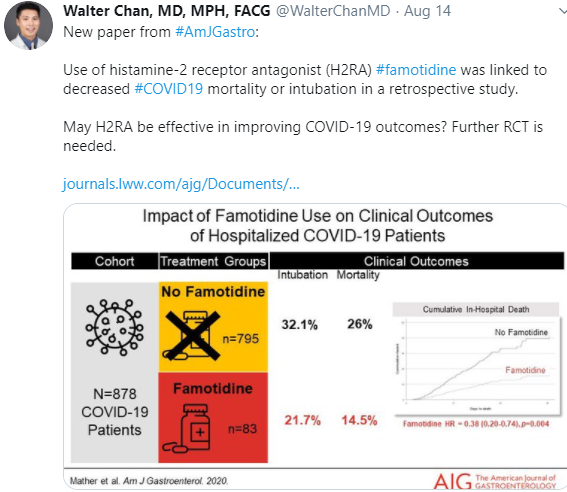
Famotidine may be helpful based on a retrospective study:


This long piece from Slate details the myriad public health mistakes in the U.S. approach to COVID-19: The Trump Pandemic