
Willie Sutton and Refractory Constipation

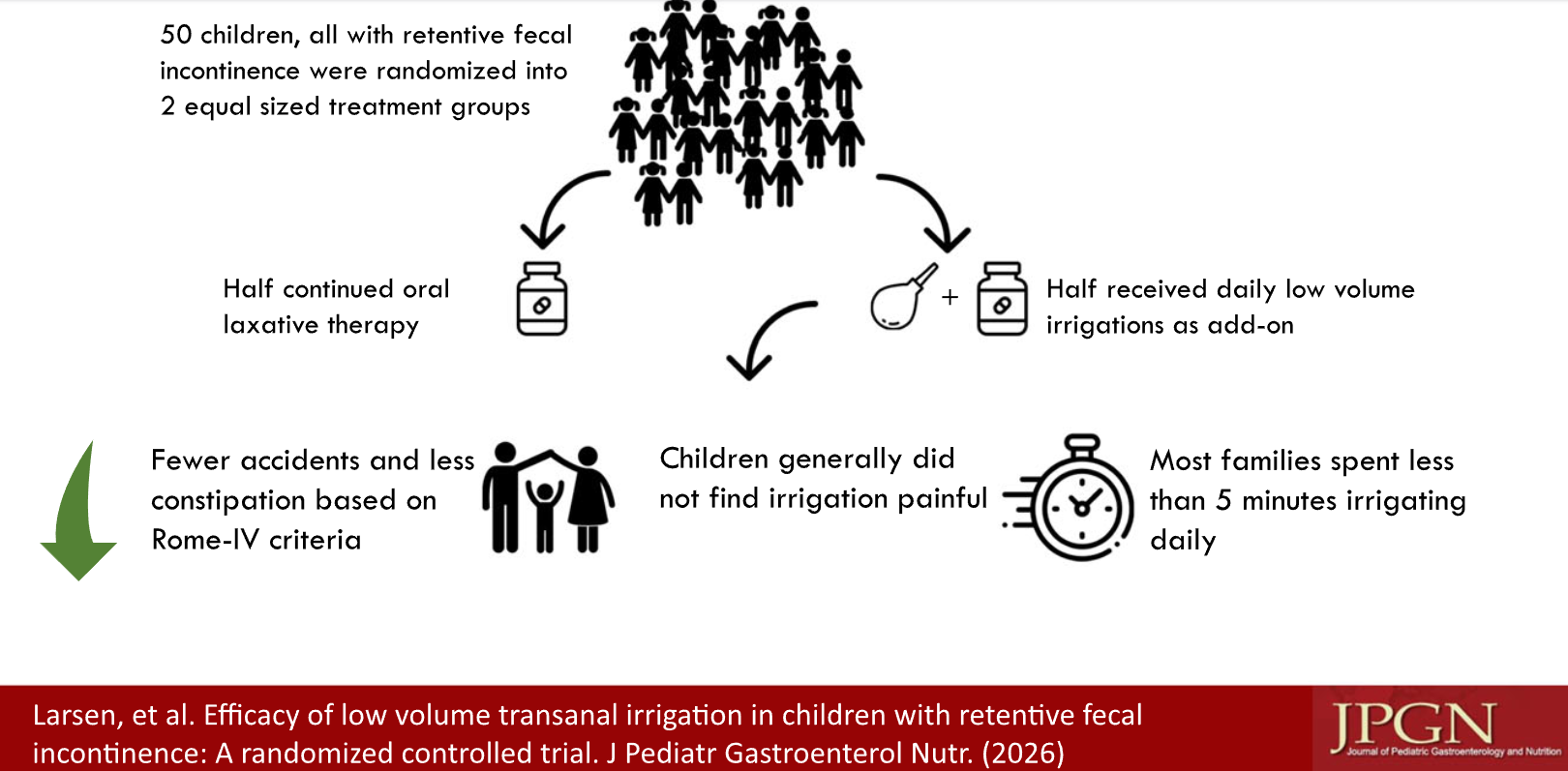
SO Larsen et al. J Pediatr Gastroenterol Nutr. 2026;82:425–433. Efficacy of low volume transanal irrigation in children with retentive fecal incontinence: A randomized controlled trial

Methods: Two-arm randomized controlled trial, including children (N=41) aged 4–14 suffering from retentive fecal incontinence. All included children were refractory to at least 2 months treatment with stool softening oral laxatives. Treatment duration was 6 weeks. The control group continued oral laxative therapy. The intervention group received  low-volume transanal irrigation (L-TAI) as add-on. 

Irrigations: “Irrigations were performed once daily with the Qufora IrriSedo MiniGo® Small system. According to the manufacturer the MiniGo® water pump contains 180 mL of water, with an estimated 20 mL residual water per use. Families were instructed to use 1 pump full of water to irrigate. If this did not result in defecation, they were instructed to refill and irrigate again.”

Key Findings:

  • In the intervention group, 75% were responders with 35% experiencing full response, while 33% in the control group were responders, with 4.8% experiencing full response
One limitation of this study, besides its sample size, is the type of laxative used prior to enrollment. Patients had been treated with PEG, magnesia or lactulose. These agents are not recommended for refractory constipation; high dose sennosides or bisacodyl have been recommended per recent position paper.

My take: Willie Sutton was a notorious bank robber who was famous for his quote (which he later denied) that he robbed banks “because that’s where the money is.” Similarly, for constipation, targeting treatment at the site of the “deposit” turns out to be an effective strategy. (I have no financial ties to the irrigation company.)

Related article: L Rodriguez et al. Clin Gastroenterol Hepatol 2026 (ahead of print). Open Access! American Gastroenterological Association-North American Society for Pediatric Gastroenterology, Hepatology and Nutrition Pediatric Functional Constipation Clinical Care Pathway

Related blog posts:

Do Occult Spinal Abnormalities on MRI Affect Constipation Outcomes?

R Bolia et al. J Pediatr Gastroenterol Nutr. 2025;81:262–265. Open Access! Impact of occult spinal abnormalities on clinical outcomes in children with refractory constipation

Methods: This was a retrospective review of records of children (n=54, median age 9 years) who underwent MRI of spine between January 2021 and December 2023 for evaluation of refractory constipation (RC). RC was defined as constipation not responding to optimal conventional treatment for at least 3 months. Conventional treatment included—education, disimpaction (if required), osmotic and stimulant laxatives, timed‐toileting and biofeedback.

Key findings:

  • Thirteen children (24%) had an abnormal MRI. Findings included—syringomyelia‐8,sacral canal meningeal cyst‐2, filum terminale lipoma‐1,spina bifida occulta‐1 (SBO‐1), and Schmorl’s node‐1. None of these patients had a tethered cord
  • Only one patient with a Chiari malformation and syrinx required a neurosurgical intervention. The surgery did not improve his constipation
  • On a median follow‐up duration of 677 (range181–1240) days, constipation resolved in 48% (n = 26) of the entire cohort
  • There was no difference in the number of patients or time to constipation resolution between those with and without abnormal MRI respectively

My take: In children with refractory constipation who do not have abnormal cutaneous/abnormal neurological exam, an MRI is unlikely to be helpful.

Related blog posts:

Disclaimer: This blog, gutsandgrowth, assumes no responsibility for any use or operation of any method, product, instruction, concept or idea contained in the material herein or for any injury or damage to persons or property (whether products liability, negligence or otherwise) resulting from such use or operation. These blog posts are for educational purposes only. Specific dosing of medications (along with potential adverse effects) should be confirmed by prescribing physician.  Because of rapid advances in the medical sciences, the gutsandgrowth blog cautions that independent verification should be made of diagnosis and drug dosages. The reader is solely responsible for the conduct of any suggested test or procedure.  This content is not a substitute for medical advice, diagnosis or treatment provided by a qualified healthcare provider. Always seek the advice of your physician or other qualified health provider with any questions you may have regarding a condition