What Went Wrong with EMRs: Death by a Thousand Clicks

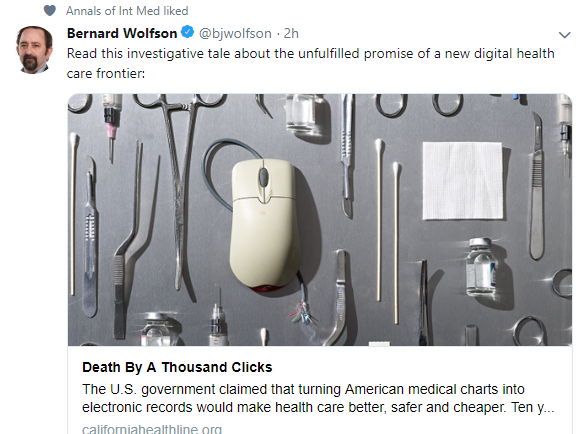
Link: Death by a Thousand Clicks Where Electronic Health Records Went Wrong

This lengthy article highlights a lot of issues with EMRs/EHRs including data sharing between systems, pulldown menus, disruption of physician-patient interactions, upcoding, safety risks and provides numerous personal examples.

An excerpt:

The U.S. government claimed that turning American medical charts into electronic records would make health care better, safer, and cheaper. Ten years and $36 billion later, the system is an unholy mess…

Instead of reducing costs, many say, EHRs, which were originally optimized for billing rather than for patient care, have instead made it easier to engage in “upcoding” or bill inflation…

More gravely still, a months-long joint investigation by KHN and Fortune has found that instead of streamlining medicine, the government’s EHR initiative has created a host of largely unacknowledged patient safety risks…

Compounding the problem are entrenched secrecy policies that continue to keep software failures out of public view. EHR vendors often impose contractual “gag clauses” that discourage buyers from speaking out about safety issues and disastrous software installations…

EHRs promised to put all of a patient’s records in one place, but often that’s the problem. Critical or time-sensitive information routinely gets buried in an endless scroll of data, where in the rush of medical decision-making — and amid the maze of pulldown menus — it can be missed…

[Problem with scrolldown options]: [doctors] had to read the list carefully, so as not to click the wrong dosage or form — though many do that too..

The numbing repetition, the box-ticking and the endless searching on pulldown menus are all part of what Ratwani called the “cognitive burden” that’s wearing out today’s physicians and driving increasing numbers into early retirement…

Beyond complicating the physician-patient relationship, EHRs have in some ways made practicing medicine harder,.. “Physicians have to cognitively switch between focusing on the record and focusing on the patient,” … “Texting while you’re driving is not a good idea.a.. But in medicine … we’ve asked the physician to move from writing in pen to [entering a computer] record, and it’s a pretty complicated interface.

My take: This article makes many good points.  Though, if you polled physicians in our group, hardly any would choose to go back to what we had before EMRs.

Related blog posts:

Tackling High Drug Costs -Lessons from Australia and Brazil

In two related commentaries referenced below, the authors detail how Australia and Brazil managed to provide a blockbuster hepatitis C virus (HCV) medication without following the going-broke example of Blockbuster video stores.

  • Australia: S Moon et al. NEJM 2019; 380: 607-9
  • Brazil: EM da Fonseca et al. NEJM 2019; 605-6.

Australia provided a lump-sum payment of approximately 770 million dollars (in U.S.) over 5 years in exchange for an unlimited volume of direct-acting antivirals (DAAs). As a result of this approach, Australia managed to treat many more patients at a much lower cost.  “The government would have to spend …U.S. $4.92 billion more to treat the same number or it could treat 93,000 fewer patients with a fixed budget” of approximately U.S. $766 million.

With the Australian approach, the authors note that it is analogous to a patent buyout and works if the ongoing drug manufacturing cost is low and the manufacturer is able to meet growing volume demand.

Brazil’s approaches for DAAs relied on either threatening loss of patent protections and/or enabling local generic production of sofosbuvir.  This resulted in ~90% price discount. Patent protection in Brazil is granted only if a medication is approved by both INPI (Instituto Nacional da Propriedade Industrial) and ANVISA (Brazilian Health Regulatory Agency).

My take: Given the rising costs of medicines, examining how other countries surmount these financial barriers is important.  In my view, the often arbitrary and exorbitant pricing by pharmaceutical companies will erode the support of protective policies in the U.S. which thus far has helped produce many advances.

Skull Rock, Joshua Tree National Park


“Grateful Patient Programs”

From NY Times: Hospitals Are Asking Their Own Patients to Donate Money

This article in the NY Times reviews a growing trend of non-profit hospitals asking patients for contributions; sometimes, physicians are asked to help identify potential donors.

An excerpt:

Many hospitals conduct nightly wealth screenings — using software that culls public data such as property records, contributions to political campaigns and other charities — to gauge which patients are most likely to be the source of large donations…

These various tactics, part of a strategy known as “grateful patient programs,” make some people uncomfortable…it could make patients worry that their care might be affected by whether they made a donation.

My take: Should hospitals simplify the process by adding a line on the bill for a tip?

Badwater basin, Death Valley


Why Hospital$ Are Hiring More Doctor$

A recent article in the Wall Street Journal details the consequence of hospitals hiring more doctors, especially primary care.:

The Hidden System That Explains How Your Doctor Makes Referrals

Key points:

  • “Hospitals are getting more aggressive in directing how physicians refer for things such as surgeries, specialty care and magnetic resonance imaging scans, or MRIs.” This often results in more out-of-pocket expenses for patients.
  • “Insurers have been working to steer patients toward doctors’ offices and other non-hospital locations for many types of care, because they are generally less expensive. The same service often costs twice as much or more when delivered in a hospital setting, compared with a doctor’s office.”

Thanks to Bryan Vartabedian’s 33mail for this reference. He notes: “The doctors in the private space relished the article as evidence of the dangers of the physician employee. But we have to remember that when doctors own their own businesses, the pressure to do things for money is huge.”

Near Zabriskie Point at Sunrise, Death Valley

WSJ: How Pfizer Settled on $9,850 per Month for New Drug

WSJ:  How Pfizer Set the Cost of Its New Drug at $9,850 a Month

An excerpt:

The average cost of a branded cancer drug in the U.S. is around $10,000 a month, double the level a decade ago

Pfizer’s multistep pricing process shows drugmakers don’t just pick a lofty figure out of the air. At the same time, its process yielded a price that bore little relation to the drug industry’s oft-cited justification for its prices, the cost of research and development.

Instead, the price that emerged was largely based on a complex analysis of the need for a new drug with this one’s particular set of benefits and risks, potential competing drugs, the sentiments of cancer doctors and a shrewd assessment of how health plans were likely to treat the product…

In 2013, Pfizer hired outside firms to conduct hourlong interviews with more than 125 cancer doctors in six cities…

Pfizer hired firms that surveyed more than 80 health-plan officials such as medical directors and pharmacists…

Pfizer employees say the mock reviews supported a monthly price below $10,000. If it was higher, insurers could start requiring doctors to fill out paperwork justifying its use.

My take: This article makes clear that the driver of higher pharmaceutical prices is based on a shrewd assessment of what the market will bear.

Related blog posts:

Why Shopping for Health Care Does Not Work and What Can Be Done About That

From NY Times:  Shopping for Health Care Simply Doesn’t Work. So What Might? (Thanks to Ben Enav for pointing out this article)

An excerpt:

What this latest study suggests, in the context of other studies, is that if people can’t shop for elective M.R.I.s, there’s hardly a chance they are going to do so with other health care procedures that are more complicated and variable.

Even if 40 percent of health care is shoppable, people are not shopping. What seems likelier to work is doing more to influence what doctors advise.

For example, we could provide physicians with price, quality and distance information for the services they recommend. Further, with financial bonuses, we could give physicians (instead of, or in addition to, patients) some incentive to identify and suggest lower-cost care.

Leaving decisions to patients, and making them spend more of their own money, doesn’t work.

Expert Actuary is Overcharged by the Hospital in ‘Collusion’ with the Insurance Company– Guess Who Wins

From NPR Why Your Health Insurer Doesn’t Care About Your Big Bills

This is a terrific article that explains a lot about what is wrong with our health system’s economics.  This article details how an expert actuary is overcharged by Aetna and NYU Langone for a partial hip replacement and how insurance companies are NOT good financial representatives for patients.

Some excerpts:

Widely perceived as fierce guardians of health care dollars, insurers, in many cases, aren’t. In fact, they often agree to pay high prices, then, one way or another, pass those high prices on to patients — all while raking in healthy profits…

Before Frank’s hip operation, he asked NYU Langone for an estimate. It told him to call Aetna, which referred him back to the hospital. He never did get a price…

For one item in his bill the implant, Aetna said NYU Langone paid a “member rate” of $26,068 for “supply/implants.” But., the maker of his implant, … told him the hospital would have paid about $1,500…

Turns out, insurers don’t have to decrease spending to make money. They just have to accurately predict how much the people they insure will cost. That way they can set premiums to cover those costs — adding about 20 percent for their administration and profit

It’s as if a mom told her son he could have 3 percent of a bowl of ice cream. A clever child would say, “Make it a bigger bowl.”

Wonks call this a “perverse incentive.”…

After the hearing, Nugent said a technicality might have doomed their case. New York defendants routinely lose in court if they have not contested a bill in writing within 30 days, he said. Frank had contested the bill over the phone with NYU Langone and in writing within 30 days with Aetna. But he did not dispute it in writing to the hospital within 30 days.

My take: While I’m no expert, I have had a similar experience where I was convinced that my insurance company would want to look into their agreement with a local hospital (Northside Hospital) because I was charged exorbitantly for the processing of a pathology specimen.  Further aggravating the situation was that I had no idea that this specimen, obtained from an outpatient visit, would be sent to a hospital system, rather than an outpatient pathology group.  It turns out that the insurance company had no interest in looking into this matter, even though the cumulative effect of these types of pathology charges were enormous.

Related blog posts:


NY Times: Financial Bill of Rights for Patients

NY Times: Nine Rights Every Patient Should Demand

This article addresses a fundamental problem in medicine: lack of price transparency, and the complexity of understanding health care expenses..

The right to an itemized bill in plain English.

  • Patients can’t detect and dispute improper charges if their bills involve dozens of pages of medical abbreviations. Studies have found that 30 percent to over 50 percent of hospital bills contain errors…

The right to never receive a surprise out-of-network bill.

The right to accurate information about the provider network in my insurance plan.

  • Doctors … must be in-network for all the procedures they normally perform and on all days of the week they practice. If a provider is listed as in-network but is not, the insurer should take care of the charge.

The right to a stable network.

  • I buy my insurance policy for a year. If my doctor or insurer stops participating in my network within that year or in the midst of treating me for an acute disease, I should still be billed as an in-network patient.

The right to be informed of conflicts of interest.

  • Patients should know if their doctors own a financial stake in a testing or procedure facility before a test or procedure is ordered or scheduled…

The right to be informed in advance about any facility fees.

  • A procedure can come with different price tags depending on where it is performed…

The right to see a price list for elective procedures.

The right to be informed of cheaper options.

  • Many doctors recommend the most expensive course of care and don’t tell patients that there are other options…

The right to know that a disputed bill will not be sent to a collection agency.

  • The threat of dealing with bill collectors and a damaged credit rating is used to intimidate patients into paying up without asking questions…

I know these rights might seem like a fantasy in our current system, with its overwhelming complexity and cost. But they are actually quite similar to the rights we expect in any other sector of our economy. 

My take: The way we pay for health care does not make sense.  Understanding costs for medical care should be like reading the nutrition label boxes.  Currently, even an expert in health care has difficulty understanding what costs to expect.