Pushback on AAP SIDS -Sleeping Guidelines

Recently, this blog summarized AAP SIDS recommendations.  These recommendations have been reviewed in a NY Times commentary: Should Your Baby Really Sleep in the Same Room as You?

This opinion piece provides a good background on the issue os whether having a baby sleep in the same room is beneficial and explains some of the flaws in the studies behind the recommendations.  Here’s an excerpt:

So when the American Academy of Pediatrics recently issued new infant sleep guidelines — highlighting a recommendation that babies sleep in their parents’ rooms for at least six months but ideally a full year — some parents despaired…

Yet the recommendation drew skepticism from some doctors, who argued that a close look at the evidence showed that the benefits of room-sharing didn’t always justify its costs to parents, who would have to sacrifice privacy, sex and, above all, sleep…

Depriving parents of good sleep can also endanger babies. Sleep-deprived people can have decreased empathy. Sleep deprivation is associated with anincrease in car accidents (which are a top killer of older children). It stresses marriages and families and is significantly associated with an increased riskof postpartum depression.

And with regard to the studies:

The first thing to note is that they all collected data in the 1990s, when SIDS was much more common than it is today. The academy said room-sharing “decreases the risk of SIDS by as much as 50 percent,” but that was before the significant improvement in SIDS rates. It’s not clear that sharing a bedroom would make as much of a difference today as it did then.

The second is these were all studies in Europe, where room-sharing is much more common. Only about 20 percent to 41 percent of infants in the control group slept in their own rooms. That makes it hard to pinpoint the reason they survived, and to generalize the findings to the United States.

My take: While the risk of SIDS may improve when infants sleep in the same room, this article makes a compelling argument that it may cause more harm than benefit.


 

Topamax and Amitriptyline Did Not Work for Pediatric Migraines

A recent study (SW Powers et al. NEJM 2016; DOI: 10.1056/NEJMoa1610384) showed that neither topamax nor amitriptyline were more effective than placebo.

Excerpt of summary from NY Times: Two Drugs for Adult Migraines May Not Help Children

Neither of the two drugs used most frequently to prevent migraines in children is more effective than a sugar pill, according to a study published on Thursday in The New England Journal of Medicine.

Researchers stopped the large trial early, saying the evidence was clear even though the drugs — the antidepressant amitriptyline and the epilepsy drug topiramate — had been shown to prevent migraines in adults…

At 31 sites nationwide, 328 migraine sufferers aged 8 to 17 were randomly assigned to take amitriptyline, topiramate or a placebo pill for 24 weeks. Patients with episodic migraines (fewer than 15 headache days a month) and chronic migraines (15 or more headache days a month) were included…

As it turned out, there was no significant difference among the groups: 61 percent of the placebo group reduced their headache days by 50 percent or more, compared with 52 percent of the children given amitriptyline and 55 percent of those who took topiramate. And there was no significant difference among the three groups in reducing the school days or other activities missed…

One child on topiramate attempted suicide. Three taking amitriptyline had mood changes; one told his mother he wanted to hurt himself, while another wrote suicide notes at school and was hospitalized.

My take: Given the overlapping features between migraines and abdominal pain, how (in)effective are these types of medications for abdominal pain?  Also, does someone know where I can buy stock in whoever makes placebo -it performed pretty well.

Related blog posts:

Disclaimer: These blog posts are for educational purposes only. Specific dosing of medications (along with potential adverse effects) should be confirmed by prescribing physician.  This content is not a substitute for medical advice, diagnosis or treatment provided by a qualified healthcare provider. Always seek the advice of your physician or other qualified health provider with any questions you may have regarding a condition.

migraine-meds

Preventing Sudden Infant Deaths -Latest Guidelines

Though sudden infant death syndrome and counseling is mainly in the realm of general pediatrics, subspecialists need to be familiar with the latest AAP recommendations as well.

A summary from NPR: Pediatricians Release New Guidance for Preventing Sudden Infant Deaths

Children should sleep in the same room but on a separate surface from their parents for at least the first six months of their lives, and ideally the first year. They say that this can halve the risk of SIDS…

You can read the AAP’s full guidance here. These are a few more of the pediatricians’ recommendations:

  • Infants under a year old should always sleep lying on their backs. Side sleeping “is not safe and is not advised,” the AAP says.
  • Infants should always sleep on a firm surface covered by only a flat sheet. That’s because soft mattresses “could create a pocket … and increase the chance of rebreathing or suffocation if the infant is placed in or rolls over to the prone position.”
  • Any other bedding or soft objects, like pillows or stuffed animals, could obstruct a child’s airway and increase the risk of SIDS and suffocation, according to the AAP.
  • The pediatricians say breastfeeding reduces the risk of SIDS.
  • The same goes for pacifiers at nap time and bedtime, although the doctors say the “mechanism is yet unclear.” They add that “the protective effect is observed even if the pacifier falls out of the infant’s mouth.”
  • Smoking – both during pregnancy and around the infant after birth – can increase the risk of SIDS. Alcohol and illicit drugs during pregnancy can also contribute to SIDS, and “parental alcohol and/or illicit drug use in combination with bed-sharing places the infant at particularly high risk of SIDS,” the pediatricians say.
2016 Pumpkin

2016 Pumpkin


How Food Advertising Works On Children’s Brains and Preferences

Newsflash: Advertising usually works!  That’s the quick conclusion from two studies that looked closer at the influence of food advertising on children.

  • AS Bruce et al. J Pediatr 2016; 177: 27-32.
  • LS McGale et al. J Pediatr 2016; 177: 33-8.

The first study recruited 209 children aged 4-8 years and asked them to rate their taste preferences  for 3 matched food pairs, presented with or without a brand equity character displayed on packaging.  Key finding: “Children were significantly more likely to show a preference for foods with a brand equity character  displayed on the packaging.” Thus, the authors conclude that these characters promote unhealthy food choices (foods high in fat, salt, and sugar) in children.

As an aside, the reverse of this type of branding happened with Obamacare: Jimmy Kimmel Obamacare vs Affordable Care Act

So how do televised food commercials work to change children’s preferences? The second study examined 23 children aged 8-14 years with functional magnetic resonance imaging while they were making food choices.  Children assessed 60 food items. Key finding: After commercials, children placed significantly more importance on taste of these food items.  “The ventromedial prefrontal cortex, a reward valuation brain region, showed increased activity during food choices after watching food commercials compared with after watching nonfood commericals.”

My take: Watching food commercials probably increases the likelihood of consumption of a less healthy diet.

Related blog posts:

Berry College, 42 ft Wood Wheel

Berry College, 42 ft Wood Wheel

Latest Vaccine Recommendations

As a pediatric specialist, I do not administer vaccines in our office; at times I wonder how the recommendations for immunizations may have changed.  Relatively new vaccines include HPV and MenB. For those who want an up-to-date guidance for 2016 from CDC/ACIP:

Screen Shot 2016-08-22 at 5.23.04 PM

How Watching TV Food Commercials Affects Children’s Brains

A recent study of 23 children (8-14 yrs) correlated functional MRI results with watching commercials.

Full text: The Influence of Televised Food Commercials on Children’s Food Choices

Key finding: The ventromedial prefrontal cortex, a reward valuation brain region, showed increased activity during food choices after watching food commercials compared with after watching nonfood commercials.

Author’s conclusion: Overall, our results suggest watching food commercials before making food choices may bias children’s decisions based solely on taste, and that food marketing may systematically alter the psychological and neurobiologic mechanisms of children’s food decisions.

My take: When is the last time you saw a commercial for broccoli?  While food companies may not fully understand how their marketing affects kids’ brains, I’m certain they understand how it affects their bottom line.

Lake McDonald, Glacier Natl Park

Lake McDonald, Glacier Natl Park


Why Asthma Study is Important: Hygiene Theory

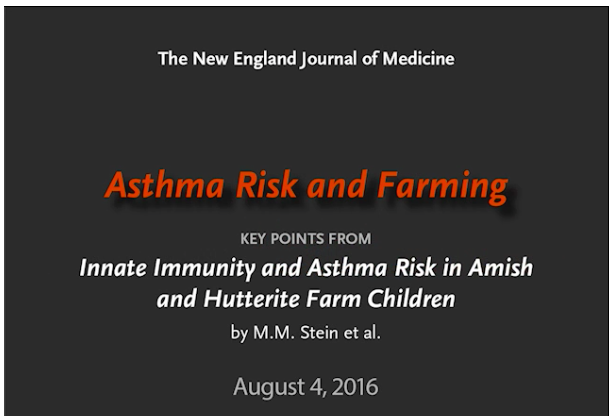
In my view, one of the most important pediatric studies this year was just published (reference below).  For a long time, it has been recognized that growing up on farms can reduce the likelihood of developing conditions like asthma, as well as inflammatory bowel disease (Related post: NYT: Educate Your Immune System | gutsandgrowth).  This study: Innate Immunity and Asthma Risk in Amish and Hutterite Farm Children provides an in depth assessment of 60 children and helps uncover the reason for these epidemiologic results.

Here’s the quick 2 minute summary: Innate Immunity and Asthma Risk in Amish and Hutterite Farm Children

Screen Shot 2016-08-05 at 9.13.14 AM


Bedtime in Preschool-Aged Children and Risk for Adolescent Obesity

An upcoming article (Journal of Pediatrics, (DOI: http://dx.doi.org/10.1016/j.jpeds.2016.06.005)shows an association between bedtime and the development of obesity:

Full-text link: Bedtime in Preschool-Aged Children and Risk for Adolescent Obesity

Abstract:

Objective

To determine whether preschool-aged children with earlier bedtimes have a lower risk for adolescent obesity and whether this risk reduction is modified by maternal sensitivity.

Study design

Data from 977 of 1364 participants in the Study of Early Child Care and Youth Development were analyzed. Healthy singleton-births at 10 US sites in 1991 were eligible for enrollment. In 1995-1996, mothers reported their preschool-aged (mean = 4.7 years) child’s typical weekday bedtime, and mother-child interaction was observed to assess maternal sensitivity. At a mean age of 15 years, height and weight were measured and adolescent obesity defined as a sex-specific body-mass-index-for-age ≥95th percentile of the US reference.

Results

One-quarter of preschool-aged children had early bedtimes (8:00 p.m. or earlier), one-half had bedtimes after 8:00 p.m. but by 9:00 p.m., and one-quarter had late bedtimes (after 9:00 p.m.). Children’s bedtimes were similar regardless of maternal sensitivity (P = .2). The prevalence of adolescent obesity was 10%, 16%, and 23%, respectively, across early to late bedtime groups. The multivariable-adjusted relative risk (95% CI) for adolescent obesity was 0.48 (0.29, 0.82) for preschoolers with early bedtimes compared with preschoolers with late bedtimes. This risk was not modified by maternal sensitivity (P = .99).

Conclusions

Preschool-aged children with early weekday bedtimes were one-half as likely as children with late bedtimes to be obese as adolescents. Bedtimes are a modifiable routine that may help to prevent obesity.

My take: Another potential reason to heed Samuel Jackson’s advice: Go the F- to Sleep (early)

Related blog posts:

Vickery Creek

Vickery Creek