Hemospray for GI Bleeding

From MD Mag: Gastrointestinal Bleeding Spray Gets FDA Marketing Go-Ahead

An excerpt:

 According to Wilson-Cook, Hemospray represents a different approach to treat GI bleeds by reaching hemostasis in patients without the precision or direct visualization required by competing treatments. This makes the device a treatment option for bleeding from damaged tissue where the bleeding source cannot be easily identified.

Hemospray is intended to treat most forms of upper or lower GI bleeding, and is backed by clinical evidence in more than 700 patients.

Its approval was supported by data from clinical studies that consisted of 228 patients with upper and lower GI bleeding, and real-world evidence from medical literature reports that featured another 522 similar patients. According to FDA review, the device stopped GI bleeding in 95% of patients with 5 minutes of its administration. Re-bleeding, as defined by a recurring event from 3-30 days after the use of Hemospray, occurred in 20% of all patients.

Pediatric Experience with Presumed Biliary Dyskinesia

A recent study (SR Matta et al. JPGN 2018; 66: 808-10) highlights the frequency of cholecystectomies for “presumed biliary dyskinesia” in the United States.

Using a nationwide inpatient database, the authors examined the indication for cholecystectomy in the pediatric population from 2002 to 2011.

Key findings:

  • During the study period, the authors identified 66,380 cholecystectomies in children.  The leading indications were calculus cholecystitis (73.6%), biliary dyskinesia (10.8%), and chronic cholecystitis without calculus.
  • The frequency of biliary dyskinesia as the indication for cholecystectomy jumped significantly during the study period, particularly the first few years: 6.6% (2002), 7.8% (2003), 9.8% (2004), 10.4% (2005 & 2006), 9.9% (2007), 11.8% (2008), 9.6% (2009), 11.9% (2010), and 10.6% (2011).
  • 75% of cases were children >12 years, and 77.5% were females.

The results from the study and the way that biliary dyskinesia is controversial are reviewed in the discussion.

  • A large proportion of biliary dyskinesia patients will develop symptoms suggestive of another functional GI disorder
  • Long-term resolution of symptoms with cholecystectomy is highly variable after surgery and “55-85% of  children with biliary dyskinesia will improve with medical management.”
  • Prospective studies are lacking, but some retrospective studies have recommended using lower cut off values for ejection fraction(eg. <15-% instead of <35%); whereas, other studies have shown no correlation between ejection fraction and outcomes.

My take: Sometimes a ‘quick fix’ is not a fix at all. As this study notes, it is difficult to rely on the diagnosis of biliary dyskinesia.  Many will improve without surgery and many develop divergent symptoms.

Related blog posts:

Big Creek Greenway, not far from McFarland

Esophageal Atresia and Barrett’s Esophagus

Briefly noted: FWT Vergouwe et al. Clin Gastroenterol Hepatol 2018; 16: 513-21.

In this prospective study of adult patients with esophageal atresia (EA) with 151 participants, 6.6% had Barrett’s Esophagus (BE); squamous cell cancer (SCC) was identified in 0.7% (youngest at 42 years).  The authors note that the prevalence of BE and SCC were ~4-fold and ~100-fold higher, respectively, compared to the general population.

Related blog posts:

Creek near Chattahoochee River

How Helicobacter pylori Survives in the Stomach

A recent basic science study (P Morey et al. Gastroenterol 2018; 154: 1391-1404) explains one of the mechanisms whereby Helicobacter pylori survives in the stomach.

The researchers used MKN45 gastric epithelial cells and human gastric cells obtained from patients undergoing gastric resections and exposed them to H pylori strains. They did additional studies in infected mice.

This report has a number of cool figures demonstrating that H pylori blocks the assembly of interferon and other cytokines.  Infected gastric cells were depleted of cholesterol which rendered them unable to respond properly to inflammatory signals from immune cells.  H pylori is able to decrease inflammation at sites of colonization while inducing inflammation in adjacent noninfected epithelium.  The authors note that patients with increased serum cholesterol (especially LDL) are at increased risk for severe H pylori gastritis.

Big Creek Greenway, Alpharetta

Button Battery -Update For Families

Children’s Healthcare of Atlanta Hope & Will blog: Common Batteries Pose Danger For Kids

Related blog posts:

Possible Quality Metric for Fatty Liver Disease: Dyslipidemia

With nonalcoholic fatty liver disease (NAFLD), it is well-documented that adverse cardiovascular events influence mortality more than any other factor.  Dyslipidemia plays an important role in these outcomes.

A recent study (KE Harlow et al. J Pediatr 2018; article in press. DOI: https://doi.org/10.1016/j.jpeds.2018.02.038) indicates that “clinically actionable dyslipidemia” is present in more than half of pediatric patients with NAFLD.

This multicenter, longitudinal cohort study included children (n=585) with NAFLD enrolled in the National Institute of Diabetes and Digestive and Kidney Diseases Nonalcoholic Steatohepatitis Clinical Research Network.

Key findings:

  • The prevalence of children warranting intervention for low-density lipoprotein cholesterol at baseline was 14%. After 1 year of recommended dietary changes, 51% achieved goal low-density lipoprotein cholesterol, 27% qualified for enhanced dietary and lifestyle modifications, and 22% met criteria for pharmacologic intervention
  • Elevated triglycerides were more prevalent, with 51% meeting criteria for intervention at baseline. At 1 year, 25% achieved goal triglycerides with diet and lifestyle changes, 38% met criteria for advanced dietary modifications, and 37% qualified for antihyperlipidemic medications.

My take: Assessing/managing dyslipidemia is an important component of NAFLD care.

Link to abstract: Clinically Actionable Hypercholesterolemia and Hypertriglyceridemia in Children with Nonalcoholic Fatty Liver Disease

Related blog posts:


Saline Shortages

Two interesting commentaries on the saline shortages:

  • M Mazer-Amirshahi, ER Fox. NEJM 2018; 378: 1472-4.
  • AM Patino et al.  NEJM 2018; 378: 1475-7.

The first explains that large quantities of saline bags are needed each month –more than 40 million bags per month!  While saline is inexpensive, the production requires meticulous care to avoid contamination and there have been supply issues since 2014, prior to Hurricane Maria.  However, the problem has been much worse since Hurricane Maria which damaged Puerto Rico.  Puerto Rico supplies 44% of the IV bags in the U.S.  These fluids are given to virtually all hospitalized patients, either for IV fluids or as a component with medications/flushes.

Other points:

  • “Drug manufacturers are not required to have redundancy in their facilities or even a business contingency plan in case of a disaster.”
  • The  FDA has “recently approved saline products from two additional manufacturers”
  • “To conserve large-volume saline bags, oral hydration is recommended.”

The article by Patino et al provides Brigham and Women’s Hospital Oral Rehydration protocol. Key points:

  • Using their protocol, the volume of IV fluid use decreased over 30% in the first week of implementation
  • The fraction of ED patients using IV fluids dropped by 15% in the first 3 weeks of implementation.
  • Oral hydration protocols are a “rational practice change…even after the current IV-fluid shortage crisis ends.”


Reliability of High Serology in Asymptomatic Celiac Disease

Another study (SP Paul et al. JPGN 2018; 66: 641-44) has shown that high anti-TTG IgA levels are reliable in establishing the diagnosis of celiac disease in asymptomatic children from high-risk groups. In this study with prospectively-collected data from 2007-2017, 84 of 157 children had anti-TTG titers >10x ULN.  75 of these 84 were from high-risk groups, mainly type 1 diabetes (36), and first degree relatives (24)

Key finding:

  • All 75 with high titers from high-risk groups had histologic evidence of celiac disease.

Related blog posts:

Related studyR Mandile et al. JPGN 2018; 66: 654-56. This prospective study showed that 19 of 35 (54%) patients with potential celiac disease had a complete clinical response on a gluten-free diet to symptoms like abdominal pain and diarrhea.  Thus, in many patients with potential celiac disease, a gluten-free diet will not be effective.

Related blog posts:


PEG 3350 is Not Associated with Elevated Glycol Levels

Everyday parents ask me if Miralax (polyethylene glycol) is safe; this has been driven by social media claims of neurotoxicity and by articles in the NY Times (see prior blog references) indicating that more testing is needed.

A recent study (KC Williams et al. J Pediatr 2018; 195: 148-53) examines one of the areas of concern, whether miralax could result in toxic levels of glycols.  In this study with 9 treated children (ages 6-12 years) and 18 controls, careful study of potentially toxic agents, ethylene glycol (EG), diethylene glycol (DEG), and triethylene glycol (TEG), were measured every 30 minutes for 3 hours after receiving 17 g of PEG 3350.

Key findings:

  • Baseline blood levels of EG (390.51 ng/mmL) and TEG (2.21 ng/mL) did not differ between control and treated groups
  • Baseline DEG levels were lower in the PEG 3350 group (40.12 ng/mL vs 92.83 ng/mL, P=.008)
  • After PEG 3350 dose, EG and TEG levels remained well below toxic levels; DEG levels did not change.  The increases in EG and TEG, which peaked at 90 minutes, were not sustained at levels different from controls.
  • EG peaked at 1032.8 ng/mL. TEG peaked at 35.17 ng/mL
  • The highest levels of EG and DEG were actually identified in control patients. Thus, “all children are exposed routinely and have measureable amounts in the blood.”

With regard to TEG toxicity, in the discussion, the authors note that, based on animal studies, “very large doses of TEG are needed to cause side effects.” Even doses of 4000 mg/kg of TEG daily for 90 days did not result in local or systemic toxicity.  The authors note that TEG concentration in PEG 3350 is “approximately 22.1-30.6 mcg per 17 gram dose of PEG 3350.”

With regard to EG and DEG, “the average EG and DEG content of the PEG samples in this study were a 100 and 800 times less, respectively, than this required 0.2% cutoff” [FDA limit].  The agency of Toxic Substances and Disease Registry profile for EG, has indicated that “EG blood levels greater tan 0.2 mg/mL are needed for acute toxic poisoning.  The average level of EG at the 90-minute peak of 1100 +/- 350 ng/mL was 182 times lower than this level.”  For chronic exposure EG toxicity, the authors estimate that one would need to take “40 capfuls [17 gram each] of PEG 3350 per day for up to a year.”  The EPA also has advisories with regard to EG.  To achieve toxic levels for a 10-kg child, this would necessitate that the child “would have to drink 1 L of water with 50 capfuls (858 g) in 1 day or 15 capfuls (258 g) per day for 10 days.”

An important limitation of this study is that there may be other metabolites that are not measured that could cause neurotoxicity.

My take: This study shows that the theoretical risk of glycol toxicity is highly unlikely.  My advice for miralax usage: (borrowed from expert review): “Generally speaking, if your child has been prescribed PEG 3350 as part of his/her treatment plan, and you feel this medicine provides benefit, you should feel safe continuing PEG 3350. At this time, PEG 3350 appears to be safe based on current medical literature. We recommend discussing any concerns you have about the safety of PEG 3350 with your child’s health care provider. If you would prefer for your child to stop taking PEG 3350, discuss other treatments options with your child’s health care team before stopping PEG 3350 therapy. Although abruptly stopping PEG 3350 is not considered dangerous, it could lead to a relapse/worsening of constipation.”

Disclaimer: These blog posts are for educational purposes only. Specific dosing of medications/diets (along with potential adverse effects) should be confirmed by prescribing physician/nutritionist.  This content is not a substitute for medical advice, diagnosis or treatment provided by a qualified healthcare provider. Always seek the advice of your physician or other qualified health provider with any questions you may have regarding a condition.

Related blog posts:

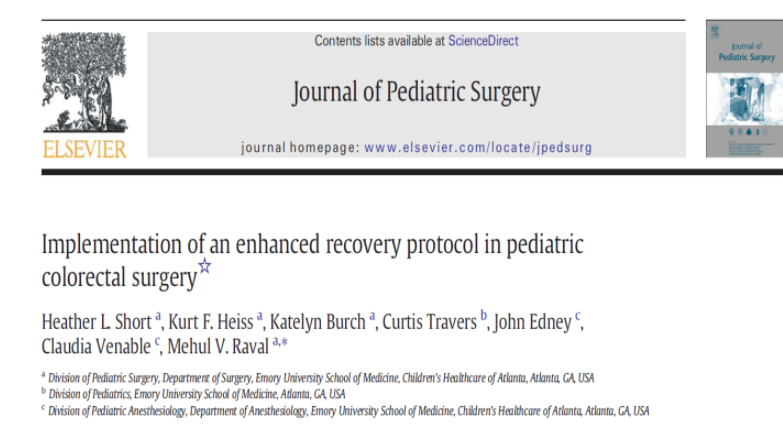
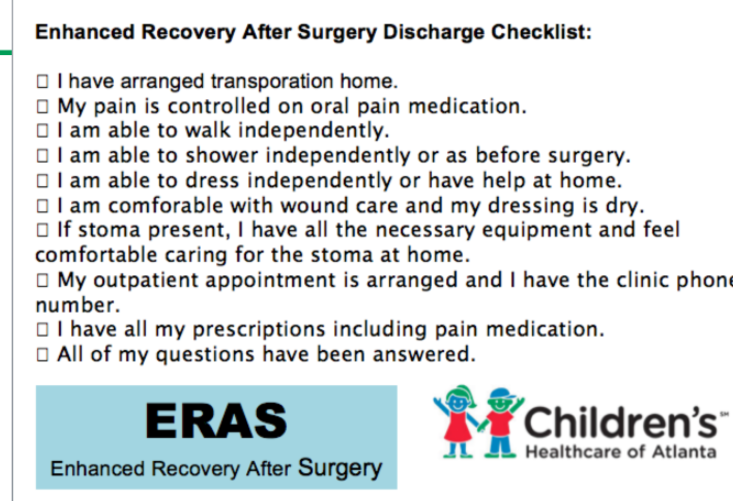
Fast Track Recovery/Enhanced Recovery After Surgery (ERAS is Awesome!)

At a recent ImproveCareNow population management meeting for our group, Dr. Kurt Heiss provided an update on the expanding use of ERAS.  In addition to colorectal surgery, uses at our hospital system have included bariatric surgery, craniofacial surgery, and umbilical hernia repairs. The results of this bundled care show fewer complications, less pain/less narcotics (more blocks), and shorter hospital stays (without increased readmission rates).

For those who are not as familiar as they would like (and for patients), I recommend a 7 minute Lego ERAS YouTube link: LEGO Surgery -Enhanced Recovery After Surgery

Related blog post: ERAS -Enhanced Recovery After Surgery (2016) With full slide set explaining ERAS further