Advancements in Pediatric Cholestatic Liver Disease Management

KR Mysore et al. J Pediatr Gastroenterol Nutr. 2025;80:549–558. Recent advances in the management of pediatric cholestatic liver diseases

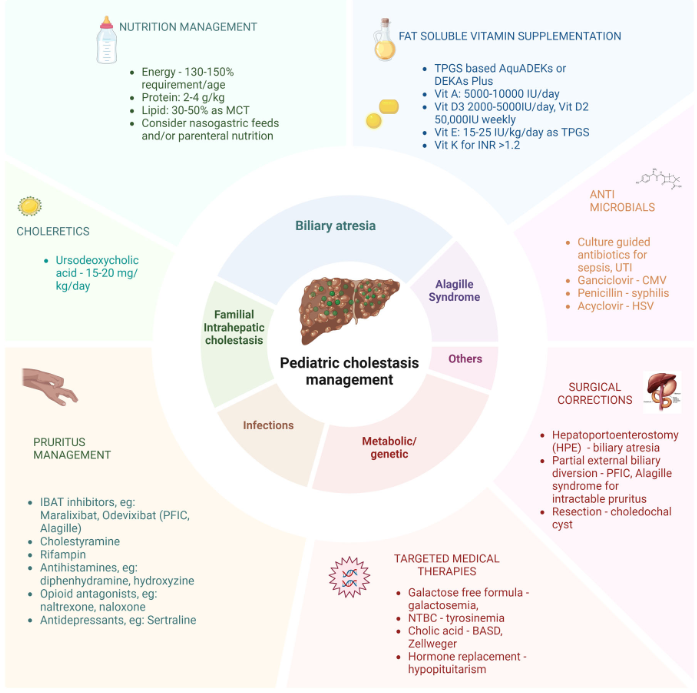
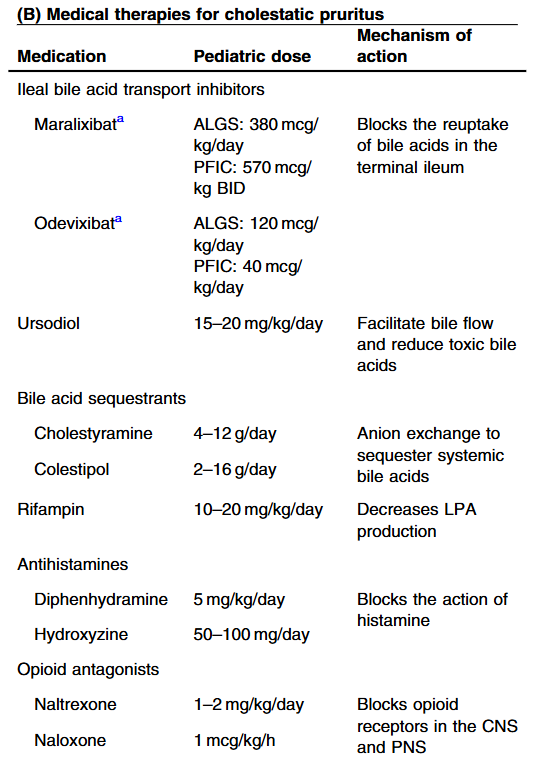
This is a useful review summarizing advances in the management of cholestatic diseases.

Treatment with IBAT inhibitors:

“Improvement in both pruritus and serum BAs/bilirubin levels has been associated with improved event‐free survival and 6‐year transplant‐free survival in ALGS patients treated with maralixibat. Additionally, this class of medication improved overall growth of the patient by improving mean height and weight Z scores that may be related to reduced impact of high serum bile acid levels on the growth axis although further studies are needed to better define the mechanism responsible for this out-come. This finding suggests these parameters could be used as surrogate end‐points for disease severity in diseases like ALGS or PFIC, where the time course to develop the need for LT commonly occurs over many years.”

Related blog posts:

Disclaimer: This blog, gutsandgrowth, assumes no responsibility for any use or operation of any method, product, instruction, concept or idea contained in the material herein or for any injury or damage to persons or property (whether products liability, negligence or otherwise) resulting from such use or operation. These blog posts are for educational purposes only. Specific dosing of medications (along with potential adverse effects) should be confirmed by prescribing physician.  Because of rapid advances in the medical sciences, the gutsandgrowth blog cautions that independent verification should be made of diagnosis and drug dosages. The reader is solely responsible for the conduct of any suggested test or procedure.  This content is not a substitute for medical advice, diagnosis or treatment provided by a qualified healthcare provider. Always seek the advice of your physician or other qualified health provider with any questions you may have regarding a condition.
Relooking at 6-Year Data of Maralixibat for Alagille Syndrome

BE Hansen et al. Hepatology 2024; 79: 1279-1292. Open Access! Event-free survival of maralixibat-treated patients with Alagille syndrome compared to a real-world cohort from GALA

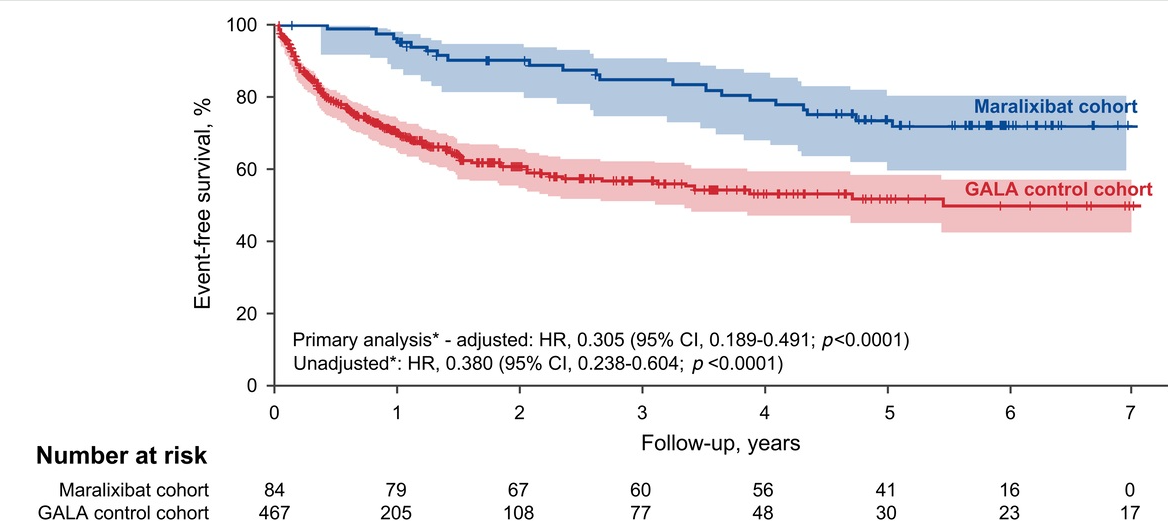
This study compared “6-year outcomes from maralixibat trials with an aligned and harmonized natural history cohort from the Global ALagille Alliance (GALA) study.”

Based on a quick review, some the data appears to overlap a recent report in the same journal: RJ Sokol et al. Hepatology 2023; 78: 1698-1710. Open Access! Predictors of 6-year event-free survival in Alagille syndrome patients treated with maralixibat, an ileal bile acid transporter inhibitor (See blog post: Six Year Data for IBAT Inhibitor Treatment for Alagille Syndrome).

In the current study, “event-free survival, defined as the time to first event of manifestations of portal hypertension (variceal bleeding, ascites requiring therapy), surgical biliary diversion, liver transplant, or death, was analyzed by Cox proportional hazards methods.”

Key findings:

  • Event-free survival in the maralixibat cohort (n=84) was significantly better than the GALA cohort (n=469) (HR, 0.305)
  • Transplant-free survival showed similar results (aHR, 0.33)

In their discussion, the authors note that much of the improvement in event-free survival is due to improvement in pruritus which is a main indication for liver transplantation. They speculate that improvement in event-free survival is also related to more broad-based clinical improvement (observed in ICONIC study), perhaps due to reduction in retained hepatic bile acids.

One of the limitations, reliance on a historical control, is discussed. “Historical control comparison is useful when there are ethical concerns regarding the recruitment of patients for long-term control arms requiring several years of study in life-threatening or debilitating diseases.”

My take: In this real-world comparison, Maralixibat, clearly was associated with improved outcomes. How much of this was due to relief of intractable pruritus and how much of this may be due to other biologic factors remains uncertain.

Related blog posts:

Six Year Data for IBAT Inhibitor Treatment for Alagille Syndrome

RJ Sokol et al. Hepatology 2023; 78: 1698-1710. Open Access! Predictors of 6-year event-free survival in Alagille syndrome patients treated with maralixibat, an ileal bile acid transporter inhibitor

In this study, the authors examined 43 potential predictors of outcomes in pediatric patients (n=76) treated with maralixibat (MRX). The median duration of MRX treatment was 4.7 years. Key findings:

  • There were 10 liver transplantations, 3 decompensations, 2 deaths, and 1 surgical biliary diversion; thus, 16/76 (21%) had liver-related events.
  • The 6-year event-free survival improved with a clinically meaningful >1-point ItchRO(Obs) reduction from baseline to W48 (88% vs. 57%; p = 0.005), W48 bilirubin < 6.5 mg/dL (90% vs. 43%; p < 0.0001), and W48 serum bile acid < 200 µmol/L (85% vs. 49%; p = 0.001). These parameters were also predictive of 6-year transplant-free survival.
  • In this cohort, younger children (<36 months) fared worse, though this was likely related to selection bias as they had more severe cholestasis. In the discussion, the authors note that in their cohort, “there is a survivor bias such that older children are inherently healthier or they would have already undergone transplantation.”
  • Improved event-free survival could be largely related to symptomatic improvement. Many kids with Alagille require transplantation due to refractory pruritus. Since this study did not include histology or noninvasive techniques to assess hepatic fibrosis, it is unclear if there was also improvement in underlying liver function/fibrosis subsequent to reduction in toxic bile acid retention.
  • 46/76 (61%) had improvement in pruritus, 52/76 (68%) had improvement in bilirubin, and 56/76 (74%) had improvement in serum bile acids.

In their discussion, the authors note that in the GALA study, “which included natural history data from >1400 patients, 358 patients required a liver transplant, with 69% being transplanted for intractable pruritus.4

My take: In patients with moderate to severe pruritus, patients who respond to IBAT inhibitors are likely to have improvement in important clinical outcomes.

Related blog posts:

IQ and Pediatric Chronic Liver Disease

DH Leung et al. JPGN2022 – Volume 74 – Issue 1 – p 96-103. Neurodevelopmental Outcomes in Children With Inherited Liver Disease and Native Liver

In this longitudinal study, the authors evaluated Full Scale Intelligence Quotient (FSIQ) in children with chronic liver disease (mean age 7.6 yrs). Key finding:

  • Patients with Alagille syndrome (ALGS) are at increased risk of lower FSIQ (with 29% <85), whereas our data suggest A1AT and PFIC are not

Related blog posts: