NASPGHAN Paper: Dietary Management in Pediatric Aerodigestive and GI Dysmotility

K El-Chammas et al. J Pediatr Gastroenterol Nutr. 2026; 83: 748-760. Dietary management and feeding considerations of pediatric aerodigestive and upper gastrointestinal motility disorders.

Oropharyngeal dysphagia (OPD):

  • “Untreated OPD (either penetration and/or aspiration) is associated with persistent symptoms, recurrent respiratory infections, elevations in pulmonary inflammatory markers, and even bronchiectasis”
  • “Because >80% of pediatric aspiration is silent, the presence of symptoms at the time of an aspiration event should not be the determining factor when considering thickening”
  • “Most infants with OPD and aspiration experience improvements in swallow function over time, and thickeners/delivery vehicles can be weaned or changed as swallow function, palate, and caloric needs change. Antegrade aspiration is unlikely to be seen in neurodevelopmentally normal children older than 2 years of age exhibiting persistent lower respiratory tract infections”
  • Table 2 lists common thickeners and key differences. In infants, cereals and gelmix (if >37 weeks gestational age) are recommended. In older age groups, xanthan gum (SimplyThick®), Corn starch (Thick-It®), Tapioca starch, and Tara gum (PuraThick®) are options.
  • “Thickening gastrostomy tube feeds either with commercial thickeners or food improves GI and pulmonary outcomes and reduces the number of gastroesophageal reflux events without prolonging gastric emptying”
  • Table 3 provides specific recommendations including the following: ‘The recommended thickener for formula-fed infants younger than 1 year of age is cereal or purées. Commercial thickeners may be an option for some expressed breast milk- or formula-fed infants under the age of 1 year without comorbidities, depending on institutional practices.”

Esophageal Dysmotility

This section reviews several disorders including achalasia, gastroesophageal reflux, and esophageal atresia.

  • Reflux: In infants with reflux, “thickening of feeds can reduce overt symptoms such as vomiting but does not decrease reflux events.” Also, in this population, “a trial of maternal cows’ milk elimination, extensively hydrolyzed or amino-acid based formulas (in more severe cases with intractable symptoms) may be appropriate”
  • Achalasia: “There are no clear guidelines on the management of feedings in pediatric or adult patients with achalasia…Patients should be encouraged to eat in an upright position and to minimize eating for several hours before bedtime. A liquid or purée may be required with the guidance of a dietitian to ensure adequate nutritional intake while waiting for the diagnosis and definitive management of achalasia”
  • Esophageal atresia: “Only 28% of children with EA are consuming age‐appropriate food textures within the first 2 years of life, with that improving to 70% of children over 5 years of age…Many infants with EA require gastrostomy tube placement because they cannot safely tolerate oral feeding or meet caloric requirements”
  • Table 4 summarizes recommendations for esophageal dysmotility, including “children with esophageal dysmotility should avoid foods with a high risk for esophageal obstruction/irritation, eat in an upright position, and avoid eating several hours before bedtime”

Gastric Dysmotility

  • “Most pediatric cases are idiopathic or post-viral, with less common causes being drug-induced or post-surgical”
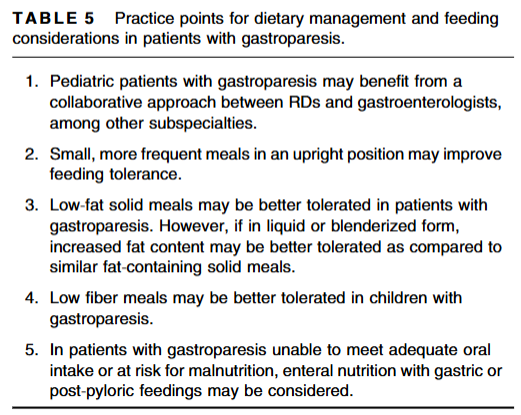
  • “While dietary modification is often considered first-line therapy in patients with mild gastroparesis, it often results in suboptimal improvement in symptoms in clinical practice. Small, frequent meals and maintaining a post-prandial upright position may be better tolerated.74, 75 Liquids typically empty from the stomach faster than solids76; therefore, increasing liquid calories and switching from solid to liquid calories later in the day may help patients with their symptoms.”
  • “Fatty, acidic, spicy, and high-fiber foods can exacerbate symptoms in patients with gastroparesis as they delay gastric emptying, exacerbate pain, and promote release of cholecystokinin”
  • “Small-particle diets, consisting of puréed, blended, or finely ground foods, facilitate gastric emptying by reducing mechanical workload on the stomach”
  • “Caution is advised when initiating enteral or parenteral nutrition in patients with gastroparesis given the significant overlap with functional dyspepsia and increased prevalence of feeding intolerance in adolescents with disorders of gut–brain interaction”
  • “In aerodigestive patients with upper gut dysmotility and feeding intolerance, gastrostomy and/or post-pyloric tube placement may provide access to decompress as well as provide nutrition when oral feeding is inadequate to sustain appropriate growth and symptom control”
  • “Blenderized tube feeds may be considered over commercial formulas to help with symptoms, decrease healthcare utilization, and improve quality of life…The American Society for Parenteral and Enteral Nutrition recently published detailed practice recommendations (L Epp et al. Nutr Clin Pract. 2023; 38(6): 1190-1219) providing guidance to medical providers and family pertaining to the use of BTFs regardless of their indication”
My take: This is a useful article regarding potential dietary interventions across a wide range of pediatric GI disorders. Just like medications, dietary interventions can result in complications. As such, the involvement of experienced dietitians and careful follow-up are needed.

Related blog posts:

Dysphagia:

Esophageal dysmotility:

Blenderized Diets:

Gastroparesis:

Data Insufficient to Recommend Immobilized Lipase Cartridge Use in Children with Short Bowel Syndrome

E Khenner et al. J Pediatr Gastroenterol Nutr. 2026;82:1488–1494. Open Access! Retrospective chart review of immobilized lipase cartridge use in children with short bowel syndrome

***Three of the authors of this study are/were employed or receive research support from Alcresta Therapeutics, Inc.

This small retrospective single-center study reports the use of in-line immobilized lipase cartridges (ILC) in 14 patients; 10 were PN-dependent, and four had enteral autonomy (Table 1). The mean age at the start of ILC use was 6 years (range 2–15 years). Mean estimated residual small bowel length was 66 cm (range 11–190 cm; n = 13). Eight patients received peptide-based EN and 6 elemental EN, typically delivered over 12–24 h.

Key findings:

  • In 9 PN-dependent patients (with Type II or III SBS), mean PN use at baseline was 45.3 kcal/kg/day (59% of supplemental nutrition). At final follow-up, mean PN use decreased by 10.6 kcal/kg/day (15.5%) and mean EN use increased by 6.0 kcal/kg/day (39.9%) after 3.8 to 23.9 months of ILC use.
  • In 4 patients with enteral autonomy (all Type III SBS), mean weight z-score improved by 0.60 and mean EN use decreased by 6.9% after 2.7 to 5.3 months of ILC use. The decrease from baseline in mean EN use at final follow-up was driven by data from one patient (#12) who had poor compliance with tube feeding.
  • None of these changes are statistically significant.

Discussion:

  • “There are limitations to ILC use in children with SBS: not all SBS patients receive EN, bolus feeding with ILC is limited to flow rates ≤400 mL/h, and ILC is not compatible with high fiber enteral formulas.6“
  • “Blenderized tube feeding is becoming the preferred method of enteral feeding in pediatrics.17 Although the use of blenderized tube feeds in children with SBS is associated with improved GI symptoms as well as a reduction in PN dependence, some patients experience intolerance or lack of weight gain.18, 19“
  • The authors conclusions: “ILC offers a low-risk option to potentially advance enteral autonomy or weight gain in some children with SBS.”

My take: I am not convinced that ILC is worthwhile for pediatric patients with SBS. I have received questions about this from our neonatal colleagues. When I have questioned leaders of several intestinal rehab centers, they have stated there is no solid data supporting its use. When I have asked the manufacturer to provide data in children with SBS less than two years of age, I have heard no response. The cost (without insurance) likely exceeds $9,000/month if using two ILCs per day. The use of this expensive product needs to be carefully evaluated in a prospective randomized trial.

Related blog posts:

BAPS Shri Swaminarayan Mandir, Atlanta (Hindu Temple)

Disclaimer: This blog, gutsandgrowth, assumes no responsibility for any use or operation of any method, product, instruction, concept or idea contained in the material herein or for any injury or damage to persons or property (whether products liability, negligence or otherwise) resulting from such use or operation. These blog posts are for educational purposes only. Specific dosing of medications (along with potential adverse effects) should be confirmed by prescribing physician. Because of rapid advances in the medical sciences, the gutsandgrowth blog cautions that independent verification should be made of diagnosis and drug dosages. The reader is solely responsible for the conduct of any suggested test or procedure. This content is not a substitute for medical advice, diagnosis or treatment provided by a qualified healthcare provider. Always seek the advice of your physician or other qualified health provider with any questions you may have regarding a condition

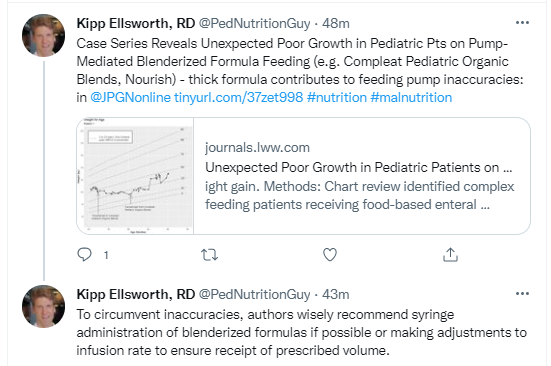
Fix the Feeding Pump, Don’t Call DFACs

J David et al. JPGN 2021; 73: 599-603. Unexpected Poor Growth in Pediatric Patients on Food-based Enteral Therapy: Case Series and Suggested Practice Changes

In this chart review with five patients, weight loss occurred when patients received only a fraction of their feeds due to feeding pump inaccuracy.

Related blog posts:

Real Foods in Short Gut Kids

Screen Shot 2016-08-17 at 7.31.27 AM

 Reference from Kipp Ellsworth:

Transition to a Tube Feeding Formula With Real Food Ingredients in Pediatric Patients With Intestinal Failure K Samela et al. NCP: Published online before print August 4, 2016, doi:10.1177/0884533616661011

Abstract: Due to concerns related primarily to allergic response and malabsorption, enteral nutrition therapy has traditionally relied on the use of elemental formulas in children with intestinal failure (IF). Blended food diets via a gastrostomy tube have been reported to improve feeding tolerance in pediatric populations receiving long-term enteral nutrition therapy. Complex macronutrients have been shown to stimulate intestinal adaptation in animal models. We report on our experience in children with IF who had an overall improvement in stool output when transitioned from an elemental formula to a tube feeding formula with real food ingredients (TFRF). Data were collected in a retrospective chart review of children with IF, >1 year of age, who were receiving enteral nutrition via continuous infusion, bolus feeding, or both. Indications for the TFRF trial were diarrhea or inconsistent stooling patterns. Ten children with a mean small bowel length of 48.3 cm were trialed on TFRF. Nine of 10 (90%) children tolerated the transition to 100% TFRF, of which 7 of 9 (78%) had their entire colon in continuity. The average age at successful transition was 29.2 months, and the average length of time to transition to 100% TFRF was 67.3 days. TFRF is well tolerated in children >1 year of age with IF; it also improves their stooling patterns. A commercially available TFRF is a cost-effective and nutritionally adequate means of providing nutrition to this patient population.


Pediatric Nutritionist/Scott Pentiuk: Update on two topics: Blenderized diets and Eosinophilic Esophagitis

From the Pediatric Nutritionist blog –two lectures from Dr. Scott Pentiuk:

Two Lectures: Blenderized diets and Eosinophilic esophagitis

These lectures feature a lot of useful references and practical advice.

Related blog posts:

Shem Creek, SC

Shem Creek, SC


Pediatric Nutritionist: Blenderized & Pureed Gtube Diets

A recent Children’s Healthcare of Atlanta Nutrition Support Colloquium provided a terrific update on the use of blenderized and pureed diets via gastrostomy tube.

Here’s the link to the talk (including slides) and a summary on the Pediatric Nutritionist blog site: The Blenderized and Pureed by Gtube Diets

I’ve found these diets to be particularly useful in children with retching.  In addition, these diets can lower costs, reduce other symptoms like constipation, and appeal to parents who desire more typical foods in their child’s diet.

Related blog post: Nutrition University -Part 1 | gutsandgrowth

Gibbs Gardens

Gibbs Gardens


Nutrition University -Part 1

While issues with nutrition are ubiquitous, among the three areas of expertise for pediatric gastroenterologists (gastroenterology, hepatology, and nutrition), it does seem that nutrition expertise receives the least interest overall.  One effort to work on this is Nutrition University (N2U) sponsored by NASPGHAN/NASPGHAN foundation.

This is the first year in which the program has been opened up to physicians who have been in practice for more than 10 years and I am looking forward to a great review. Prior to attending, the participants were asked to review previous N2U modules which are available at NASPGHAN website: 2012 N2U Course ( a good source for CME as well).

This year’s syllabus: 2015 N2U Syllabus & Presentations (posted with permission from course organizers).

Last night the meeting started off with some comments by Praveen Goday (Praveen’s training in Cincinnati overlapped with mine) who has spearheaded this effort; subsequently the faculty addressed previously submitted attendee questions.

Here’s a sampling:

Should we be recommending a low FODMAPs diet for IBS? Rob Shulman indicated that about ~70% of adults responded in one study and that a similar study in children at Baylor College of Medicine produced similar results.  However, the diet is difficult and help from a dietician/nutritionist is needed.  If there is not a response in 7-10 days, then it is likely to be ineffective.

What should be the first formula for Cow’s Milk allergy/intolerance in infancy? The recommendation for most infants (not the very sickest) was to start with a hydrolysate formula which should be effective in more than 90%.  It was suggested that amino acid based formulas be reserved for hospitalized infants and those who do not respond to hydrolysates.

What about fish oil enterally or parenterally? James Heubi(*) noted that a lot more data is needed but fish oil either enterally or parenterally may be beneficial.  Rob Shulman commented that recent work indicates that vitamin E may be an important reason why fish oil could be better than soy-based lipid emulsions.

How practical are blenderized diets for gastrostomy fed children? Catherine Karls noted that the general goal is to provide nutrients which mimic the commercial formulas but there are many important caveats for DIY (do-it-yourself formula).

  • An RD needs to supervise to assure all micronutrient needs are being met.  Using computer programs, this facilitates calculating dietary reference intakes (DRIs).
  • Many parents prefer as homebrews are perceived as more natural or holistic
  • Some children have better tolerance (eg. volume-sensitive, patients with retching)
  • Drawbacks: time commitment, additional costs (though may be cheaper for some), and concerns regarding food safety
  • Homebrews are not recommended for jejunostomy feeds (gastrostomy only) or for those with small-caliber feeding tubes (needs to be at least 14 Fr)
  • Don’t use without the assistance of an RD!

Which is better for NAFLD -low carb or low fat? Ann Scheimann stated that this question is misleading –it is a lot more complicated.  It depends on the carbs and it depends on the fat.  Fructose clearly worsens NAFLD but so does a diet high in animal fat.

What are the nutritional management recommendations for acute pancreatitis? Justine Turner indicated that too many centers continue to rely on parenteral nutrition.  Yet, guidelines recommend the use of enteral nutrition due to lower risk of poor outcomes (eg. infections when NPO and on parenteral nutrition). ‘Resting pancreas is not helpful.’ With acute pancreatitis, enzyme secretion is reduced.  Her approach is to start nasogastric (NG) feedings at about 24 hours after presentation, as long as hemodynamically stable.  She indicated that nasojejunal (NJ) feedings can be done if NG is not well-tolerated.  NJ feedings are effective at reducing enzyme secretion.  However, Praveen Goday stated that his practice was often starting with NJ feeds.  “Sometimes there is only one shot” before the ICU team starts HAL.  Both physicians indicated that polymeric formulas were probably acceptable; however, starting with semi-elemental or elemental feedings are often done, again as a practical matter to minimize the likelihood of reverting to parenteral nutrition.

What is the advice regarding children who need far less than typical calories for weight (eg. wheelchair-bound inactive child)? Generally all nutrients are being met if a child less than 10 years is receiving 4 cans of commercial formula. For children 10 and older, receiving 6 cans per day should ensure adequate nutrients.  For those who fall below this threshold, several options:

  • Reduced calorie formula (eg. Pediasure Sidekicks, Compleat Reduced) are approximately 0.6 cal/mL but have all the other nutrients
  • Supplementation: multivitamin, calcium, phosphorus, protein
  • Need to meet at least 80% of typical fluid needs, thus not much rationale for 2 cal/mL formulas. As a practical matter, if the child is urinating well, they are receiving enough fluids.

*I was fortunate to have Jim as an attending during my fellowship at Cincinnati. In fact, even before then, Jim interviewed me when I was considering Cincinnati for my pediatric residency.  He is a terrific person and amazing to work with.

Disclaimer: This blog entry has abbreviated/summarized this presentation. Though not intentional, some important material is likely to have been omitted; in addition, transcription errors are possible as well.

These blog posts are for educational purposes only. Specific dosing of medications/diets (along with potential adverse effects) should be confirmed by prescribing physician/nutritionist.  This content is not a substitute for medical advice, diagnosis or treatment provided by a qualified healthcare provider. Always seek the advice of your physician or other qualified health provider with any questions you may have regarding a condition.