High Rates of Denying Medical Care for Medicaid Patients Managed by Health Insurers

7/19/23 NY Times: Insurers Deny Medical Care for the Poor at High Rates, Report Says

Some excerpts:

Private health insurance companies paid by Medicaid denied millions of requests for care for low-income Americans with little oversight from federal and state authorities, according to a new report by U.S. investigators published Wednesday.

Medicaid, the federal-state health insurance program for the poor that covers nearly 87 million people, contracts with companies to reimburse hospitals and doctors for treatment and to manage an individual’s medical care. About three-quarters of people enrolled in Medicaid receive health services through private companies, which are typically paid a fixed amount per patient rather than for each procedure or visit.

The report by the inspector general’s office of the U.S. Department of Health and Human Services details how often private insurance plans refused to approve treatment and how states handled the denials.

Doctors and hospitals have increasingly complained about what they consider to be endless paperwork and unjustified refusals of care by the insurers when they fail to authorize costly procedures or medicinesThe investigators also raised concerns about the payment structure that provides lump sums per patient. They worried it would encourage some insurers to maximize their profits by denying medical care and access to services for the poor...

The investigators emphasized the insurers were much more aggressive in refusing to authorize care under Medicaid than under Medicare…Unlike with Medicare, if an insurer refuses to authorize a treatment, patients are not automatically provided with an outside medical opinion as part of their appeal...

The investigators also found that state oversight of coverage denials was lax. Many states do not routinely examine the insurers’ denials nor collect information about how many times a plan denies requests for prior authorization...

The denial rates recorded by the investigators varied widely by insurer and by state.

My take: This is more evidence of the distorted incentives in U.S. healthcare where health insurance companies profit when patients are denied beneficial care.

Related blog posts:

Le Jardin Exotique, Eze France
Narrow walkways in Eze, France

Picking the Wrong Health Insurance Policy

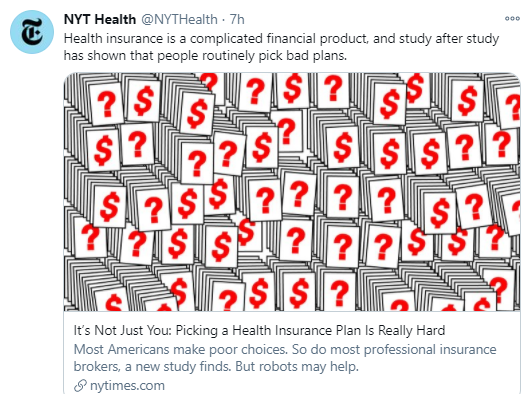
NY Times: It’s Not Just You: Picking a Health Insurance Plan Is Really Hard

An excerpt:

Health insurance is a complicated financial product, and study after study has shown that people routinely pick bad plans, even choosing options that leave them worse off financially in every possible scenario…

 Many Americans don’t understand terms like “deductible” or “coinsurance” very well. And few are good at predicting what sort of health care needs they will have in the coming year…

A recent study in the Netherlands, which offers insurance to everyone through an Obamacare-like marketplace, found that only 5 percent of Dutch customers did a better job at choosing an ideal plan than they would have by choosing a plan at random… People with less education and income, who tend to be in worse health, were very likely to choose a plan that cost them more to cover their health care — a situation that might leave them skimping on needed medicine or procedures.

My take: This article is so true. When I choose health insurance, this is always a complicated task despite my familiarity and expertise. I would expect that computer-aided decision-making could be developed and be helpful.

Related blog posts:

Trick or Tweets?

Rock art
This tweet was posted on 10/21/20
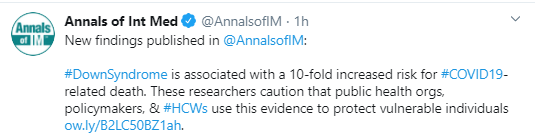
Ful Text Link: COVID-19 Mortality Risk in Down Syndrome: Results From a Cohort Study Of 8 Million Adults
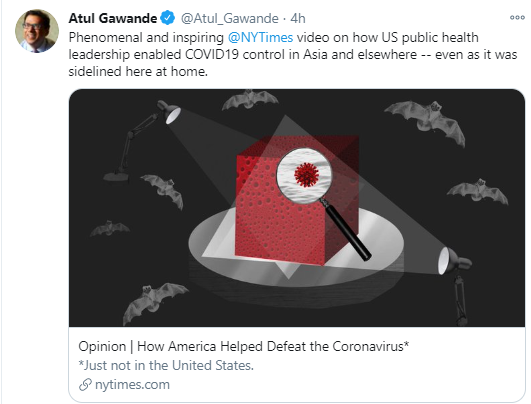
15 min video Link: How America Helped Defeat the Coronavirus* (not in U.S.). an excerpt: We’ve all heard how U.S. leadership failed its citizens with its pandemic response. We had the playbooks, we had the money, we had the experts. We just … didn’t use them. But it turns out, other countries did. Because U.S. public health leaders and scientists have been planning for a catastrophe just like Covid-19 for decades, and, in typical American fashion, we didn’t just write the pandemic playbook — we exported it around the world.

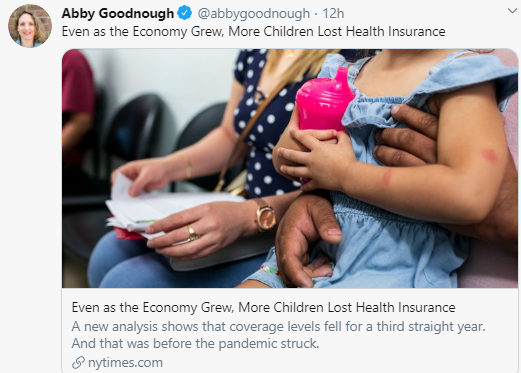
Newsworthy Tweets: Climate Change, Sugary Beverage Laws, Increasingly Uninsured Children, and Flu Vaccine Effectiveness

Climate change:

Related blog posts:

Sugary beverage Law:

Related blog posts –Sugary Beverages/Diet:

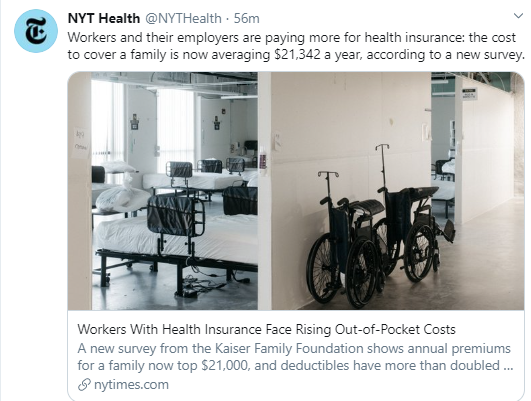
Related blog posts –Health Insurance:

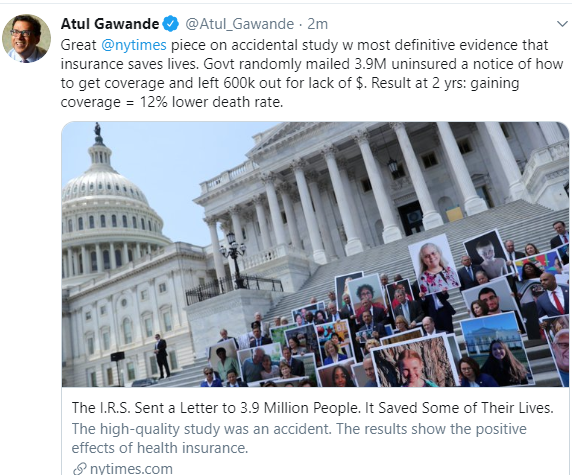
How The IRS Proved That Health Insurance Saves Lives

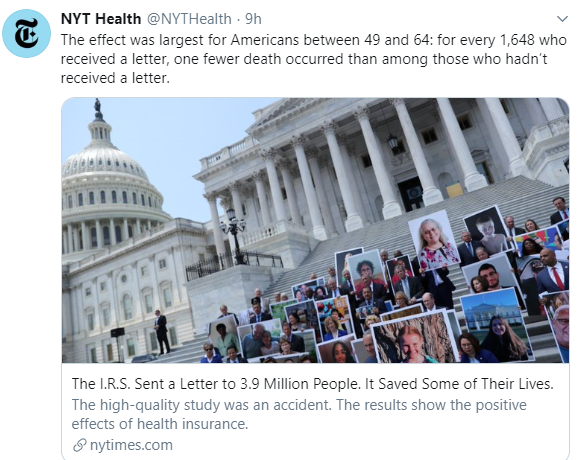
NY Times: The I.R.S. Sent a Letter to 3.9 Million People, It Saved Some of Their Lives

Recently, economists have shown that an I.R.S. letter encouraging people to sign up for health insurance saved lives.  This letter was an inadvertent randomized trial as 600,000 people who were eligible for the letter did not receive it due to a budget shortfall.

An excerpt:

Three years ago, 3.9 million Americans received a plain-looking envelope from the Internal Revenue Service. Inside was a letter stating that they had recently paid a fine for not carrying health insurance and suggesting possible ways to enroll in coverage…

Obtaining insurance… reduced premature deaths by an amount that exceeded any of their expectations. Americans between 45 and 64 benefited the most: For every 1,648 who received a letter, one fewer death occurred than among those who hadn’t received a letter.

In all, the researchers estimated that the letters may have wound up saving 700 lives…

The results also provide belated vindication for the much-despised individual mandate that was part of Obamacare until December 2017, when Congress did away with the fine for people who don’t carry health insurance…

The uninsured rate for Americans is rising for the first time in a decade, as states tighten eligibility rules for Medicaid, and as the Trump administration cuts back on health care outreach…

Previous research has found a link between expanded health insurance access and fewer deaths. Multiple studies showed a decline in mortality rates after states expanded Medicaid, but none could tie the outcome directly to the policy change, since states typically cannot randomly pick which residents do and don’t receive Medicaid. That makes the Treasury experiment, an unintended result of a budget shortfall, distinctively useful.

My take: This analysis shows that prompting health care coverage by sending a single letter can save lives.  It is unfortunate that we are currently heading in the opposite direction.

Related blog posts:

A Leading Cause of Mortality in U.S….

Being uninsured.  A recent article in Annals of Intern Medicine (2014; 160: 585-93) explored the reduction in mortality associated with expansion of Medicaid.

Key result: “Reform in Massachusetts was associated with a significant decrease in all-cause mortality compared with the control group (−2.9%; P = 0.003, or an absolute decrease of 8.2 deaths per 100 000 adults).”  The control group consisted of similar patients from other states.

An editorial (advbd.co/1lWHfsu) on this subject (from Atul Gawande retweet), notes the following: “The takeaway: Every 830 additional people who got insurance under Massachusetts’ health reforms prevented roughly one death….

A 2012 Urban Institute report estimated that 15.1 million uninsured adults could gain coverage if every state expanded Medicaid. Using the 830 figure from the Massachusetts study, and acknowledging that the state’s coverage wasn’t exactly equivalent to Medicaid, that would translate to 18,193 deaths prevented per year.

For a sense of comparison—that would make the Medicaid coverage gap the number five leading cause of preventable death in the United States

1 “Medicaid Coverage Gap” based on 2012 estimate; other causes based on 2010 data.

Bottomline: Not having health insurance can be very bad for your health.

Related blog post:

45,000 Unnecessary Deaths Per Year | gutsandgrowth