More Cognitive Problems, Worse Outcomes with Hirschsprung’s Disease

H Gagnon et al. JPGN 2023; 77: 592-596. Short and Long-Term Outcomes in Hirschsprung Disease: Are the Syndrome-Associated Patients Really Doing Worse?

In this retrospective single-center study with 76 pediatric patients with Hirschsprung’s disease (HD), the authors compared the outcomes of those who had associated syndromes (or neurocognitive issues) (SA-HD, n=24) to those with isolated (I-HD, n=52). Most patients had undergone a Soave procedure (n=67). Only 11 patients were available for followup data at 10 years of age.

Key findings:

  • SA-HD patients became bowel continent at a significantly older age (mean age 8.43 vs 4.94 years)
  • SA-HD patients had urinary incontinence at a significantly older age (P = 0.0136, 5 years)
  • SA-HD patients had more constipation at all ages: at age 3 years (29% vs 17%), at age 5 years (55% vs 22%), and at 10 years (83% vs 20%)
  • SA-HD included Down syndrome (38%), cognitive impairment (29%), MEN (8%), hypoventilation syndrome (aka Ondine) (8%), oro-facio-digital (8%), Smith-Lemli-Opitz (4%) and Bardet-Biedl (4%). The authors note that expected toilet training completion for Down syndrome is between 4.7-6.6 years of age compared to 2.3-3.4 years for neurotypical kids.

My take: Since SA-HD includes children with high rates of cognitive impairment, it is not surprising that there were delays in toilet training, higher rates of constipation and higher rates of urinary retention.

The study reinforces the need for long-term follow-up in this cohort. NASPGHAN has provided a useful position paper (JPGN 2023; 76: 533-546. Open Access! Evaluation and Management of Postsurgical Patient With Hirschsprung Disease Neurogastroenterology & Motility Committee: Position Paper of North American Society of Pediatric Gastroenterology, Hepatology, and Nutrition (NASPGHAN)).

Related blog posts:

Diagrams of 3 common pull-through operations for Hirschsprung disease.
From left to right: full-thickness rectosigmoid dissection (Swenson), a recto-rectal pouch procedure (Duhamel), and an endorectal dissection (Soave). JPGN 2023; 76(4):533-546.

You Can Do Anorectal Manometry in Your Sleep, But Should You?

DF Baaleman et al. JPGN 2023; 76: 731-736. Open Access! Accuracy of Anorectal Manometry to Detect the Rectoanal Inhibitory Reflex in Children: Awake Versus Under General Anesthesia

In this retrospective review from a tertiary referral center with 34 children.

Background: “The RAIR is an involuntary anal reflex mediated by a complex intramural neuronal plexus that results in a decrease of the internal anal sphincter (IAS) pressure following distension of the rectum. Such distension can be caused by gas, feces, or an inflated balloon during ARM testing (3). In patients with Hirschsprung disease, the RAIR is absent due to an abnormal development of the enteric nervous system resulting in the absence of ganglion cells (4). Additionally, the RAIR is occasionally found to be absent in children with normal presence of ganglion cells who are then diagnosed with internal anal sphincter achalasia (IASA) (5,6). The clinical significance of this diagnosis is still unclear (5).”

Key findings:

  • In 9 of 34 (26%) children the RAIR was solely identified during ARM under general anesthesia (GA) and not during ARM while awake.
  • In 4 of 34 (12%) children, assessment of the RAIR was inconclusive during ARM under GA due to too low, or loss of anal canal pressure.  In 2 of those children, ARMs while awake showed presence of a RAIR.
  • In the entire cohort, 2 children were diagnosed with Hirschsprung disease. 1 had an inconclusive study while awake and absence of RAIR while under GA. 1 had absence of RAIR while awake and under GA.
  • Other findings among the 34 children: 13 (38%) were diagnosed with pelvic floor dyssynergia, 3 (9%) were diagnosed with IASA, 2 (6%) were diagnosed with IASA and pelvic floor dyssynergia

Discussion:

The authors note that in patients with absent RAIR while awake but present while under GA, could result in “incorrect identification of an absent RAIR [and] may result in the unnecessary performance of rectal biopsies and the incorrect diagnosis of IASA…. Still, the ARM while awake more likely represents what they experience when they try to defecate during the day. Therefore, one could argue that these children may experience obstructive symptoms in daily life similar to a child diagnosed with IASA… In our sample, 9 children would have been misdiagnosed with IASA if they would not have undergone a repeat ARM (5).”

My take: It is interesting that about a quarter of children had RAIR identified only while under GA. Given the uncertainty regarding the clinical significance of a IASA diagnosis, in many centers the next step would be arranging a rectal biopsy rather than repeating a study under GA.

Related blog posts:

Good Bowel Sound Podcasts: Cow’s Milk Intolerance and Hirschspurng Disease

Two recent bowel sound podcasts had some useful clinical insights. Some of my summation below could be off a bit as I tend to listen to these while driving. So, it may be a good idea to hear the podcasts for yourself.

Victoria Martin discussed cow milk intolerance/allergic proctocolitis.

Listen now: http://buzzsprout.com/581062/12503492

Dr. Martin emphasized the importance of challenging children with these diagnoses; in many, the disorder is transient. A challenge is typically done 1 month after resolution of symptoms. In those with confirmed reactions, rechallenge 6 months later is typical. The reasons for doing this:

  1. This is in keeping with international guidelines
  2. Many children do not need to stay on expensive formulas or dietary restrictions (if breastfed)
  3. This is likely to reduce the risk of developing lifelong food allergies
  4. Other pointers: generally it is not helpful to follow stool heme testing (high number of normal infants with heme-positivity). Stool calprotectin is not helpful (wide variability in infants). Flexible sigmoidoscopy is rarely needed. In those with mild symptoms, it may be reasonable to watch without intervention, especially in breastfed infants.

Related blog posts:

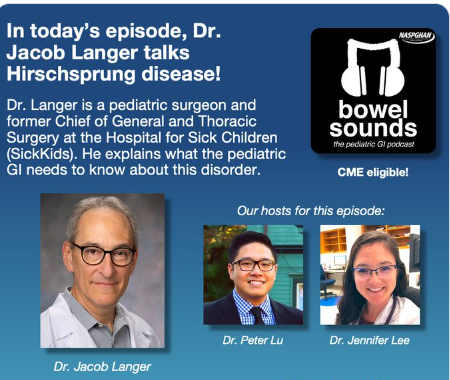
Jacob Langer discussed Hirschsprung disease

Listen now: https://buzzsprout.com/581062/12359851

In terms of diagnosis, Dr. Langer recommended use of rectal suction biopsy as 1st step in smaller kids (less than 1 yr of age) and rectal manometry as 1st step in those older than 1 yr of age. He reviewed the three main operations:

  • Swenson -pulldown to anus
  • Duhamel -pouch: with an end-to-side anastomosis is performed with the remaining rectum
  • Soave -cuff: strip mucosa and leave a muscular cuff

He noted that he prefers Soave but that there is not clear superiority of one operation.

Other pointers:

  • Enterocolitis is #1 cause of mortality. If someone is coming in sick, worthwhile to start an in-and-out irrigation promptly. Irrigation information can be found on YouTube. From Colorado Children’s: Rectal Irrigations for Hirschsprung
  • He pioneered the use of Anal Botox for children post-operatively. Many children with obstructive symptoms related to sphincter malfunction will improve with time and this often allows a child to avoid a myectomy
  • He described workup for post-operative soiling and potential pathophysiology: muscle issues (manometry), sensory issues, functional retention with overflow, and hypermotility (sigmoid propelling stool rapidly which may improve with imodium)
  • Dr. Langer is also a musician — you can listen to his music here.

Related blog posts:

Prickly Pear Cactus, Tucson, AZ

Disclaimer: This blog, gutsandgrowth, assumes no responsibility for any use or operation of any method, product, instruction, concept or idea contained in the material herein or for any injury or damage to persons or property (whether products liability, negligence or otherwise) resulting from such use or operation. These blog posts are for educational purposes only. Specific dosing of medications (along with potential adverse effects) should be confirmed by prescribing physician.  Because of rapid advances in the medical sciences, the gutsandgrowth blog cautions that independent verification should be made of diagnosis and drug dosages. The reader is solely responsible for the conduct of any suggested test or procedure.  This content is not a substitute for medical advice, diagnosis or treatment provided by a qualified healthcare provider. Always seek the advice of your physician or other qualified health provider with any questions you may have regarding a condition.

IBD Shorts June 2018

AL Granstrom et al. JPGN 2018; 66: 398-401. Using a nationwide Swedish registry, the authors determined that patients with a Hirschsprung disease had an increased risk of receiving a diagnosis of IBD (OR 4.99).  In total 20 of 739 HD patients, developed IBD.

T Card et al. Inflamm Bowel Dis 2018; 24: 953-9.  This article questions the ‘what is the risk of progressive multifocal leukoencephalopathy ..with vedolizumab?  The authors are not certain.  But they state that after reviewing 54,619 patient-years “there have been no cases of PML reported in association with vedolizumab use.”

LCT Buer et al. Inflamm Bowel Dis 2018; 24: 997-1004. This case report of 10 patients describes combination therapy with anti-TNF therapy with vedolizumab. “At the end of follow-up, all patients were in clinical remission, and 8 patients could discontinue anti-TNF treatment.”

OJ Adedokun et al. Gastroenterol 2018; 154: 1660-71. This study examined pharmocokinetics and response of ustekinumab in patients with Crohn’s disease from 701 patients in phase 3 studies..  “Trough concentrations was approximately threefold higher in patients given ustekinumab at 8-week intervals compared with 12-week intervals…Trough concentrations of 0.8 (or even up to 1.4 mcg/mL) or greater were associated with maintenance of clinical remission.”  Also, “concentrations of ustekinumab did not seem to be affected by cotreatment with immunomodulators.”

View from Pine Mountain