When Will Intestinal Ultrasound for IBD Become Practical?

M Allocca et al. Gastroenterol 2023; 164: 851-855. Open Access! Intestinal Ultrasound in the Assessment and Management of Inflammatory Bowel Disease: Is It Ready for Standard Practice?

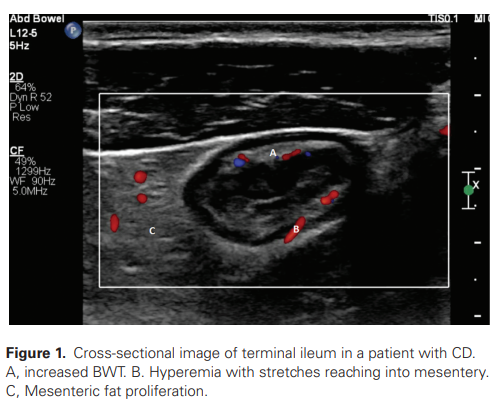
This short article outlines the indications, availability, technical skills, cost-effectiveness and potential value of intestinal ultrasound (IUS). Some key points:

  • Goal: “IUS is used as a first-line investigation and can avoid or delay the need for more invasive and expensive testing (CT, MRI, or colonoscopy). Thus, costs are minimized and patient convenience is optimized”
  • Availability: “IUS is quite widespread in many European countries, but its uptake has been significantly less in other parts of the world, including the United States. Limitations to its use include the absence of standardized and reproducible protocols, lack of local expertise, and the perception that IUS is an operator-dependent tool, feasible only by highly experienced operators. In reality, however,…. studies specifically addressing sonographer variability demonstrate substantial agreement for color Doppler signals and almost perfect agreement for bowel-wall thickness, as the most relevant IUS parameter.”
  • Expertise: Trainees “have to perform at least 300 supervised ultrasound examinations in Italy and 400 in Germany to achieve full competency…It is believed that learners can achieve competency in IUS after approximately 200 supervised examinations, but it is important to acknowledge that a formal learning curve and the criteria for competency assessment have not yet been fully defined”

My take: Despite all the interest in this useful point-of-care tool, for IUS to become more widespread in the U.S. it will need to be incorporated in training programs. The threshold for competency is not achievable with a weekend seminar. It will be interesting to see how this test affects cost, management, and outcomes. Will it reduce or increase other cross sectional imaging testing? Is the information from IUS more useful than a calprotectin (stool biomarker) which could also be a point-of-care test?

Related blog posts:

The Oro Valley/Tucson Loop shared use bike path extends over 130 car free miles throughout unincorporated Pima County, Marana, Oro Valley, and Tucson.

How Does Bowel Ultrasound Stack Up to MRE for Crohn’s Disease?

A Rispo et al. Inflamm Bowel Dis 2023; 29: 563-569. David Against Goliath: Direct Comparison of Handheld Bowel Sonography and Magnetic Resonance Enterography for Diagnosis of Crohn’s Disease

Lately, there has been a lot of ‘buzz’ about the potential use of point-of-care bowel sonography (aka intestinal ultrasound). This study (2019-2021) prospectively enrolled patients with a high likelihood of Crohn’s disease (CD) and compared handheld bowel sonography (HHBS), MRE (all patients, n=85, had ileocolonoscopy)

Key findings:

  • Sensitivity, specificity, positive predictive values, and negative predictive values for CD diagnosis were 87.50%, 91.89%, 93.33%, and 85% for HHBS; and 91.67%, 94.59%, 95.65%, and 89.74% for MRE, without significant differences in terms of diagnostic accuracy (89.41% for HHBS vs 92.94% for MRE, P = NS)
  • Magnetic resonance enterography was superior to HHBS in defining CD extension (r = 0.67; P < .01) with a better diagnostic performance than HHBS for detecting location (k = 0.81; P < .01), strictures (k = 0.75; P < .01), abscesses (k = 0.68; P < .01), and fistulas (k = 0.65; P < .01).

My take: In this study, MRE was clearly superior at defining CD complications. This study suggests that HHBS could be an effective screening tool but is not likely a definitive imaging study. In terms of bedside monitoring, it would be helpful to see how clinical monitoring with HBSS compares with a highly sensitive marker like a calprotectin. I also worry that HBSS could perform more poorly with more widespread application due to potential increase in operator error.

Coming to a GI Clinic Near You? Intestinal Ultrasound for Ulcerative Colitis

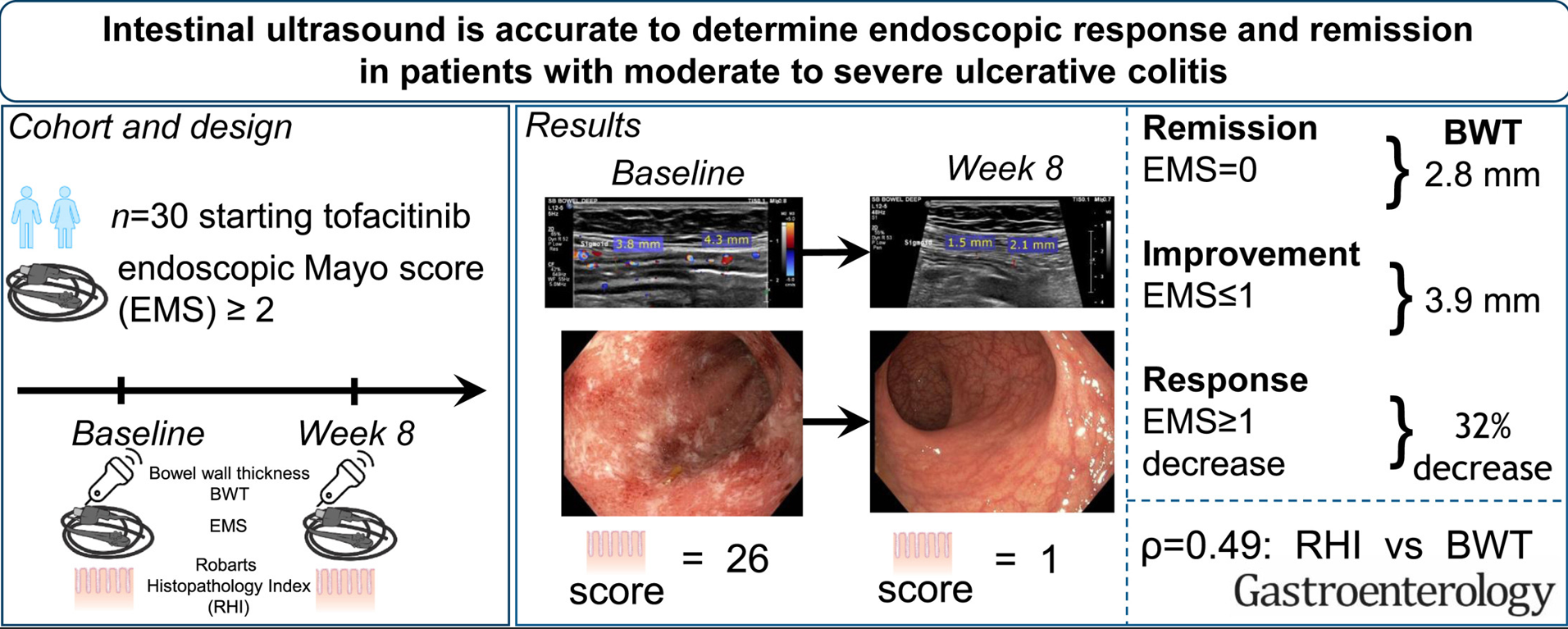
F De Voogd, et al. Gastroenterol 2022; 163: 1569-1581. Intestinal Ultrasound Is Accurate to Determine Endoscopic Response and Remission in Patients With Moderate to Severe Ulcerative Colitis: A Longitudinal Prospective Cohort Study

27 patients with moderate to severe ulcerative colitis (UC) completed followup in this single-center, prospective, longitudinal cohort study. Key findings:

  • Bowel wall thickness (BWT) correlated with endoscopic Mayo score. “The most accurate cutoff for BWT was 2.8 mm for endoscopic remission, 3.9 mm for improvement, and a decrease of 32% for response.”

The associated editorial (C Palmela, C Maaster. Gastroenterol 2022; 163: 1485-1487. Open Access! The Use of Intestinal Ultrasound in Ulcerative Colitis-More Than a Mucosal Disease?) details other studies showing the utility of intestinal ultrasound, including the TRUST%UC study which enrolled 253 patients with UC. “. At baseline, 88.5% of patients had increased bowel wall thickness (BWT). Response to therapy could be detected as early as 2 weeks after initiation of therapy, as shown by reduction of abnormal BWT.” In anothre study with severe UC, “BWT reduction of >20% being an excellent predictor of response to intravenous steroids at 48 hours, as shown recently by Ivemark et al.10

The editorial notes that intestinal ultrasound “is often thought as being operator dependent. Nonetheless, several studies have shown an excellent inter-observer agreement in IUS, especially for the assessment of BWT,7,12 as was also found in this [De Voogd] study.” An additional finding in the De Voogd study was that the “the submucosa was the most thickened layer, and after 8 weeks of therapy it was also the most responsive layer;” thus, UC is not simply a mucosal disease.

My take: This study shows that with more widespread adoption, many UC patients could be followed non-invasively with intestinal ultrasound (and calprotectin).

Related blog post:

IBD -Briefly Noted: Intestinal U/S and Anxiety/Depression Not Worsening Pediatric IBD Activity

EA van Wassenaer et al. Inflamm Bowel Dis 2022; 28: 783-787. Open Access PDF: Intestinal Ultrasound in Pediatric Inflammatory Bowel Disease: Promising, but Work in Progress

Key points from this review:

  • Research has shown that IUS has the potential to be a valuable additional point-of-care tool to guide treatment choice and to monitor and predict treatment response, although evidence of its accuracy and value in clinical practice is still limited
  • The utility may be operator-dependent as well

My take: Due to low upfront costs, IUS would be appealing adjunct to current monitoring. However, one could envision IUS leading to more downstream studies (& costs), especially if its sensitivity and specificity are not very high.

EJ Brenner et al. Inflamm Bowel Dis 2022; 28: 728-733. Anxiety and Depressive Symptoms Are Not Associated With Future Pediatric Crohn’s Disease Activity

In this internet-based cohort of 9-17 yr olds (n=159, 96% white), the authors found no association between baseline PROMIS Pediatric anxiety score and subsequent sCDAI (change in sCDAI for 3-point change in PROMIS Pediatric −0.89; 95% CI −4.81 to 3.03). This study is in contrast to studies in adults which have shown a bidirectional relationship between anxiety/depression and IBD activity.

My take: It is difficult to know with certainty whether anxiety/depression may trigger IBD activity; more studies are needed. Treatment of mental health is important regardless of its effects on IBD activity.

Related blog posts: