TRIUMPH-1: Impressive Results for Obesity Treatment with Triple Agonist Retatrutide

AA Jastreboff et al. NEJM 2026; DOI: 10.1056/NEJMoa2604169.
Retatrutide, a Triple Hormone Receptor Agonist, for Treatment of Obesity

Background: Retatrutide (LY3437943) is an agonist of the glucose-dependent insulinotropic polypeptide, glucagon-like peptide 1, and glucagon receptors.

In 2023, “a phase 2 trial involving participants with obesity, once-weekly subcutaneous retatrutide (at a dose of 12 mg) resulted in a mean weight reduction of 24.2% at 48 weeks24 and improved multiple cardiometabolic measures, including waist circumference, systolic and diastolic blood pressure, glycated hemoglobin, and lipid levels.” This randomized, double-blind phase 3 trial examined a larger cohort (n=2339) with respect to obesity as well as knee osteoarthritis and obstructive sleep apnea in participants with obesity without diabetes.

Key findings:

  • Obesity at 80 weeks: The mean percent change in body weight in the retatrutide groups at 80 weeks was −17.6% (4-mg dose), −23.7% (9-mg dose), and −25.0% (12-mg dose) versus −3.9% in the placebo group. The 12 mg dose resulted in a mean change of -28.3% (according to the efficacy estimand) at 80 weeks
  • Obesity at 104 weeks: In the extension phase of the trial, retatrutide treatment was associated with a mean weight reduction of up to 29.9% (treatment-regimen estimand) and 30.3% (efficacy estimand) at 104 weeks
  • Osteoarthritis: the mean change in the WOMAC pain subscale score (in points) at week 80 for the knee osteoarthritis basket was −3.5 and −3.6 with retatrutide 9 mg and 12 mg, respectively, and −1.9 with placebo. Treatment with retatrutide resulted in a reduction in pain of up to 61.6%
  • Obstructive sleep apnea: the mean change in the AHI events per hour at week 80 was −34.3 and −31.7 with retatrutide 9 mg and 12 mg, respectively, and −9.9 with placebo; this resulted in a mean decrease in AHI events per hour of up to 57.3% (hybrid-treatment estimand)
  • Limitations of the trial include the absence of an active comparator, which may have contributed to greater attrition in the placebo group,
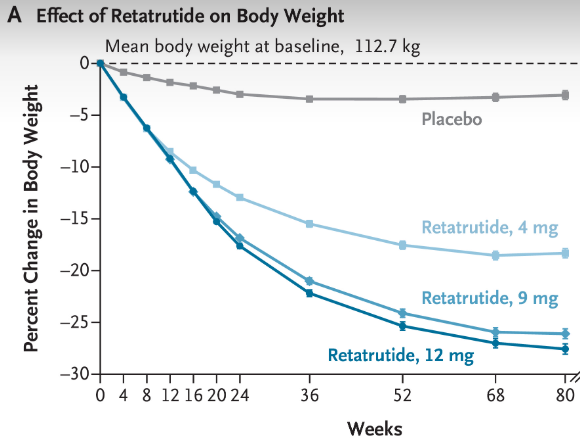
Panel A shows the percent change in body weight from baseline to week 80 (controlled for type I error). The curves on the left show changes from week 0 to week 80 on the basis of observed means during treatment according to the efficacy estimand data-point set
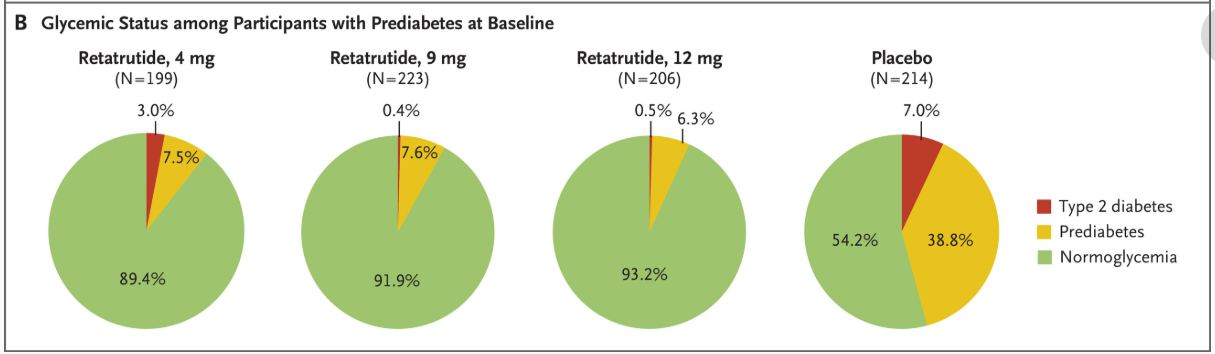
Panel B shows the percentage of participants with normoglycemia, prediabetes, and type 2 diabetes at week 80 among the participants who had prediabetes at baseline

My take: Retatrutide was so effective, even at lower doses, that use of the lowest effective dose to achieve treatment goals may be a useful strategy rather than expecting to maximize the dose in all individuals. While the results are terrific, access and affordability remain important issues with these newer obesity medications.

Disclaimer: This blog, gutsandgrowth, assumes no responsibility for any use or operation of any method, product, instruction, concept or idea contained in the material herein or for any injury or damage to persons or property (whether products liability, negligence or otherwise) resulting from such use or operation. These blog posts are for educational purposes only. Specific dosing of medications (along with potential adverse effects) should be confirmed by prescribing physician.  Because of rapid advances in the medical sciences, the gutsandgrowth blog cautions that independent verification should be made of diagnosis and drug dosages. The reader is solely responsible for the conduct of any suggested test or procedure.  This content is not a substitute for medical advice, diagnosis or treatment provided by a qualified healthcare provider. Always seek the advice of your physician or other qualified health provider with any questions you may have regarding a condition.

Pilot Study: Treating Obstructive Sleep Apnea with Beneficial Effects on Fatty Liver Disease in Children

Briefly noted: A small pilot study (n=9) (SS Sundaram et al. J Pediatr 2018; 198: 67-75) showed that treatment (with home CPAP) of obstructive sleep apnea (OSA) was associated with improved alanine aminotransferase levels, reduced metabolic syndrome markers and lower F(2)-isoprostanes (a marker of oxidative stress) in pediatric patients with nonalcoholic fatty liver disease (NAFLD). All nine of the participants were Hispanic males with a median age of 11.5 years; they had a median BMI of 29.5 and had biopsy-proven NAFLD. The improvement in NAFLD parameters occurred despite an increase in BMI. The authors note that studies in adults have shown contradictory findings with regard to whether treatment of OSA helps NAFLD.

My take: This study suggests potential beneficial liver effects of treating OSA.  Regardless, treatment of OSA could be considered a quality metric in the care of children with NAFLD as better sleep at night has additional clear benefits.

Related blog posts:

Outside Mercedes-Benz Stadium (Atlanta)

NAFLD –Analogous to a Dog Chasing A Bus?

I am not sure of the origin of the expression “what is a dog going to do if it catches a bus?”  However, I am reminded of this expression after reading a recent article about nonalcoholic fatty liver disease (J Pediatr 2014; 164: 707-13).

This retrospective study, “Histologic Abnormalities in Children with Nonalcoholic Fatty Liver Disease with Normal or Mildly Elevated Alanine Aminotransferase Levels,” analyzed 91 children (5-18 years) with suspected NAFLD who had normal or mildly elevated ALT values from 12 U.S. medical centers.  They obtained liver biopsy specimens within 180 days of the ALT measurement and compared them from 392 children with elevated ALT.

When reading this title, one has to wonder, how did they select these children for this study?  First of all the authors used two NASH CRN databases with 483 children.  The reasons for NAFLD evaluation at entry in the current study included symptoms of liver disease in 22%, identification during evaluation of another illness in 38%, routine physical exam (41%), and other causes in 6%. At one point, elevated ALT was evident in 74% and radiographic evidence of steatosis in 55%.

The authors conclude that “liver biopsy specimens from children with NAFLD with normal or mildly elevated ALT levels show significant histological abnormalities, including advanced fibrosis…measurement of ALT may underestimate liver injury in NAFLD.” Yet, while it is true that ALT values may not have adequate sensitivity for liver injury, the authors deploy some circular logic; when one understands the selection of these patients, it comes as no surprise that some had advanced liver findings on biopsy.  If one identifies an abnormal liver on ultrasound and confirms this on liver biopsy, this is targeting a population whose findings are not generalizable.

Outside of a research study, how does one decide which patients will benefit from a liver biopsy? This study does not offer any clarity.

And, if one identifies more cases of NAFLD, what is one to do?  Besides weight loss (which should be recommended already in the majority), there are no other proven treatments.  The associated editorial (pgs 684-86) reminds the reader to use appropriate normative values for ALT (<25.8 U/L for boys and <22.1 U/L for girls).  In the study’s discussion, the lack of consensus among expert recommendations is acknowledged.  Furthermore, in those who have recommended frequent screening with ALT values in obese children, the authors note that “evidence of the utility and cost-effectiveness of this approach is still lacking.”

Another study in the same issue (J Pediatr 2014; 164: 699-706) suggests a possible link between obstructive sleep apnea (OSA) and more advanced liver histology in NAFLD.  This was a cross-sectional study with only 25 patients (88% Hispanic, mean age 12.8 years).  The authors speculate that nighttime hypoxemia triggers oxidative stress and may induce further liver injury.  53% of those with OSA had stage 2 or higher fibrosis compared with only 10% of those without OSA.

Bottomline: NAFLD occurs in a lot of children and a normal or mildly elevated ALT does not exclude more severe disease.  OSA may be either an epiphenomenon or a causative factor for more severe NAFLD findings.

Related blog posts: