
Drips Feeds Compared to Bolus Feeds in Extremely Low Birth Weight Infants

H Balasubramanian et al. J Pediatr 2026;298:115235. Effect of Extended Infusion Versus Intermittent Bolus Feedings on Hospital Weight Gain in Extremely Low Birth Weight Infants Born at <29 Weeks of Gestation: A Randomized Noninferiority Clinical Trial

Methods: The authors randomized 132 infants (infusion, n = 68; bolus, n = 64). The median gestational age and birth weight were 26.4 ± 1.2 weeks and 752 ± 140 g. Bolus feedings were provided every 2 hours through an orogastric tube over a duration of 10-20 minutes by gravity. Drip feeds: over a 24-hour time period, milk was delivered in 4 infusion cycles. Each infusion cycle comprised of 5 hours of continuous milk infusion followed by an hour of feeding break.

Key findings:

  • The median time to full enteral feedings was similar: infusion: 10 days [IQR: 7-12]; bolus: 9 days [IQR: 7-12], P = .82
  • The mean (SD) rate of weight gain at discharge was similar: infusion 15.3 ± 2.6 g/kg/day vs bolus 15.7 ± 2.8 g/kg/day
  • The infusion group had significantly fewer days of feeding interruptions (6.7 days [5.6-8.1] vs 8.7 [7.4-10.1] per 100 patient days, P = .03) in the first 28 days
  • Duration of hospitalization and morbidities were similar in study groups
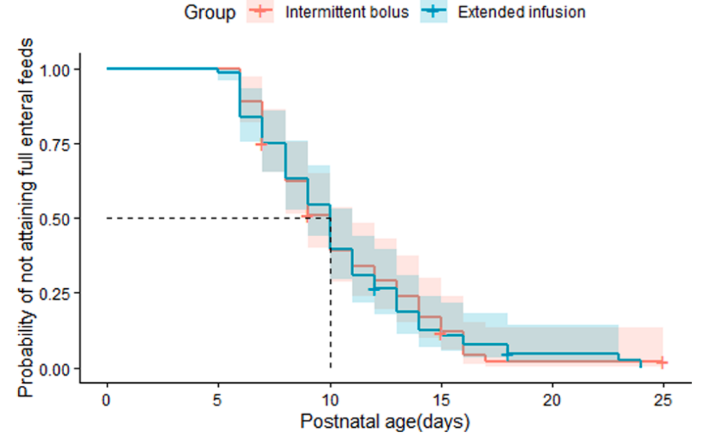
Kaplan-Meier curves for time to full enteral feeds in both groups.
The dashed line represents the median time to full enteral feeds in both groups (10 days).
Discussion Points:

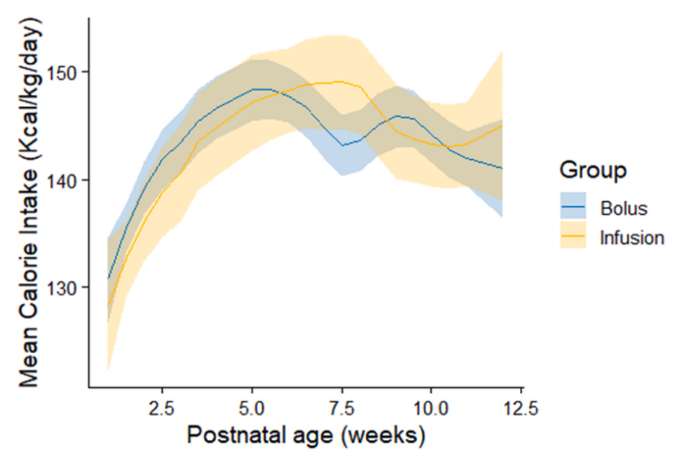
  • “Feeding intervals may play an important role in nutrient absorption and assimilation in neonates. An in vitro model of simulated feeding of thawed unprocessed donor human milk indicated that continuous feeding resulted in 40%, 35%, and 20% losses of fat, calcium, and phosphorus content, respectively, compared with 6%, 9%, and 7% losses of the same macronutrients when bolus fed. Periodic manual agitation of infusion pumps, use of inverted or vertically oriented infusion systems, and infusion rates of 5 mL/hour have been identified as important approaches (level II evidence) to combat fat losses from milk infusions”
  • There were feeding interruptions in this study. “In our study, consistent with current feeding practices, infants were exclusively human milk fed until 33 weeks of gestation and feeding decisions were not affected by gastric residual volumes.”

My take (borrowed from the authors): “Extended infusion feedings were noninferior to intermittent bolus feedings for hospital weight gain in infants born with ELBW.”

Related blog posts:

Probiotics in Preemies: Lifesaving Therapy

Lots of studies have indicated that probiotics may be beneficial in premature newborns; the problem is that there are currently no FDA-approved probiotics for preterm infants. The use of probiotics as a non-regulated FDA product leads to the potential risk of contamination due to inconsistent quality control as well as variability in the strains and concentrations.  The risks are not inconsequential as there has been a report of 29-week infant who died from mucormycosis due to probiotic contamination with mold.

Despite the potential problems with probiotics in this population, their usage is increasing as described in a recent multicenter retrospective cohort study (KD Gray et al. J Pediatr 2020; 222: 59-64) which took place between 1997-2016 with 78,076 infants (23-29 weeks gestational age) in 289 NICUs.

Key findings

  • 3626 (4.6%) received probiotics
  • Probiotic use increased over the study period (>10% in 2015 & 2016)
  • By matching 2178 infants who received probiotics with 33,807 without probiotics, the authors determined that those received probiotics had a decrease likelihood of necrotizing enterocolitis (OR 0.62) and death (OR 0.52).  The authors observed an increase in Candida infection (OR 2.23); though, this is an infrequent infection and the absolute difference in risk was <1%
  • Limitations: “similar to many previous studies, there was great variation in probiotic products and organisms, as well as a lack of dosing information, which made it unclear which product, organism, or dose might be most effective.”  Also, other contributing factors like consumption of breastmilk and antibiotic exposure are not detailed in this report.

My take: Probiotics could be life-saving for premature infants. It would be nice if we could find out which strains work and which ones do not as well as to assure safe manufacturing processes.

Related blog posts:

Continuous Feeds versus Bolus Feeds

Briefly noted:

Another study (JB van Goudoever et al. JPGN 2015; 61: 659-64) indicates that bolus feeds are likely as safe as continuous feeds in preterm infants; though, the “continuous” feeding was atypical.  In this study, the bolus group received their feedings every 3 hours via gravity whereas the “continuous” feeding cohort received feedings by gravity by giving one-fourth of the hourly feeding every 15 minutes.

Key finding: In a study of 246 infants (<1750 g & <32 weeks gestational  age), there was no significant difference in reaching full enteral feedings between the group assigned to continuous feedings compared with bolus feedings

Related blog post:  Which is Safer -Drip Feeds or Bolus Feeds in Healthy Preterm …