Confusing Guidance and “Conditional” Recommendations for Probiotic Use in Pediatric Irritable Bowel Syndrome and Functional Abdominal Pain

R Francavilla et al. J Pediatr Gastroenterol Nutr. 2026;83:3–6. Open Access! From evidence to advice: How uncertainty shapes probiotic guidance in pediatric irritable bowel syndrome

Key points:

  • “Recent guidance documents of the European Society for Paediatric Gastroenterology Hepatology and Nutrition (ESPGHAN) and North American Society for Pediatric Gastroenterology, Hepatology and Nutrition (NASPGHAN) on probiotic use in pediatric irritable bowel syndrome (IBS) do not simply converge toward a shared recommendation.13 Rather, they illustrate an evolution in how scientific uncertainty is operationalized in clinical advice. “
  • “The ESPGHAN Position Paper Probiotics for the Management of Pediatric Gastrointestinal Disorders represents the most structured approach among the three documents, treating probiotics as strain-specific interventions evaluated against predefined clinical outcomes.1 In functional abdominal pain disorders, healthcare professionals may recommend Limosilactobacillus reuteri DSM 17938 to reduce pain intensity, while in pediatric IBS Lactobacillus rhamnosus GG may be recommended to reduce pain frequency and intensity. These recommendations are accompanied by explicit dosing ranges, defined clinical targets, and formal appraisal of evidence certainty (moderate) and strength of recommendation (weak).”
  • “The joint ESPGHAN/NASPGHAN guideline on treatment of IBS and functional abdominal pain—not otherwise specified in children aged 4–18 years represents a shift in emphasis.2 L. rhamnosus GG is conditionally suggested as a therapeutic option for pediatric IBS, supported by moderate overall certainty of evidence and a small, reported effect size. Multistrain probiotics and synbiotics are likewise framed as options that may be suggested, but with low certainty of evidence. In contrast to earlier ESPGHAN position papers, the guideline does not specify detailed dosing regimens, treatment duration, or stopping rules.”
  • “This reframing extends further in the European and North American guidance addressing IBS and functional abdominal pain in childhood.3 …Within this framework, probiotics are positioned less as therapies to be prescribed and more as adjunctive measures to be discussed with families, including in primary care settings.”


Conclusions from authors: “At a policy level, conditional recommendations do not operate in a neutral context…Probiotics are widely available, variably regulated, and commonly perceived as harmless. In pediatric IBS, where symptoms are chronic, placebo responsiveness is high, and pharmacological options are limited, conditional guidance may be interpreted as tacit approval for routine use, regardless of modest effect sizes…their use may drift from deliberate intervention toward habitual supplementation.”

My take: I rarely recommend probiotics for pediatric IBS. Even simple dietary changes are much more likley to be beneficial. In addition, there is a concern about the lack of quality control in the production of probiotics.

Related blog posts:

Disclaimer: This blog, gutsandgrowth, assumes no responsibility for any use or operation of any method, product, instruction, concept or idea contained in the material herein or for any injury or damage to persons or property (whether products liability, negligence or otherwise) resulting from such use or operation. These blog posts are for educational purposes only. Specific dosing of medications (along with potential adverse effects) should be confirmed by prescribing physician. Because of rapid advances in the medical sciences, the gutsandgrowth blog cautions that independent verification should be made of diagnosis and drug dosages. The reader is solely responsible for the conduct of any suggested test or procedure. This content is not a substitute for medical advice, diagnosis or treatment provided by a qualified healthcare provider. Always seek the advice of your physician or other qualified health provider with any questions you may have regarding a condition
Probiotics in Addition to Standard Therapy Associated with Improved Eradication of H pylori

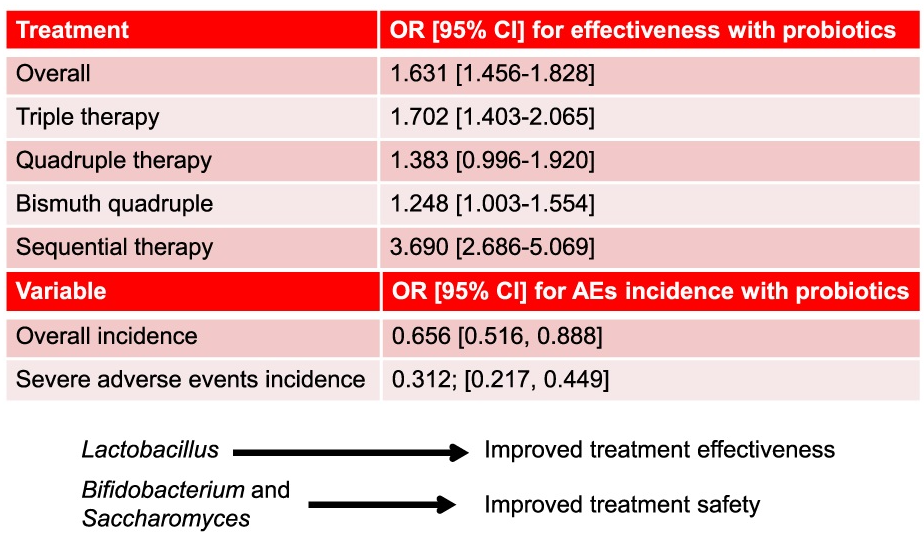
DC Deza et al. AJG 2025. 120:p 2644-2659Probiotics Prescribed With Helicobacter pylori Eradication Therapy in Europe: Usage Pattern, Effectiveness, and Safety. Results From the European Registry on Helicobacter pylori Management (Hp-EuReg) Thanks to Ben Gold for this reference.

Methods: Prospective European registry with 36,699 treatments were recorded, where 8,233 (22%) were prescribed with probiotics. The analysis of the effectiveness of probiotics was restricted to those receiving first-line therapy.

Key findings:

  • Overall, the eradication rate was 90.6% with probiotics and 86.1% without probiotics.
  • With quadruple therapy, the eradication rate was 93.1% with probiotics and 89.3% without probiotics

Discussion Points:

  • “The prevalence of H pylori infection remains close to 45% in the European population”
  • The population receiving probiotics may have been expected to have a higher risk of eradication failure (eg. antibiotic resistance and more prior treatments) and/or higher expectations of adverse effects
  • This was NOT a randomized study which limits a more definitive conclusion on the effectiveness of adding a probiotic

My take: In highly-motivated families, probiotics may be worthwhile as part of an H pylori eradication regimen. This could, of course, necessitate changes in nomenclature. Would quadruple therapy with probiotics be called 5-drug (quintuple) treatment?

Related blog posts:

H pylori:

Probiotics:

What About the Risk of Not Intervening to Prevent Necrotizing Enterocolitis?

J Tobias et al. J Pediatr 2022; 244; 64-71. Open Access: Bifidobacterium longum subsp. infantis EVC001 Administration Is Associated with a Significant Reduction in the Incidence of Necrotizing Enterocolitis in Very Low Birth Weight Infants

Editorial: MA Underwood J Pediatr 2022; 64: 14-16. Open Access: Bifidobacterium infantis, Necrotizing Enterocolitis, Death, and the Role of Parents in the Neonatal Intensive Care Unit

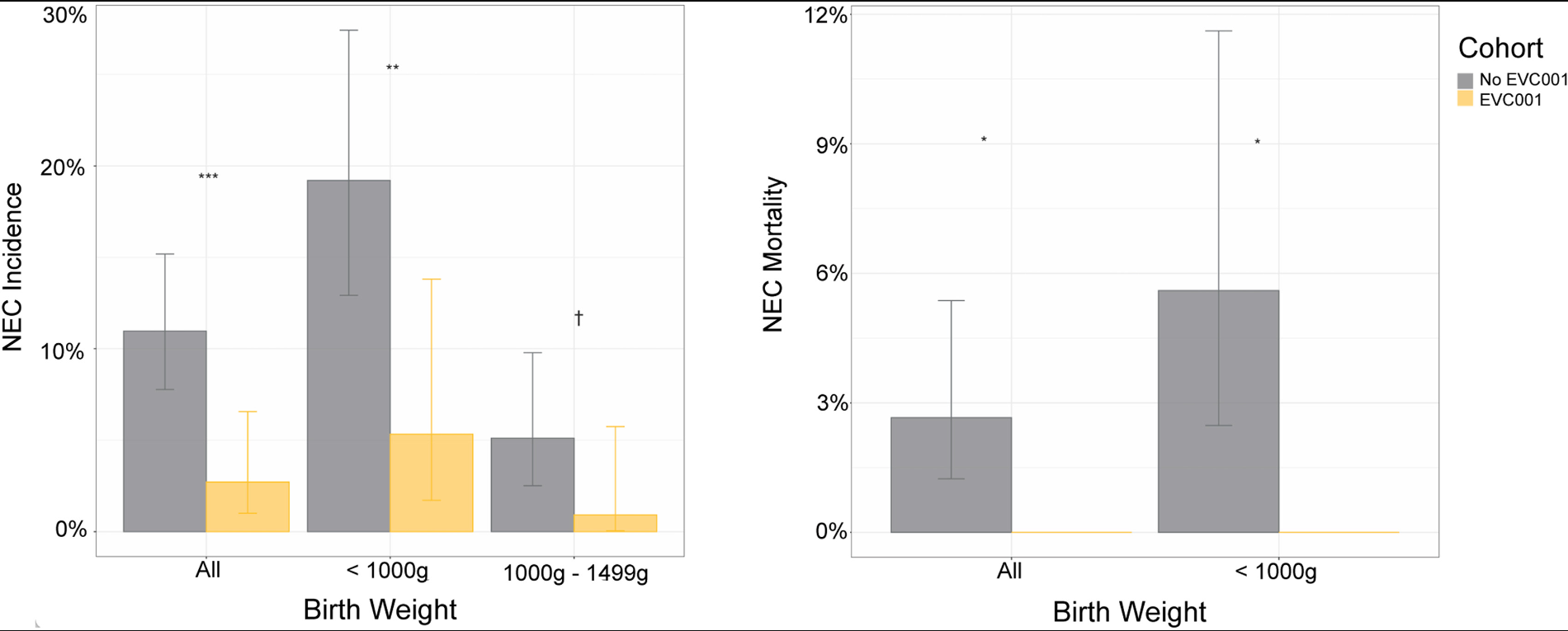
Methods: Nonconcurrent retrospective analysis of 2 cohorts of 483 very low birth weight (VLBW) infants not exposed and exposed to B infantis EVC001 probiotic at Oregon Health & Science University from 2014 to 2020

Key findings:

  • The cumulative incidence of NEC diagnoses decreased from 11.0% (n = 301) in the no EVC001 (unexposed) cohort to 2.7% (n = 182) in the EVC001 (exposed) cohort (P < .01); this was a 73% risk reduction of NEC
  • NEC-associated mortality decreased from 2.7% in the no EVC001 cohort to 0% in the EVC001 cohort (P = .03)
  • There was a lack of adverse events (including probiotic sepsis)

Key points from editorial:

  • “The first cohort study showing a significant decrease in necrotizing enterocolitis (NEC) with the routine administration of probiotic dietary supplements [was] more than 20 years ago”
  • “The most recent Cochrane Database systematic review 2 included 56 randomized or quasi-randomized trials in which 10 812 infants participated. Meta-analysis found evidence for decreased risk of NEC (Risk ratio [RR] 0.54)”
  • Both the AGA and ESPGHAN have recommended routine probiotics administration to preterm infants. However, the AAP recommends “against routine probiotic administration citing ‘the lack of FDA-regulated pharmaceutical-grade products in the United States, conflicting data on safety and efficacy, and potential for harm in a highly vulnerable population.’”
  • “Recognizing that many neonatologists have opted to adopt routine probiotic administration to infants born preterm, the recent American Academy of Pediatrics statement6 recommends that an informed consent process for utilizing probiotics. Dr. Underwood counters: “there is no mention of a need to discuss these risks and benefits by those well-informed clinicians who may not believe that the data support administering probiotics. Inclusion of parents in decision-making in the NICU improves parent satisfaction and infant outcomes.”
  • Parent and clinician resource: necsociety.org. 9 Things You Need to Know About Necrotizing Enterocolitis and NEC Facts

My take: It is hard to understand that, despite 20 years of research showing probiotics can reduce mortality and morbidity in premature infants, we have not been able to manufacture a consistent, reliable high-quality probiotic capable of meeting FDA standards.

Favorite Posts of 2020

These are some of my favorite posts of the past year.

Humor:

GI:

Endoscopy:

Liver:

Nutrition

COVID-19:

Other:

From Picnic Island, Tampa Bay

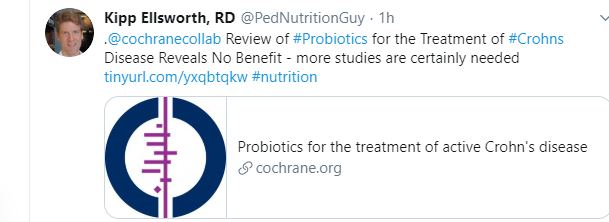
Cochrane Review: Probiotics NOT Proven Effective for Acute Gastroenteritis

Collinson S, Deans A, Padua-Zamora A, Gregorio GV, Li C, Dans LF, Allen SJ. Link to website with PDF availability: Probiotics for treating acute infectious diarrhoea. Cochrane Database of Systematic Reviews 2020, Issue 12. Art. No.: CD003048. DOI: 10.1002/14651858.CD003048.pub4. Thanks to Kipp Ellsworth for this reference.

This review identified “82 studies in 12,127 people (included 11,526 children) with acute diarrhea.” Key findings:

  • The number of children with diarrhea longer than 48 hours was not different between those taking a probiotic and those taking a placebo
  • “It was unclear whether taking probiotics shortened the time spent in hospital compared with taking a placebo or no additional treatment .”

My take: Probiotics probably make little or no difference in the setting of acute gastroenteritis/diarrhea. This analysis is based on large trials with low risk of bias.

Related blog posts:

Why We Are Not Making Progress with Probiotics

A recent commentary A Khoruts et al. Gastroenterol 2020; 159: 409-413. Full text: Probiotics: Promise, Evidence, and Hope

Despite the fact that the probiotic industry has ample money which is projected to reach $70 billion yearly, there is very little high quality research.

Key points:

  • Probiotics are regulated by the Food and Drug Administration (FDA) and the Federal Trade Commission (FTC). The FDA, unlike the FTC, regulates products by category (eg, foods, drugs, dietary supplements, medical devices, and cosmetics)…Foods and dietary supplements, unlike drugs, do not require FDA premarket approval. By law, probiotic foods and dietary supplements must be safe. However, food manufacturers are permitted to make a self-determination of whether their product meets the “generally recognized as safe” (GRAS) designation, typically based on history of prior use”
  • Probiotic food and dietary supplement manufacturers do not have to specify on their product labels the strains they use in probiotic products or specify the number of live microbes of each strain that the product delivers through the end of its shelf life; and, although they are required to have validation of label claims, they are not required to submit it to the FDA
  • Dietary supplements can make structure/function claims, even though they cannot claim to treat any specific disease. These claims can sound very promising and consumers may be hard pressed to distinguish between a statement that a product “improves digestion,” a structure/function claim that is so vague that it is literally untestable
  • Rational selection of donor microbiota should be possible based on microbiome-based diagnostics, as well as in vitro technologies that interrogate the functional potential of complex microbial communities. There are parallel, intensive efforts to develop defined microbial communities. A common theme among these different approaches is deployment of complex assemblages of microorganisms rather than single strains. Such complex consortia are likely to have more consistent and predictable effects.
  • The emergence of microbial therapeutics requires development of a new branch of pharmacology. The challenges of formulation, pharmacokinetics, and pharmacodynamics are very distinct from those of small molecule therapeutics or protein biologics.

My take: “These next-generation probiotics will need to be tested for safety and efficacy in well-designed and properly powered clinical trials.”  Probably the only way that will happen is to empower regulatory agencies to insist that these products are treated like medications.  Given the fact that probiotics are so profitable now with little evidence of efficacy for most strains, I am not optimistic about any changes in the near future.

Related blog posts:

Weak Support For Probiotics in Acute Gastroenteritis

Two recent well-controlled studies (D Schnadower et al.N Engl J Med 2018; 379:2002-2014, SB Freedman et al. N Engl J Med 2018; 379:2015-2026) showed that probiotic-treated children with acute gastroenteritis (AGE) did not have better outcomes than placebo-treated children. In addition, a recent AGA practice guideline recommended against the use of probiotics for most GI conditions, including in AGE.

However, a new report (H Szajewska et al. JPGN 2020; 71; 261-69) from an ESPGHAN  working group recommends that probiotics should have a role for AGE.  Several points about this report:

  1. Their recommendations are very qualified: “weak recommendation” with “low to very low certainty of evidence” for the following in descending order: S boulardiii, L rhamnosis GG, L reuteri DSM 17938, and L rhamnosus 19070 & L reuteri DSM 12246
  2. It is noted that this report has a disclaimer from ESPGHAN: “it does not represent ESPGHAN policy and is not endorsed by ESPGHAN”
  3. The authors have extensive disclosures
  4. The report notes that “despite large number of identified trials, we could not identify 2 randomized controlled trials of high quality for any strain that provided benefit when used for treating acute gastroenteritis”

Of note, the associated editorial (pg 146-47) also favors probiotics in the setting of AGE.  “These recommendations…have clarified that there is a role for probiotics in treating” AGE.

Related article (just published): F Mourney et al. The Pediatric Infectious Disease JournalAugust 7, 2020 – Volume Online First – Issue –doi: 10.1097/INF.0000000000002849 A Multicenter, Randomized, Double-Blind, Placebo-Controlled Trial of Saccharomyces boulardii in Infants and Children With Acute Diarrhea (n=100) Key findings: The time of recovery from diarrhea was significantly shorter in the probiotic group compared with the placebo group (65.8 ± 12 hours vs. 95.3 ± 17.6 hours, P = 0.0001).

My take: Overall, probiotic effectiveness is overstated; though, some strains may be helpful for AGE.  Still, there are concerns about variation in production and quality standards even in these strains.

Related blog posts:

IBD Update -August 2020

S Jansson et al JPGN 2020; 71: 40-5. This retrospective study (1998-2008) showed that pediatric patients with extraintestinal manifestations (EIM) had more severe IBD course than patients with IBD without an EIM.  EIM often had a temporal relationship with a relapse of IBD as well. Of 333 patients, 14 had an EIM at diagnosis and 47 had an EIM develop during followup.

PA Olivera, JS Lasa et al. Gastroenterol 2020; 158: 1554-73. This systematic review and meta-analysis ultimately included 82 studies with 66,159 patients (including those with IBD and other immune-mediated diseases) exposed to a JAK inhibitor; two-thirds of studies were randomized controlled trials.  Key findings:

  • Incidence rates of serious infections, herpes zoster infection, malignancy, and major cardiovascular events were 2.81, 2.67, 0.89, and 0.48 per 100 person year respectively. After meta-analysis, the authors conclude that there is an increased risk of herpes zoster (RR 1.57), but all other adverse events were not increased among patients treated with JAK inhibitors
  • Mortality was not increased in those receiving JAK inhibitors compared to placebo

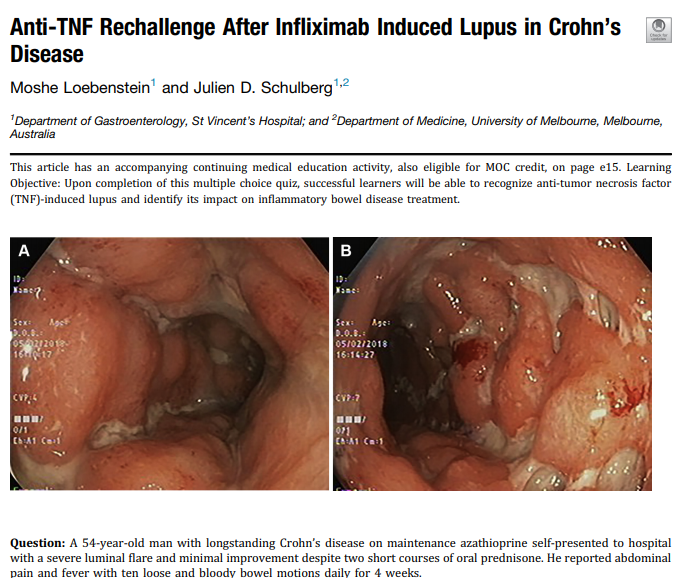
Loebenstein, JD Schulberg. Gastroenterol 2020; 158: 2069-71.  This case report describes a successful alternative anti-TNF rechallenge after infliximab induced Lupus in Crohn’s disease.  The authors note that in a previous study, 14 of 20 IBD patents with drug-induced lupus secondary to an anti-TNF agent were rechallenged with an alternative anti-TNF agent and 13/14 tolerated rechallenge without recurrent lupus (Inflamm Bowel Dise 2013; 19: 2778-86).

These images show active disease prior to intervention. The article provides f/u images showing endoscopic remission after re-starting a different anti-TNF agent.

Probiotics in Preemies: Lifesaving Therapy

Lots of studies have indicated that probiotics may be beneficial in premature newborns; the problem is that there are currently no FDA-approved probiotics for preterm infants. The use of probiotics as a non-regulated FDA product leads to the potential risk of contamination due to inconsistent quality control as well as variability in the strains and concentrations.  The risks are not inconsequential as there has been a report of 29-week infant who died from mucormycosis due to probiotic contamination with mold.

Despite the potential problems with probiotics in this population, their usage is increasing as described in a recent multicenter retrospective cohort study (KD Gray et al. J Pediatr 2020; 222: 59-64) which took place between 1997-2016 with 78,076 infants (23-29 weeks gestational age) in 289 NICUs.

Key findings

  • 3626 (4.6%) received probiotics
  • Probiotic use increased over the study period (>10% in 2015 & 2016)
  • By matching 2178 infants who received probiotics with 33,807 without probiotics, the authors determined that those received probiotics had a decrease likelihood of necrotizing enterocolitis (OR 0.62) and death (OR 0.52).  The authors observed an increase in Candida infection (OR 2.23); though, this is an infrequent infection and the absolute difference in risk was <1%
  • Limitations: “similar to many previous studies, there was great variation in probiotic products and organisms, as well as a lack of dosing information, which made it unclear which product, organism, or dose might be most effective.”  Also, other contributing factors like consumption of breastmilk and antibiotic exposure are not detailed in this report.

My take: Probiotics could be life-saving for premature infants. It would be nice if we could find out which strains work and which ones do not as well as to assure safe manufacturing processes.

Related blog posts:

AGA Practice Guidelines: Probiotics NOT Helpful for Most GI Conditions

Here is a link to the EPUB draft of AGA clinical report (G Su et al. Gastroenterology DOI: https://doi.org/10.1053/j.gastro.2020.05.059): AGA Clinical Practice Guidelines on the Role of Probiotics in the Management of Gastrointestinal Disorders

Here is a link to the pre-draft technical review by GA Preidis et al. Gastroenterology DOI: https://doi.org/10.1053/j.gastro.2020.05.060 AGA Technical Review on the Role of Probiotics in the Management of Gastrointestinal Disorders

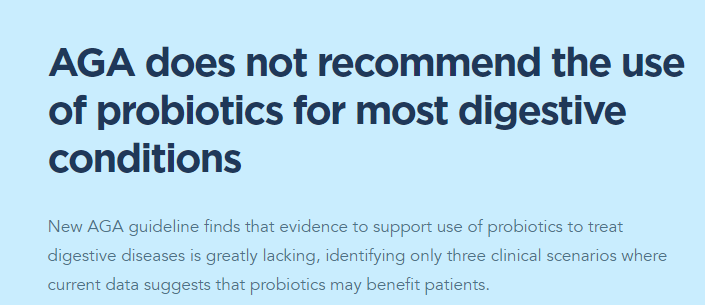
  • The report recommends NOT using probiotics outside of clinical trials for irritable bowel syndrome, Clostridium difficile infection treatment, Crohn’s disease, and gastroenteritis.
  • It recommends a specific probiotic for pouchitis and for prevention of necrotizing enterocolitis in preterm infants <37 weeks and 3 probiotics for patients who are receiving antibiotics (to prevent Clostridium difficile infection)

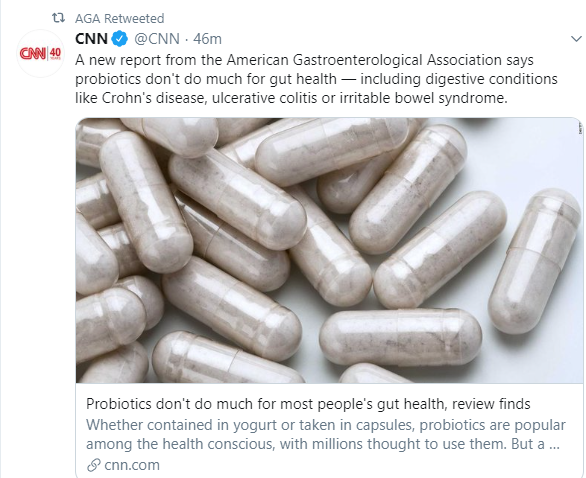
CNN summary: Probiotics don’t do much for most people’s gut health despite the hype, review finds

“While our guideline does highlight a few use cases for probiotics, it more importantly underscores that the public’s assumptions about the benefits of probiotics are not well-founded,” said Dr. Grace L. Su, a professor of medicine and chief of gastroenterology at the University of Michigan, Ann Arbor, in a news statement. She was the chair of the panel that issued the new guidance….

“The industry is largely unregulated and marketing of product is often geared directly at consumers without providing direct and consistent proof of effectiveness,” said the new guidelines. “This has led to widespread use of probiotics with confusing evidence for clinical efficacy,” it said…

“Not all probiotics are created equal. Some probiotic strains and mixtures are very effective for some types of diseases and should not be overlooked due to studies that lump all probiotics together as one”

My take: Probiotics are overhyped and underperform for most conditions. This report suggests that most people should NOT be taking probiotics.

Related blog posts: