Short Bowel Syndrome and Risk of Eosinophilic Disease

N Du, C Torres. JPGN 2024;78:1149–1154. Prevalence of eosinophilic gastrointestinal diseases in children with short bowel syndrome: A single center study

Methods: EoEdefined as ≥15 eosinophils per high powered field (HPF), eosinophilic gastritis (EoG) as ≥30 eosinophils per HPF, eosinophilic enteritis (EoGN) as >50 eosinophils per HPF, and eosinophilic colitis (EoC) as>80–100 eosinophils per HPF.

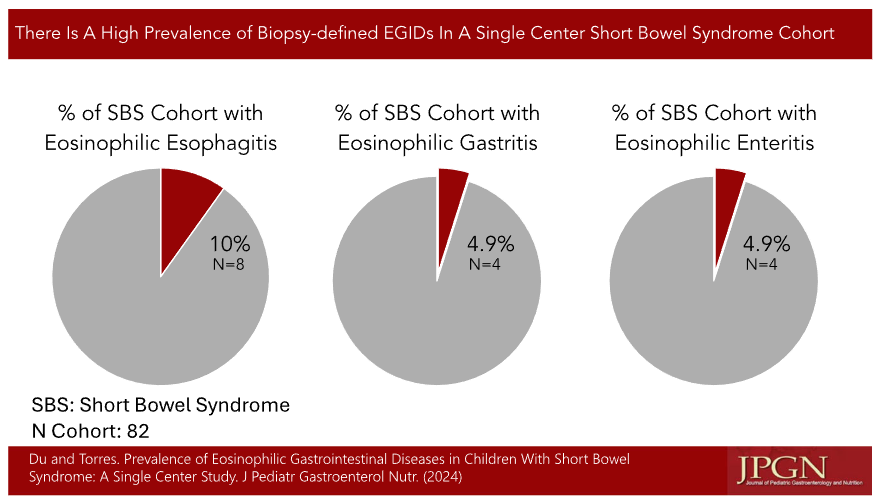
Key findings in this retrospective study (n=82):

  • The prevalence of eosinophilic esophagitis in our SBS cohort was10%, eosinophilic gastritis was 4.9%, and eosinophilic enteritis was 4.9%
  • SBS patients with history of allergy or atopy were more likely to have esophageal and intestinal eosinophilia on biopsy than patients without allergy
  • One patient had EoC

In their discussion, the authors speculate on the potential role for dysbiosis, possibly related to parenteral nutrition. They note that “rare SBS patients were on amino acid‐based formulas alone and almost all were exposed to food allergens around the same age as the general population.” I did not see any information about PPI use in this cohort.

My take: This report reinforces the fact that eosinophilic disorders are more frequent in SBS (see related post below). The exact role of altered diet/use of amino acid based formulas and the role of medications like PPIs in regards to the development of EGIDs remains unclear.
Related blog posts:

Looking Beyond the Headline for Ultra-Short Bowel Syndrome

A quick glance at a recent study (JPGN 2014; 58: 438-42) suggests a favorable outlook for patients with ultra-short bowel syndrome (U-SBS). U-SBS has been defined as having a residual small bowel length <10 cm distal to the ligament of Treitz.  A more cynical definition by a colleague years ago was that U-SBS was when patients can fart and burp at the same time.

Looking at the details:  This study enrolled 11 patients into a prospective Italian database since 2000 and examined their outcomes.  Inclusion criteria included U-SBS diagnosed in the neonatal period (<28 days) and necessitating home parenteral nutrition at discharge.

The demographics note that these patients were bigger at birth and less premature than typical series of patients with SBS:

  • Only one of the patients had necrotizing enterocolitis as the sole underlying disease and six patients had volvulus.
  • All but two had ≥50% of their colons, with five having their entire colon.
  • All but one of these patients had gestational age ≥32 weeks and only two  patients had documented birth weight less than 2300 gm.

The authors note that these patients currently receive SMOFlipid as outpatients and Omegaven as inpatients.  All patients receive some enteral feedings.  Loperamide is used selectively.

Results:

  • Inpatient hospital care ranged from 23 to 104 days/year, but had improved during the last year of followup.
  • With >5 years of followup, 2 of the 11 patients had died.  One of these patients had severe intestinal failure associated liver disease (IFALD) despite use of Omegaven.
  • One patient underwent isolated intestinal transplantation.
  • No children in this series underwent a bowel-lengthening…”given the shortness of the residual small bowel, the gain of length after any procedure will not significantly improve absorption.”

Given their results, the authors note that despite recommendations for early referral for intestinal transplantation in patients with U-SBS, this may not result in a survival benefit.  They note a study by Pironi et al (Gut 2011; 60: 17-25) that showed that among 80 intestinal transplant candidates, 5-year survival was greater in those who were not transplanted.

Bottomline: This small cohort shows that certain populations of U-SBS may do well clinically for a long time with medical management. Caution should be used in extrapolating these results to SBS patients with different demographics.

CLMP–why some children are born with a short gut

CLMP stands for Coxsackie- and adenovirus receptor-like membrane protein. It is required for intestinal development (Gastroenterology 2012; 142: 453-62).

In this study of seven patients from five families with congenital short-bowel syndrome (SBS), the authors identified a loss-of-function of CLMP in five of the patients.  CLMP is a tight-junction-associated protein that is expressed in the intestine of human embryos throughout development.

To study the effect of CLMP expression, the authors created a zebrafish model with compromised CLMP activity.  This lead to offspring with a foreshortened body and intestine, strengthening the evidence that CLMP dysfunction is responsible for congenital short-bowel syndrome.

Additional references/previous related posts: