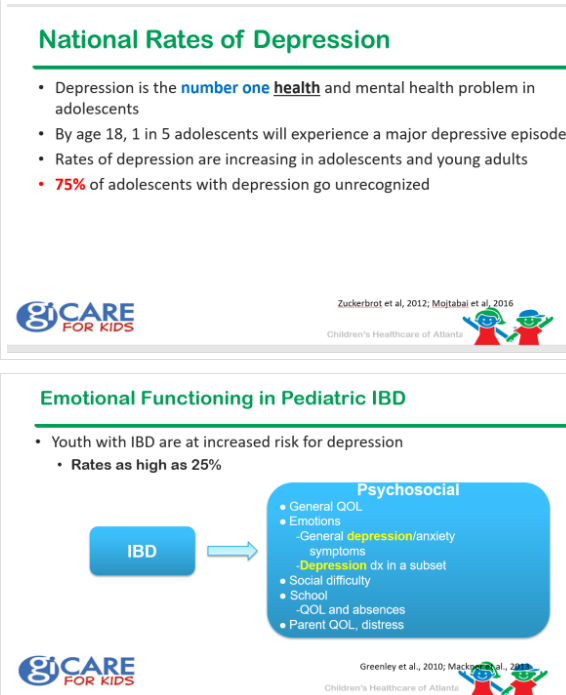
IBD Depression Screening

LM Mackner et al. JPGN 2020; 70: 42-47. Bonney Reed, our psychologist at GI Care for Kids is one of the authors as well.

Key points:

  • Recommendation #1: Screen adolescents with IBD ages 12 and older for depression annually.
  • Recommendation #2: Screening Measures
    Age 12 years: Moods and Feelings Questionnaire, Short Form (MFQ-SF) ; age 13: Patient Health Questionnaire-9 (PHQ-9)
  • Recommendation #3: Evaluate youth who endorse SI (eg, PHQ-9 item # 9) further
    per clinic protocol or via a suicide screener, such as the Columbia Suicide Severity Rating Scale (C-SSRS)
  • Recommendation #4: Educational Resources. Provide patients, families, and other clinicians with educational resources as needed. An additional aim of our tool kit is to give GI providers resources to assist patients, families, and other clinicians
  • Resources for modules 1-4, Supplemental Digital Content http://links.lww.com/MPG/B721

My take (borrowed from authors): “Implementing depression screening in a busy clinic may seem like a daunting task and is likely to require changes in workflow and procedures. Nonetheless, optimal IBD care treats all aspects of health, and identifying depression symptoms, that often go undetected and can affect IBD outcomes, benefits patients, families, and providers.”  In our office, we have implemented screening and there is now a smartform available in EPIC.  We are fortunate to work closely with psychologists who can help when there is an abnormal screen.

Related blog posts:

Disclaimer: These blog posts are for educational purposes only. Specific dosing of medications/diets (along with potential adverse effects) should be confirmed by prescribing physician/nutritionist.  This content is not a substitute for medical advice, diagnosis or treatment provided by a qualified healthcare provider. Always seek the advice of your physician or other qualified health provider with any questions you may have regarding a condition.


Weak Link in Celiac Screening Guidelines

A recent study (AS Faye et al. Clin Gastroenterol Hepatol 2019; 17: 463-8) finds a weak link in the screening guidelines for celiac disease. Generally, guidelines recommend screening all symptomatic first degree relatives and consider screening of asymptomatic first-degree relatives.  Yet, little is known about adherence to these guidelines.

The authors utilized emergency contact information from the electronic records of 2081 patients with biospy-diagnosed celiac disease to assess how commonly celiac disease testing occurs in patients who are first-degree relatives.

Key findings:

  • Of the 539 relatives identified, 212 (39.3%) were tested for celiac disease including 193 of 383 (50.4%) of first-degree relatives and 118 of 165 (71.5%) of symptomatic first-degree relatives.
  • Of the 383 first-degree relatives, only 116 (30.3%) had a documented family history of celiac disease.

Thus, this study shows that ~30% of symptomatic first degree relatives have not received celiac testing and that ~70% of all first-degree relatives do not have a documented family history.

My take: If a family history of celiac disease is not conveyed to health care providers, this greatly reduces the likelihood that symptomatic first degree relatives will undergo recommended screening. This weakness in screening could be overcome by either:

  1. changing to a policy which encourages screening all first degree relatives, whether symptomatic or asymptomatic
  2. leveraging technology (when feasible) to assure that family history is documented in all at risk patients

Related blog posts:

Shenandoah National Park


Caution with Celiac Genetic Testing Plus Two

Conventional wisdom and previous studies have indicated that negative testing for HLA-DQ8 and HLD-DQ2.5 alleles makes a diagnosis of celiac disease (CD), now or in the future, very unlikely.  While ~60% of the population has one of these alleles, testing negative for these alleles has been regarded as having a high negative predictive value (>99%) and can be valuable in cases of equivocal diagnosis.

The authors of recent report (F Fernandez-Banares et al. Clin Gastroenterol Hepatol 2017; 15: 594-96) challenged this wisdom, noting that there is expected to geographical variation in the presence of these alleles. The goal of their study was to assess the prevalence of HLA-DQ2.5/8 among CD patients in Spain by reviewing previous studies; 12 studies were included. To be included, patients had to have villous atrophy, positive serology and available genotyping.

Key finding:

  • Among 2963 Spanish CD patients, 3% “might be negative for HLA-DQ2.5/8.”

This is a brief report.  It is expected that limitations would relate to the accuracy of genotyping and of excluding other causes of villous atrophy.

My take: (from the authors) “This information highlights the need to be cautious when ruling out CD only on the basis of genetics.”

Related blog posts:

Briefly noted:

L Kivela et al. J Pediatr 2017; 183: 115-21.  This study divided children with CD into those identified via screening (n=145) and those identified due to clinical symptoms (n=359). Key findings:

  • There were no differences in serology or histology between the two groups
  • More than half (51.8%) of screen-detected patients had symptoms at diagnosis, but typically these were milder than in the clinically-detected group.
  • Anemia was more common in the ‘clinical group’ 22.9% vs 7.1% (screen group) as was poor growth (36.9% vs. 15.7%).

AJ Irvine et al. Am J Gastroenterol 2017; 112: 65-76. (Thanks to Ben Gold for this reference) In this systemic review with 15,256 individuals (& 9,275 with irritable bowel), “prevalence of positive celiac serology and biopsy-proven CD was significantly higher in subjects with symptoms suggestive of IBS vs. healthy controls.”  The odds ratio for serology-positive and/or biopsy-proven CD ranged from 2.75 to 4.48, though there was no significant increase in these ORs for North American studies.

Palace of Versailles