In this prospective study (n=76), patients with UC in clinical and endoscopic remission, defined as a partial Mayo score (PMS) ≤ 2 points and a Mayo endoscopic subscore 0–1, were enrolled and followed for 2 years or until relapse, defined as a PMS > 2 or medication escalation.
Key findings:
The median fecal calprotectin (FC) value in patients with histologic healing (HH) (n = 40) was 56.2 µg/g, significantly lower than that in those with histological activity (118.1 µg/g; P < .01)
The optimal FC cutoff value to predict prolonged CR was 84.6 µg/g (72% sensitivity; 85% specificity; P < .01)
My take: Even among ulcerative colitis in clinical & endoscopic remission, fecal calprotectin levels are an objective way to identify histologic healing and to stratifying likelihood of prolonged remission.
Two recent bowel sound podcasts had some useful clinical insights. Some of my summation below could be off a bit as I tend to listen to these while driving. So, it may be a good idea to hear the podcasts for yourself.
Victoria Martin discussed cow milk intolerance/allergic proctocolitis.
Dr. Martin emphasized the importance of challenging children with these diagnoses; in many, the disorder is transient. A challenge is typically done 1 month after resolution of symptoms. In those with confirmed reactions, rechallenge 6 months later is typical. The reasons for doing this:
This is in keeping with international guidelines
Many children do not need to stay on expensive formulas or dietary restrictions (if breastfed)
This is likely to reduce the risk of developing lifelong food allergies
Other pointers: generally it is not helpful to follow stool heme testing (high number of normal infants with heme-positivity). Stool calprotectin is not helpful (wide variability in infants). Flexible sigmoidoscopy is rarely needed. In those with mild symptoms, it may be reasonable to watch without intervention, especially in breastfed infants.
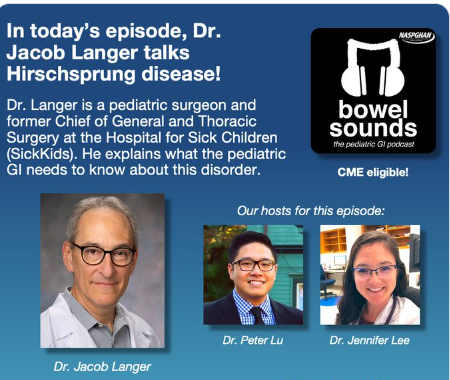
In terms of diagnosis, Dr. Langer recommended use of rectal suction biopsy as 1st step in smaller kids (less than 1 yr of age) and rectal manometry as 1st step in those older than 1 yr of age. He reviewed the three main operations:
Swenson -pulldown to anus
Duhamel -pouch: with an end-to-side anastomosis is performed with the remaining rectum
Soave -cuff: strip mucosa and leave a muscular cuff
He noted that he prefers Soave but that there is not clear superiority of one operation.
Other pointers:
Enterocolitis is #1 cause of mortality. If someone is coming in sick, worthwhile to start an in-and-out irrigation promptly. Irrigation information can be found on YouTube. From Colorado Children’s: Rectal Irrigations for Hirschsprung
He pioneered the use of Anal Botox for children post-operatively. Many children with obstructive symptoms related to sphincter malfunction will improve with time and this often allows a child to avoid a myectomy
He described workup for post-operative soiling and potential pathophysiology: muscle issues (manometry), sensory issues, functional retention with overflow, and hypermotility (sigmoid propelling stool rapidly which may improve with imodium)
Dr. Langer is also a musician — you can listen to his music here.
Disclaimer: This blog, gutsandgrowth, assumes no responsibility for any use or operation of any method, product, instruction, concept or idea contained in the material herein or for any injury or damage to persons or property (whether products liability, negligence or otherwise) resulting from such use or operation. These blog posts are for educational purposes only. Specific dosing of medications (along with potential adverse effects) should be confirmed by prescribing physician. Because of rapid advances in the medical sciences, the gutsandgrowth blog cautions that independent verification should be made of diagnosis and drug dosages. The reader is solely responsible for the conduct of any suggested test or procedure. This content is not a substitute for medical advice, diagnosis or treatment provided by a qualified healthcare provider. Always seek the advice of your physician or other qualified health provider with any questions you may have regarding a condition.
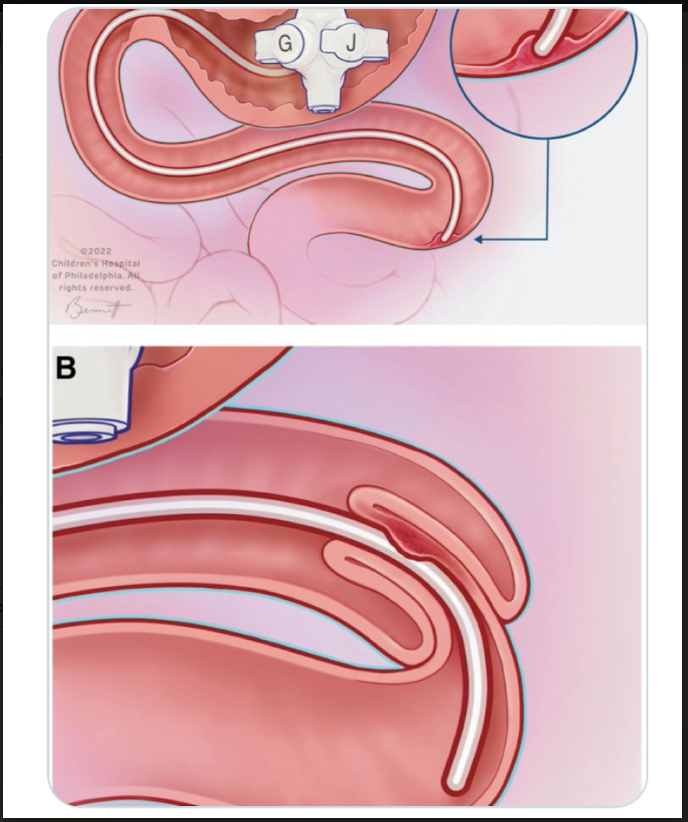
In this retrospective study, 46 GJ intussusceptions were identified; patients had a median age of 2.8 years. Key findings:
There were 7 recurrences (15.2%).
There was no difference in recurrence based on time of bowel rest (5 days in those without vs 6 days in those with, P = 0.30) nor a difference in recurrence with <72 hours of bowel rest compared to >72 hours (1/15, 6.7% vs 6/31, 19.3%)
In 15 patients who had a smaller GJ tube replaced, there were no recurrences compared with 7 recurrences among 29 (24%) that had the same caliber GJ tube replaced (P=0.08)
My take: This study indicates that prolonged removal of GJ is not needed with GJ intussusception and if feasible, consider replacement with a smaller (or shorter) GJ tube.
Key finding: In this cluster randomized controlled trial (n=181, ages 6-10 years), screen media reduction in the treatment group resulted in an increase of 45.8 minutes per day of physical activity compare to the usual routine group.





 gutsandgrowth