

A brief commentary (LS Dafny et al. NEJM 2016; 375: 2013-15) helps explain how easy it is to prevent high-value care. The authors note that one example of encouraging high-value care is to tier drugs in insurance plans. Insurers can encourage consumers to use drugs that provide high value by providing lower copays (lower tier) and at the same time this allows the insurers some leverage with pharmaceutical manufacturers in negotiating prices of their medications. Roughly 75% of insurance plans have at least three drug tiers.
The pharmaceutical companies have “counterattacked” by offering “copayment coupons.” Since insurers still pay ~80% of the costs, even with these coupons, the manufacturers are able to shift spending to higher-priced medications and still make a considerable profit. The net effect of copayment coupons:
The authors note that health care providers may ultimately pursue similar pathways to try to get around insurance companies preferred provider panels. This could occur as insurance companies increasingly try to control costs by demanding steep discounts from providers in exchange for inclusion in more limited networks.
My take: Providing high value care is not the chief concern for private industry. Both the insurance companies and the pharmaceutical companies develop policies and countermoves to further their best interests.
Related blog posts:

Jones Bridge Trail
Multiple sources have reported that the anti-vaccine crowd is pleased with the results of the 2016 presidential election.
From Slate (11/22/16): Trump reportedly assured vaccine skeptics of of his support
An excerpt:
The president-elect has a long history of vaccine misinformation; he first began to express his beliefs that there might be a relationship between vaccines and autism nearly a decade ago—years after this association was scientifically discredited. He’s repeated these ideas over the years, and he never found it necessary to correct or refine his position during the election…
Jennifer Larson, CEO of the autism-focused Holland Center, in which she explained that she and other vaccination skeptics discussed their concerns with Trump at a donor event in August. According to her account, Trump assured them that he’s on their side.
From StatNews (11/30/16): Meeting with Trump emboldens anti-vaccine activists, who see an ally in the Oval Office
An excerpt:
“For the first time in a long time, I feel very positive about this, because Donald Trump is not beholden to the pharmaceutical industry,” movement leader Andrew Wakefield told STAT in a phone interview…
A former doctor whose medical license was revoked, Wakefield launched the movement to question the safety of vaccines nearly two decades ago with a fraudulent study (which has since been retracted) suggesting that a widely administered vaccine against measles, mumps, and rubella can cause autism…
Those who seek to undercut trust in vaccines “see in Donald Trump a fellow traveler — someone who, like them, is willing to basically ignore scientific studies and say, ‘This is true. Vaccines cause autism because I believe it’s true,’” said Dr. Paul Offit, the head of the infectious diseases department at Children’s Hospital of Philadelphia.
My take: There is a reason anti-vaxxers see Donald Trump as a fellow traveler.

Acadia Natl Park
A recent NPR report: Americans Don’t Trust Scientists’ Take On Food Issues
This reports how frequently misinformed the US public is about is about food safety issues but at least this information is not associated with partisan political views.
An excerpt:
39 percent of the survey participants believe that genetically modified foods are worse for your health than non-GM food. However, there’s essentially no scientific evidence to support that belief — a conclusion confirmed most recently by a National Academy of Sciences report…
Americans believe that there’s no scientific consensus on GMOs. Just over 50 percent of respondents believe that “about half or fewer” of scientists agree that GM foods are safe to eat. Only 14 percent’s beliefs match the reality — that “almost all” scientists agree that GM foods are safe to eat…
Roughly equal shares of Republicans and Democrats (39 percent versus 40 percent) feel that GMOs are worse for people’s health. More Democrats than Republicans (60 percent versus 50 percent) believe that organic foods are healthier. It’s significant, but not a huge difference….
Related posts:
Here’s another related link: NY Times Stop Bashing GMO Foods

Ft Knox, Maine
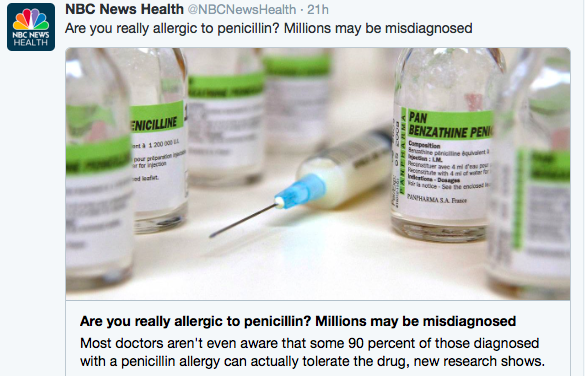
Here’s a link to the video story regarding misdiagnosis of penicillin allergy: Your Allergy to Penicillin May Be Non-Existent
Link to print version: Allergy to Penicillin?
An excerpt: Dr. Thanai Pongdee, an allergist at the Mayo Clinic in Jacksonville, Florida and colleagues tested 384 people who said they were allergic to penicillin. Tests showed 94 percent of them were in fact, not allergic.
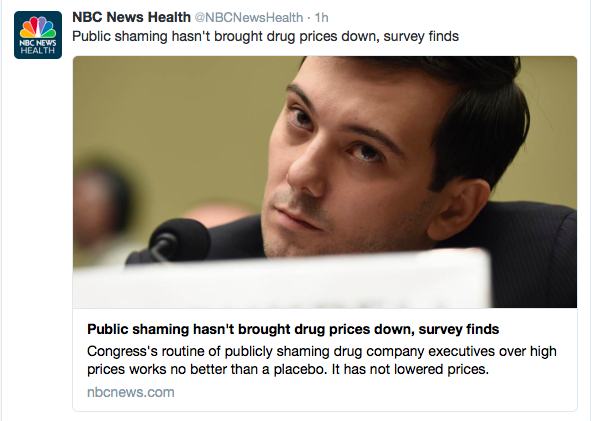
From NBC News: Congress Doesn’t Scare Drug Execs Into Lowering Prices
Excerpt:
Congress’s routine of publicly shaming drug company executives over high prices works no better than a placebo: It may make some people feel better, but it doesn’t treat the problem…
But a review by The Associated Press of the list prices of nearly 30 brand-name medications and generic versions targeted by congressional investigators shows most haven’t budged since coming under federal scrutiny, according to figures from Truven Health Analytics.
Related posts:
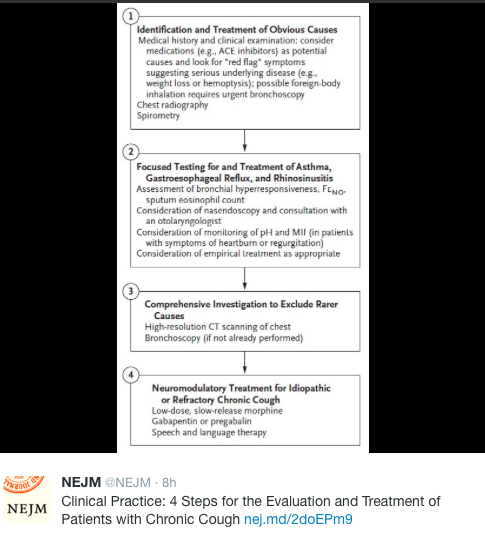
It is not uncommon for a pediatric gastroenterologist to see a patient with a chronic cough due to concerns about potential gastroesophageal reflux disease (GERD). As such, a recent clinical practice article (JA Smith, A Woodcock. NEJM 2016; 375: 1544-51) by lung specialists was of interest, even though this article was not targeted to the pediatric population.
Key points:
GERD:
My take: In the absence of clinical reflux, reflux therapy is unlikely to help with chronic cough. However, in patients with an adequate workup, an empiric course of a PPI is likely more preferable than empiric morphine or gabapentin.
Related blog posts:

A new study provides some reassurance that anesthesia at a young age is unlikely to cause harm (little to no effect) in most children.
Full text: P Glatz et al. JAMA Pediatrics, Published online November 7, 2016. doi:10.1001/jamapediatrics.2016.3470: Association of Anesthesia and Surgery During Childhood with Long-Term Academic Performance
Findings In this cohort study among 33 514 exposed children, exposure to surgery with anesthesia before age 4 years was associated with 0.41% lower school grades and 0.97% lower IQ test scores, with no difference in school grades with regard to age. The overall difference was markedly less than the differences associated with sex, maternal educational level, or month of birth during the same year.
Comment: Despite efforts to control for indications which of themselves could impact the results, it is quite possible that the small changes detected in this study are a result of confounding factors rather than due to the anesthetic itself.
My take (from the authors): “Exposure to anesthesia and surgery before age 4 years is associated with a small difference in academic performance or cognitive performance in adolescence on a population level. The magnitude of this association should be interpreted in light of potential adverse effects of postponing surgery.”
Related blog post: More evidence of anesthetic neurotoxicity


