Why Exercise is Good For Health

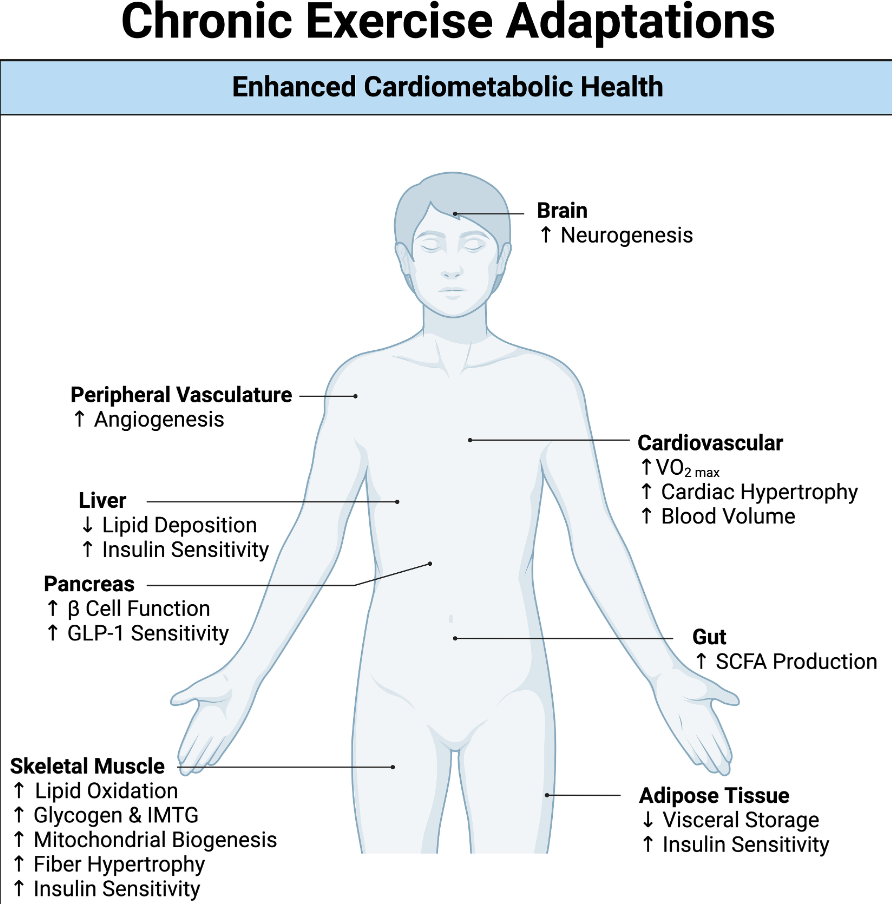
SP Ashcroft et al. Cell Metabolism 2024; https://doi.org/10.1016/j.cmet.2023.12.008. Open Access! Exercise induces tissue-specific adaptations to enhance cardiometabolic health

This is a 23 page review with 395 references.

“The risk associated with multiple cancers, cardiovascular disease, diabetes, and all-cause mortality is decreased in individuals who meet the current recommendations for physical activity…Over time, the associated metabolic stress of each individual exercise bout provides the basis for long-term adaptations across tissues, including the cardiovascular system, skeletal muscleadipose tissue, liver, pancreas, gut, and brain. Therefore, regular exercise is associated with a plethora of benefits throughout the whole body, including improved cardiorespiratory fitness, physical function, and glycemic control. Overall, we summarize the exercise-induced adaptations that occur within multiple tissues and how they converge to ultimately improve cardiometabolic health.”

Related blog posts:

Silencing the FDA’s Voice on Drug Information

T Watson, C Robertson. NEJM 2023; 389; 25: 2312-2314. Silencing the FDA’s Voice — Drug Information on Trial

Recently (9/1/23), “a panel of the Fifth Circuit Court of Appeals allowed a case to proceed against the Food and Drug Administration (FDA) concerning its public statements on the use of ivermectin for treating Covid-19.1“ Even though a district court had dismissed the suit due to “sovereign immunity,” the Fifth Court stated the FDA had exceeded its authority.

Some excerpts from this commentary:

Between August 2021 and April 2022, however, the agency released several public messages about ivermectin and Covid-19 — including an informal consumer update titled “Why You Should Not Use Ivermectin to Treat or Prevent COVID-19”

Three physicians who prescribed and promoted ivermectin for Covid-19 treatment sued the FDA, alleging that its statements interfered with their ability to practice medicine and harmed their professional reputations, even though they hadn’t been named by the FDA. One doctor claimed the agency’s statements had caused him to be referred to his state medical board; the others claimed to have lost admitting privileges at a hospital and a role at a medical school.

According to the Fifth Circuit, the FDA “has authority to inform, announce, and apprise — but not to endorse, denounce, or advise”….

The Fifth Circuit panel’s opinion is puzzling in light of the FDA’s long-standing and generally unquestioned role as a public health educator. The agency routinely releases consumer-directed information; for example, its website instructs consumers about the appropriate use of antibiotics and includes related clinical information. The opinion suggests the FDA may need to reevaluate each of these communications — an impractical proposition.

The opinion is also in tension with a long-standing constitutional principle known as the government speech doctrine, according to which the government can itself be a speaker, like any person or corporation, and isn’t required to be neutral when it expresses an opinion..

The Fifth Circuit’s holding reflects suspicion of agency influence, even in matters in which the agency is an expert speaking directly about products it regulates. The court’s interpretation of the FDA’s proper role may permit only narrow forms of expression...

Subsequent courts could use the Fifth Circuit’s logic to disempower other agencies with health-related missions, such as the Centers for Disease Control and Prevention and the Environmental Protection Agency… Meanwhile, “junk science” pervades social media and harms public health.2

My take: It is hard to believe that the justification for this challenge comes from three physicians prescribing ivermectin. It turns out the FDA’s advice was spot on and that these physicians were offering an ineffective therapy. This is a worrisome trend in which the judicial branch seeks

  1. To limit government agencies without explicit line-by-line authorization by a dysfunctional congress
  2. And to substitute its judgement over matters in which it has little expertise over governmental agencies tasked with protecting our country (eg. FDA, CDC, EPA, and others)

Here is a link to one of the FDA’s communications on Ivermectin –good advice (12/10/21): Why You Should Not Use Ivermectin to Treat or Prevent COVID-19

Related blog posts:

Bad Advice for COVID, Then and Now

  1. Hydroxychloroquine (HCQ) was used off-label for COVID-19 during the first wave despite the absence of evidence documenting its clinical benefits. A recent study has estimated that it resulted in an increase death rate of 11%. ”The number of hydroxychloroquine related deaths in hospitalized patients is estimated at 16,990 in six countries.” Ref: Open Access! A Pradelle et al. Biomedicine & Pharmacotherapy 2024; 171: 116055. Deaths induced by compassionate use of hydroxychloroquine during the first COVID-19 wave: an estimate
  2. NY Times 1/3/24: Citing Misinformation, Florida Health Official Calls for Halt to Covid Vaccines

An excerpt:

Florida’s surgeon general on Wednesday called for a halt to the use of Covid vaccines, citing widely debunked concerns that contaminants in the vaccine can permanently integrate into human DNA.

Dr. Ladapo’s latest contention is “very irresponsible,” said John Wherry, a vaccine expert and director of the Institute for Immunology at the University of Pennsylvania. “He has, however, demonstrated a tenuous grasp of science and medicine in general over the course of the pandemic so this is not surprising,” Dr. Wherry said….

For Dr. Ladapo’s claim to be true, humans would need to have an enzyme that can incorporate foreign DNA into their genomes. “We don’t have one,” said Dr. Eric Rubin, a member of the F.D.A.’s vaccine advisory committee and the editor in chief of the New England Journal of Medicine.

My take: The first article estimates the number of deaths due to the bad advice of using hydroxychloroquine. Perhaps in a few years, researchers will be able to calculate the number of deaths and hospitalizations that occur due to the bad advice of Florida’s surgeon general.

Related blog posts:

When Hospitals Look Like The Ritz (But Cost Even More)

The Atlantic, Elisabeth Rosenthal (11/17/23): Hospitals Have Gotten Too Nice

This article starts off discussing a recent trend of how medical problems are often described as a “journey.” However, the main focus is the trend of hospitals developing expensive amenities further adding to huge medical bills.

An excerpt:

So much of being seriously ill has been rebranded in American health care as a kind of adventure…But on these journeys, you don’t get to go anywhere—except maybe the hospital or doctor’s office, which is likely, too, to have bought into the travel concept. In the past two decades, American hospitals have gotten into the business of hotel-like hospitality (illness can be fun!) rather than confine themselves to the business of disease (what a downer). And although the care might stay solid, the focus on luxurious amenities and the fancy new buildings that house them is one of the factors that have helped send costs for patients soaring that much higher, to prices well above those in other developed countries…

In recent years, tight budgets, staffing shortages, and burnout have hit American hospitals. At the same time, many health centers in the U.S.—including the most prestigious ones, and even some community hospitals—have morphed into seven-star hotels…A hospital might now boast about its views, high-thread-count sheets, or food provided by a Michelin-starred chef…

Back in 2008, researchers at the National Bureau of Economic Research estimated that a hospital investing in amenities would increase demand by 38 percent, whereas a similar investment in clinical quality would lead to only a 13 percent increase…

These amenities have a cost, and they are not worth nearly what we’re paying for them as we’re billed for $100,000 joint replacements and $9,000 CT scans. Room charges in many hospitals can exceed $1,000 a night. And “facility fees” for outpatient procedures and even office visits can reach hundreds of dollars, and simply don’t exist elsewhere. A hospital’s function is to diagnose and to heal, at a price that sick people can afford. I dream of a no-frills Target- or Ikea-like hospital for care…

How about focusing on the very basic things that health systems in the U.S. should do, but—in my experience—in many cases do not, like making it easier for patients to schedule appointments? Shortening the now lengthy wait times to see physicians who take insurance plans? Paying for adequate staffing on nights and weekends, so patients don’t linger in bed pointlessly for two days until social workers return on Monday? Or ending those two-day stays in emergency rooms when all inpatient beds are full? 

Related blog posts:

Obidos, Portugal

Personal Account of Extreme Short Bowel Syndrome

Jeff Lewis, one of my colleagues for the last 25 years, recently shared a story on The Moth Atlanta. For those of you who have not been to The Moth, you can hear many of these stories on NPR (The Moth Radio Hour) or The Moth Podcast. Each session has a topic and 10 people are invited to share their heartfelt and sometimes hilarious stories.

Jeff is a brilliant, innovative individual and a good friend. Some of his diverse accomplishments include helping start a camp for our celiac patients (Camp WeeKanEatit), starting our microbiome transplant program (FMT), advancing the health of special needs kids (given an award for this by the Georgia Department of Public Health) and starting a lecture series to honor our surgical colleague Donald Schaffner. He even prompted changes in the hospital’s advice line. In addition, he has been instrumental in making the business part of our office work and in initiating a whole host of research projects. One of his children has told me that Jeff has a calling as a clinician which is so true.

Here is the kind, sad and thoughtful story he shared (6 min): The Moth (YouTube Link -not available without link https://youtu.be/yK-iOMSDlYM)

My take: It would be a great idea to have a Moth-type session at our national meeting. I enjoy listening to these stories particularly on long trips.

Per google search: “The Moth was founded in 1997 by the writer George Dawes Green — its name comes from his memories of growing up in St. Simons Island, Ga., where neighbors would gather late at night on a friend’s porch to tell stories and drink bourbon as moths flew in through the broken screens and circled the porch light.”

Related blog post: Short Bowel Syndrome is a Full Time Job

Changing Approach to Pain Management

Recently, Amy Baxter, who is the inventor and CEO of BuzzyHelps.com, VibraCool.com ,
Distraction cards, and DuoTherm, gave a terrific update on chronic pain and new ways to help. She has given a TED talk on this topic as well with about 1 million views

TED talk (April 2023): Amy Baxter: How to Hack Your Brain When You are in Pain (12 minute talk and then 4 minutes for Q&A)

Some of her slides:

Some of her key points:

  • Needle phobia has broader health impacts like lowering immunization rates in adults
  • Pain is contextual and often related to fear. Many individuals with fear of vaccines and blood draws do fine with extensive tattooing
  • Exercise helps pain gradually. 10 minutes of exercise twice a day in which one raises their heart rate is sufficient
  • Focus on function/activities not on pain levels. Expect some pain after insults/injuries.
  • Distraction is useful. During intense pain, one can count the “holes” in the letters to relieve pain. [23 letters bolded in last two sentences, see 2nd to last slide)
  • Justin Schmidt helped advance pain science by allowing himself to be stung by multiple insects and describing the type of pain induced. (Schmidt JO. 1983 Archives of Insect Biochemistry and Physiology. 1 (2): 155–160)
  • Previous efforts to eliminate pain with “non-addictive” narcotics and describe pain as a 5th vital sign were big mistakes. Focus should be on getting more comfortable rather than eliminating pain
  • Gate control of pain -motion helps limit pain
  • Focusing on pain increases pain. Focus on valued activity and movement reduces pain
  • “Pain is the opinion of the brain about how safe you are.” Sometimes you have to tell the brain that everything is fine
Counting “holes” in letters helps as a distraction during severe pain

Related blog posts:

“A Reason to Retire?”

N Berman. NEJM 2023; 389: 1354-1355. A Reason to Retire?

If you regularly read the NEJM, what did you think about this article? Personally, I could relate a lot to the commentary.

The article starts off with the author, at the time in his 40s, chiding a colleague who was considering retiring at age 64 despite being very capable. His colleague responded: “My patients’ illnesses are starting to get to me.” Now, the author in his 70s has a different perspective.

Some excerpts:

Having just retired myself at 71, I now understand exactly what he meant…As a young physician, I was able to compartmentalize illness: it was something that happened to my patients, not to me. I could understand their illnesses, but I never saw myself in their place. I would try to alleviate their suffering, but my primary task was to diagnose and treat their condition. 

I needed the distance from their suffering to be able to face the same situation with the next patient. Empathizing was not considered “professional,” but I think the real reason for avoiding it was that it undermined our defenses against the disappointment of failing in our mission to cure disease…”

Objectivity helped me cope with the stress of dealing with my patients’ life-threatening and life-changing situations. It enabled me to see my work in a more intellectual and less emotional light…

But as I grew older, this distinction became harder to maintain… My patients and their problems became more difficult to compartmentalize as separate from me. I started to feel the “extra-medical” aspects of their illnesses much more acutely than I had when I was younger — the unfairness of disease, the inevitability of age and the breakdown of the body.”

My take: As I have become older, it is harder to compartmentalize some of the suffering that I have witnessed. Even though this can help with empathy, I would rather forget a few of these experiences.

Related blog posts

Castelo de São Jorge in Lisbon

Cautionary Tale: Chronic Pain and Accusations of Medical Child Abuse

One of our excellent APPs ,Alison Miller, recommended a movie this week called “Take Care of Maya.” It is available on Netflix.

While this is a one-sided account, it provides a well-documented perspective of a family accused of medical child abuse. It is probably a good idea for anyone involved from the medical side of child abuse to watch this movie; it will help them understand a family’s, often awful, experience with this process and may help with providing better care.

Here’s the trailer: Take Care of Maya (1:30)

Related blog posts:

Why It is Still Not a Good Idea to Test Healthy Children for Enteric Pathogens & Infant Mortality Rates Rising in Georgia (& much of U.S.)

BR Lee et al. J Pediatr 2023; 261: 113551. A Comparison of Pathogen Detection and Risk Factors among Symptomatic Children with Gastroenteritis Compared with Asymptomatic Children in the Post-rotavirus Vaccine Era

Patients (<11 yrs old) with acute gastroenteritis (AGE, n=2503) and healthy controls (HC, n=537) old enrolled in the New Vaccine Surveillance Network study between December 2011 to June 2016. Key findings:

  • One or more organisms was detected in 1159 of 2503 children (46.3%) with AGE compared with 99 of 537 HC (17.3%).
  • Norovirus was detected most frequently among AGE (n = 568 [22.7%]). The other frequent pathogens detected were rotavirus 7.8% (despite ~75% vaccinated population), adenovirus 4.8%, C difficile 5.3%, Salmonella 6.4%, and Shigella 4.5%. 63.5% of all pathogens detected were viruses.
  • C difficile was detected more frequently in the HC population (7% vs 5.3%). E coli infections, likewise, were very commonly observed in the HC population (2.1% vs 1.1%). The false positive rates for C difficile pathogenicity would have been higher if the authors had not restricted their analysis to >12 months for C diff. The rates of Norovirus and Rotavirus in the HC group was 6.8% and 2.6% respectively.
  • Codetection of multiple pathogens was common. For example, with norovirus, 20.8% had a copathogen detected. Salmonella and C difficile had the highest codection rates of 53.5% and 54.5% respectively.

This study shows substantial improvement in rotavirus infections with a drop from 26% in detection prior to vaccine era to 6% afterwards.

My take: These muliplex molecular assays are quite useful and have improved our ability to determine underlying infections. This is particularly useful in children with underlying diseases (eg. IBD, malignancy). However, this report serves as a cautionary note that many pathogens, including C diff and E coli, are frequently identified with PCR assays in healthy children

Related blog posts:

In 2022, 892 infants died in Georgia, an increase of 116 from prior year. About 7 infants dying for every 1000 births. AJC 11/1/23: CDC: Georgia’s infant mortality increase is among the worst in U.S.

Bromelia