Surprise $urgical Billing –Affects 1 in 5

A recent study has shown how pervasive surprise billing has become.  This is another area in medicine in which deceptive billing practices undermine the relationship between families and health care providers.

Related blog posts:

Legislative Agenda for Drug Pricing

There have been some recent terrific advances in pharmacology –a few that come to mind:

The one common feature is that these are all very expensive; there are many other expensive medications with less benefit.  Given the rise in costs of these medications, there is a need to do a better job in getting good value in our drug costs.  A potential path forward is outlined in a recent commentaries (SB Dusetzina, J Oberlander. NEJM 2019; 381: 2081-4; PB Bach. NEJM 2019; 381: 2084-6).

In the first commentary, the authors review the Elijah E Cummings Lower Drug Costs Now Act of 2019 (HR 3).

  • In essence, this act establishes a drug-price negotiation process and limits price increases on existing products.  “Companies whose products are selected for ‘negotiation’ will in reality face price regulation and a severe penalty for noncompliance.”
  • The act would examine U.S. prices compared to prices paid in other countries.  “There would also be a legislatively set maximum price that could not exceed 120% of the average net price paid for the same drug in designated countries.”
  • The bill also would cap Medicare Part D out-of-pocket spending at $2000 per year.

In the second commentary, Dr. Bach notes that drugs that have too little evidence to support full approval and those that are ‘too late in their life cycle’ both should have their pricing negotiated by the government.  This would side step some of the arguments about undermining the incentive for new drug development.

“Too little”

  • The FDA grants approval of some drugs on the market conditionally on the basis of data indicating that they improve a surrogate marker of patient benefit. “Despite the conditional nature of the approval, …the pharmaceutical firms currently charge the same high prices that fully approved drugs capture.”
  • Required studies frequently show that these conditionally-approved medications are ineffective.  Of the 198 indications granted accelerated approval since 1992, only 115 have garnered full approval.  Also, conditional approval may result in less incentive to complete the needed trials in a timely fashion.

“Too late”

  • In this category, the author notes that some medications have found many ways to extend their monopolies, which are intended as a time-limited reward for the effort of developing a new medication.  These include overlapping patents, refusing to provide samples to competitors, and paying other companies to delay bringing generic or biosimilar products to market
  • Most of the potential for savings are in this category rather than the ‘too little’ category
  • Negotiating prices of the top 10 too little and 10 too late medications with reference to 120% of UK pricing would have provided about nearly 27 billion in savings in 2019

My take: While current partisanship makes reaching agreement difficult, targeting soaring pharmaceutical costs is one area in which I predict common ground can be found.  While many are going to benefit from the therapeutic advances listed above, there are other medications which are overpriced and should be negotiated like in other high-income countries.

Related blog posts:

Bathroom mural for bicycle enthusiasts (at a stop on the Petit Train du Nord Linear Park)

“America’s Huge Health Care Problem”

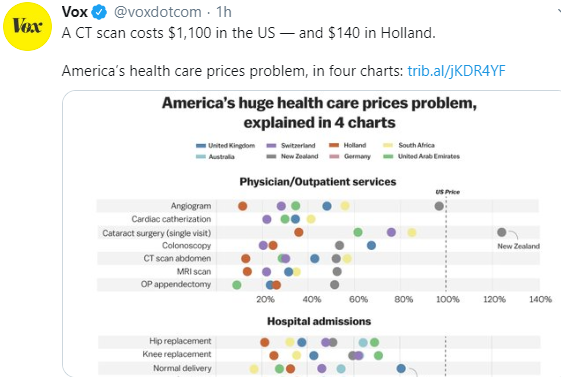
From Vox: A CT scan costs $1,100 in the US — and $140 in Holland

An excerpt:

The Health Care Cost Institute put out a new report Tuesday showing how the prices paid for medical services by private insurance in the United States stack up against prices in other countries. As expected, American prices are collectively higher than the rest.

But four charts, based on the report, show just how thoroughly the United States is outspending other countries for almost every medical service or prescription drug.

Image Available on Twitter and Can be Found in Article

Related blog posts:

Healthcare: “Where the Frauds Are Legal”

A recent NY Times commentary: “Where the Frauds Are Legal” details another group of problems with health care economics.  These problems are on top of a long list of other problems which at their core relate to lack of price transparency/hidden charges and excessive charges for some services.

Here’s an excerpt:

Much of what we accept as legal in medical billing would be regarded as fraud in any other sector…

Medical Swag…Companies are permitted by insurers to bill for “durable medical equipment,” stuff you receive for home use when you’re in the hospital or doctors’ office. That yields some familiar marked-up charges, like the sling you can buy at Walgreens for $15 but for which you or your insurer get a bill for $120 after it is given to you at urgent care…

The Cover Charge…Trauma activation fees have been allowed since 2002, after 9/11, when the Trauma Center Association of America, an industry group, convinced regulators that they needed to be compensated for maintaining a state of “readiness.”…

Impostor Billing…We received bills from doctors my husband never met… for bedside treatment from people who never came anywhere near the bed to deliver the care…

The Drive-By…There was no significant health service given. Just an appearance and some boxes checked on a form. It’s a phenomenon called drive-by doctoring.

The Enforced Upgrade…[like meeting] in the emergency room [because clinic is closed]

Why do insurers pay? Partly because insurers have no way to know whether you got a particular item or service. But also because it’s not worth their time to investigate the millions of medical interactions they write checks for each day. Despite the advertised concern about your well-being, as one benefits manager enlightened me: They’re “too big to care about you.”…these are all everyday, normal experiences in today’s health care system, and they may be perfectly legal. If we want to tame the costs in our $3 trillion health system, we’ve got to rein in this behavior, which is fraud by any other name.

My take: I find it troubling to be a cog in a system that has such devious billing practices.  This particularly relates to my interactions when providing hospital-based care.  In our office, we have at least some measure of control and we can offer services like outpatient endoscopy at one-third of the cost compared to hospital-based endoscopy; similarly, our outpatient infusions are much more cost-effective than hospital-based infusions.

In terms of the health care system, my expectation is that there is not a strong enough incentive or empowerment for physicians to tackle rising health care costs (& low value care) and as such the industry will face a reckoning from outside forces.

Related blog posts:

Hidden Costs of Medical Schools

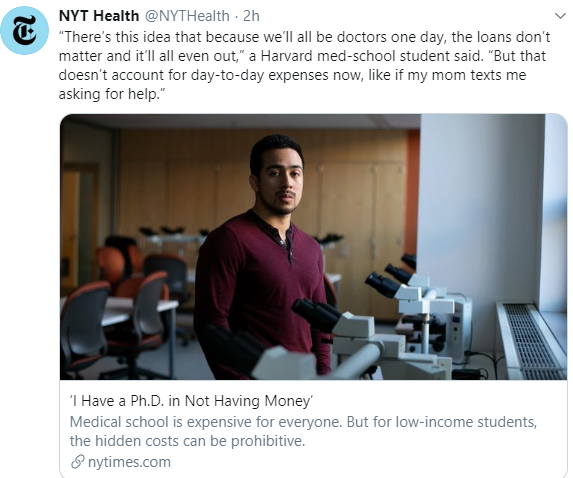
From NY Times: ‘I Have a Ph.D. in Not Having Money’

An excerpt:

Medical school is expensive for everyone. But for low-income students, the hidden costs can be prohibitive…

American medical schools are the training grounds for a white-collar, high-income industry, but they select their students from predominantly high-income, and typically white, households…Between 1988 and 2017, more than three-quarters of American medical school students came from affluent households…

Students from low-income families who choose to apply to medical school find the path lined with financial obstacles. The application phase entails MCAT registration ($315) and preparation, application fees ($170 for the first school and $40 for each additional one), travel and attire for interviews (on average more than $200 per school). After enrollment, students are expected to purchase equipment and study aids. Each year brings new certification tests, with registration fees running upward of $600.

Aspiring doctors know that tuition is costly; the median educational debt held by medical school graduates in 2018 was $200,000, up 4 percent from the previous year. But less advertised are all the hidden costs of a medical education.

Rising ER Costs & Changes in Billling Codes

USAToday: ‘Really astonishing’: Average cost of hospital ER visit surges 176% in a decade, report says

An excerpt:

The average emergency room visit cost $1,389 in 2017, up 176% over the decade. That is the cost of entry for emergency care; it does not include extra charges such as blood tests, IVs, drugs or other treatments…

In 2008, 17% of hospital visits were charged the most expensive code. That surged to 27% of visits in 2017, the report said. The average price for the most expensive code more than doubled from $754 in 2008 to $1,895 in 2017.

Hospitals also increased billings for the second most expensive code, but they billed the three least expensive codes less often compared to a decade ago.

Related blog posts:

Healthcare Company CEO Salaries

Becker’s Hospital Review: Highest-paid CEOs in 2018: Who made the list from healthcare  The full list includes 200 chief executives from public companies with revenue of at least $1 billion. Thanks to Jeff Lewis for pointing out this list.

Total compensation may include salary, bonuses, perks, stock and options.

  1. Hologic, Stephen MacMillan — $42 million
  2. Align Technology, Joseph Hogan — $42 million
  3. Regeneron Pharmaceuticals, Leonard Schleifer — $27 million
  4. Centene, Michael Neidorff — $26 million
  5. Universal Health Services, Alan Miller — $24 million
  6. Abbott Laboratories, Miles White — $23 million
  7. CVS Health, Larry Merlo — $22 million
  8. Merck, Kenneth Frazier — $21 million
  9. Abbvie, Richard Gonzalez — $21 million
  10. Johnson & Johnson, Alex Gorsky — $20 million
  11. HCA Healthcare, R. Milton Johnson — $20 million
  12. Pfizer, Ian Read — $20 million
  13. Bristol-Myers Squibb, Giovanni Caforio — $19 million
  14. Cigna, David Cordani — $19 million
  15. Vertex Pharmaceuticals, Jeffrey Leiden — $19 million
  16. Thermo Fisher Scientific, Marc Casper — $19 million
  17. Amgen, Robert Bradway — $19 million
  18. UnitedHealth Group, David Wichmann — $18 million
  19. DaVita, Kent Thiry — $17 million
  20. Gilead Sciences, John Milligan — $17 million
  21. Alexion Pharmaceuticals, Ludwig Hantson — $16 million
  22. Humana, Bruce Broussard — $16 million
  23. Celgene, Mark Alles — $16 million
  24. Biogen, Michel Vounatsos — $16 million
  25. United Therapeutics, Martine Rothblatt — $16 million
  26. IQVIA Holdings, Ari Bousbib — $16 million
  27. Eli Lilly, David Ricks — $16 million
  28. Baxter International, José Almeida — $16 million
  29. Biomarin Pharmaceutical, Jean-Jacques Bienaimé — $16 million
  30. Danaher, Thomas Joyce Jr. — $15 million
  31. Molina Healthcare, Joseph Zubretsky — $15 million
  32. Tenet Healthcare, Ron Rittenmeyer — $15 million

Canaletto.  El Gran Canal desde San Vio. Thyssen-Bornemisza Museum. https://www.museothyssen.org/en/collection/artists/canaletto/grand-canal-san-vio-venice


What Went Wrong with EMRs: Death by a Thousand Clicks

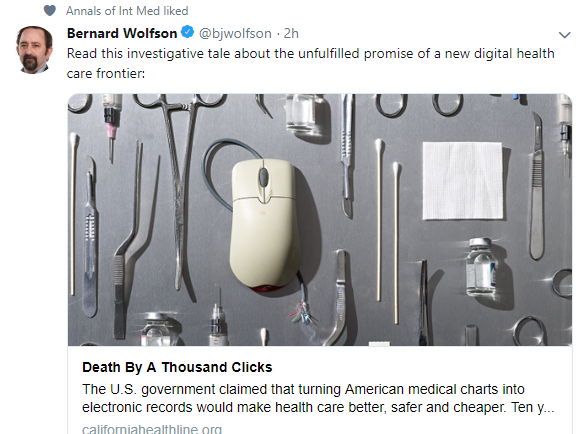
Link: Death by a Thousand Clicks Where Electronic Health Records Went Wrong

This lengthy article highlights a lot of issues with EMRs/EHRs including data sharing between systems, pulldown menus, disruption of physician-patient interactions, upcoding, safety risks and provides numerous personal examples.

An excerpt:

The U.S. government claimed that turning American medical charts into electronic records would make health care better, safer, and cheaper. Ten years and $36 billion later, the system is an unholy mess…

Instead of reducing costs, many say, EHRs, which were originally optimized for billing rather than for patient care, have instead made it easier to engage in “upcoding” or bill inflation…

More gravely still, a months-long joint investigation by KHN and Fortune has found that instead of streamlining medicine, the government’s EHR initiative has created a host of largely unacknowledged patient safety risks…

Compounding the problem are entrenched secrecy policies that continue to keep software failures out of public view. EHR vendors often impose contractual “gag clauses” that discourage buyers from speaking out about safety issues and disastrous software installations…

EHRs promised to put all of a patient’s records in one place, but often that’s the problem. Critical or time-sensitive information routinely gets buried in an endless scroll of data, where in the rush of medical decision-making — and amid the maze of pulldown menus — it can be missed…

[Problem with scrolldown options]: [doctors] had to read the list carefully, so as not to click the wrong dosage or form — though many do that too..

The numbing repetition, the box-ticking and the endless searching on pulldown menus are all part of what Ratwani called the “cognitive burden” that’s wearing out today’s physicians and driving increasing numbers into early retirement…

Beyond complicating the physician-patient relationship, EHRs have in some ways made practicing medicine harder,.. “Physicians have to cognitively switch between focusing on the record and focusing on the patient,” … “Texting while you’re driving is not a good idea.a.. But in medicine … we’ve asked the physician to move from writing in pen to [entering a computer] record, and it’s a pretty complicated interface.

My take: This article makes many good points.  Though, if you polled physicians in our group, hardly any would choose to go back to what we had before EMRs.

Related blog posts:

Tackling High Drug Costs -Lessons from Australia and Brazil

In two related commentaries referenced below, the authors detail how Australia and Brazil managed to provide a blockbuster hepatitis C virus (HCV) medication without following the going-broke example of Blockbuster video stores.

  • Australia: S Moon et al. NEJM 2019; 380: 607-9
  • Brazil: EM da Fonseca et al. NEJM 2019; 605-6.

Australia provided a lump-sum payment of approximately 770 million dollars (in U.S.) over 5 years in exchange for an unlimited volume of direct-acting antivirals (DAAs). As a result of this approach, Australia managed to treat many more patients at a much lower cost.  “The government would have to spend …U.S. $4.92 billion more to treat the same number or it could treat 93,000 fewer patients with a fixed budget” of approximately U.S. $766 million.

With the Australian approach, the authors note that it is analogous to a patent buyout and works if the ongoing drug manufacturing cost is low and the manufacturer is able to meet growing volume demand.

Brazil’s approaches for DAAs relied on either threatening loss of patent protections and/or enabling local generic production of sofosbuvir.  This resulted in ~90% price discount. Patent protection in Brazil is granted only if a medication is approved by both INPI (Instituto Nacional da Propriedade Industrial) and ANVISA (Brazilian Health Regulatory Agency).

My take: Given the rising costs of medicines, examining how other countries surmount these financial barriers is important.  In my view, the often arbitrary and exorbitant pricing by pharmaceutical companies will erode the support of protective policies in the U.S. which thus far has helped produce many advances.

Skull Rock, Joshua Tree National Park


“Grateful Patient Programs”

From NY Times: Hospitals Are Asking Their Own Patients to Donate Money

This article in the NY Times reviews a growing trend of non-profit hospitals asking patients for contributions; sometimes, physicians are asked to help identify potential donors.

An excerpt:

Many hospitals conduct nightly wealth screenings — using software that culls public data such as property records, contributions to political campaigns and other charities — to gauge which patients are most likely to be the source of large donations…

These various tactics, part of a strategy known as “grateful patient programs,” make some people uncomfortable…it could make patients worry that their care might be affected by whether they made a donation.

My take: Should hospitals simplify the process by adding a line on the bill for a tip?

Badwater basin, Death Valley