Little Evidence to Support Dietary Intervention in Autism Spectrum Disorders

Thanks to Kipp Ellsworth Twitter feed for reference:  Nutritional and Dietary Interventions for Autism Spectrum Disorder: A Systematic Review N Sathe Pediatrics 2017; vol 139.

Abstract:

CONTEXT: Children with autism spectrum disorder (ASD) frequently use special diets or receive nutritional supplements to treat ASD symptoms.

OBJECTIVES: Our objective was to evaluate the effectiveness and safety of dietary interventions or nutritional supplements in ASD.

DATA SOURCES: Databases, including Medline and PsycINFO.

STUDY SELECTION: Two investigators independently screened studies against predetermined criteria.

DATA EXTRACTION: One investigator extracted data with review by a second investigator. Investigators independently assessed the risk of bias and strength of evidence (SOE) (ie, confidence in the estimate of effects).

RESULTS: Nineteen randomized controlled trials (RCTs), 4 with a low risk of bias, evaluated supplements or variations of the gluten/casein-free diet and other dietary approaches. Populations, interventions, and outcomes varied. Ω-3 supplementation did not affect challenging behaviors and was associated with minimal harms (low SOE). Two RCTs of different digestive enzymes reported mixed effects on symptom severity (insufficient SOE). Studies of other supplements (methyl B12, levocarnitine) reported some improvements in symptom severity (insufficient SOE). Studies evaluating gluten/casein-free diets reported some parent-rated improvements in communication and challenging behaviors; however, data were inadequate to make conclusions about the body of evidence (insufficient SOE). Studies of gluten- or casein-containing challenge foods reported no effects on behavior or gastrointestinal symptoms with challenge foods (insufficient SOE); 1 RCT reported no effects of camel’s milk on ASD severity (insufficient SOE). Harms were disparate.

LIMITATIONS: Studies were small and short-term, and there were few fully categorized populations or concomitant interventions.

CONCLUSIONS: There is little evidence to support the use of nutritional supplements or dietary therapies for children with ASD.

Related blog post: Gluten-free, Casein-free -No improvement in Autism

Bayeux, France

Treatment of Childhood Obesity Can Be Focused on Parent(s) -Children Do Not Need to Attend

From JAMA Pediatrics Full Text: Effect of Attendance of Child on Obesity Treatment

(Thanks to NASPGHAN twitter feed for this reference) KN Boutelle et al. JAMA Pediatr. Published online May 30, 2017. doi:10.1001/jamapediatrics.2017.0651

From Abstract:

Importance  Family-based weight loss treatment (FBT) is considered the gold-standard treatment for childhood obesity and is provided to the parent and child. However, parent-based treatment (PBT), which is provided to the parent without the child, could be similarly effective and easier to disseminate.

Objective  To determine whether PBT is similarly effective as FBT on child weight loss over 24 months. Secondary aims evaluated the effect of these 2 treatments on parent weight loss, child and parent dietary intake, child and parent physical activity, parenting style, and parent feeding behaviors.

Design, Setting, and Participants  Randomized 2-arm noninferiority trial conducted at an academic medical center, University of California, San Diego, between July 2011 and July 2015. Participants included 150 overweight and obese 8- to 12-year-old children and their parents.

Interventions  Both PBT and FBT were delivered in 20 one-hour group meetings with 30-minute individualized behavioral coaching sessions over 6 months. Treatments were similar in content; the only difference was the attendance of the child.

Main Outcomes and Measures  The primary outcome measure was child weight loss (body mass index [BMI] and BMI z score) at 6, 12, and 18 months post treatment. Secondary outcomes were parent weight loss (BMI), child and parent energy intake, child and parent physical activity (moderate to vigorous physical activity minutes), parenting style, and parent feeding behaviors.

Results  One hundred fifty children (mean BMI, 26.4; mean BMI z score, 2.0; mean age, 10.4 years; 66.4% girls) and their parent (mean BMI, 31.9; mean age, 42.9 years; 87.3% women; and 31% Hispanic, 49% non-Hispanic white, and 20% other race/ethnicity) were randomly assigned to either FBT or PBT. Child weight loss after 6 months was −0.25 BMI z scores in both PBT and FBT. Intention-to-treat analysis using mixed linear models showed that PBT was noninferior to FBT on all outcomes at 6-, 12-, and 18-month follow-up with a mean difference in child weight loss of 0.001 (95% CI, −0.06 to 0.06).

Conclusions and Relevance  Parent-based treatment was as effective on child weight loss and several secondary outcomes (parent weight loss, parent and child energy intake, and parent and child physical activity). Parent-based treatment is a viable model to provide weight loss treatment to children.

My take: This study indicates that parental instruction is likely the key element in improving outcomes in childhood obesity.  In many cases, counseling parents without the presence of the child (patient) could improve ease of scheduling.  In other cases, parents may prefer for direct childhood involvement.  On a tangential note, the absence of the child may make billing issues (often a problem regardless) more complicated.

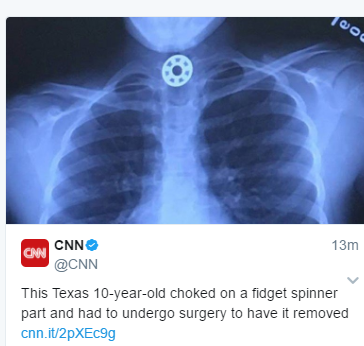
I’ve recently noted the popularity of these fidget spinners. I have yet to remove one with endoscopy


Codeine and Tramadol –Additional Warnings

NY Times: FDA Strengthens Warnings for Painkillers in Children

An excerpt:

The Food and Drug Administration announced on Thursday that any child younger than 12 should not take the opioid codeine, and those 18 and younger should not take tramadol, another painkiller, after certain surgeries. In addition, nursing mothers should avoid both drugs, since they pose dangers to breast-feeding babies, the agency said.

“The problem with both codeine and tramadol is that some people are “ultrarapid metabolizers” whose livers metabolize the drugs way too quickly, causing dangerously high levels of opioids to build up, said Dr. Douglas Throckmorton, the deputy director for regulatory programs at the F.D.A.’s Center for Drug Evaluation and Research.

Related posts:

FPIES Guidelines

Recently, international consensus guidelines (A Nowak-Wegrzyn et al. J Allergy Clin Immunol 2017; 139: 1111-26) for the diagnosis and management of food protein-induced enterocolitis (FPIES) have been published.

The report starts with a review of epidemiology and diagnosis. Table 1 outlines features:

  • early vs. late: <9 months or >9 months
  • severity: mild-to-moderate =repetitive emesis with or without diarrhea, mild lethargy, severe =repetitive projectile emesis, pallor, lethargy, dehydration, hypotension
  • timing: acute vs chronic.  Acute occurs with intermittent exposures with emesis 1-4 h following exposure. Chronic occurs with repetitive food exposures (eg. formula in young infants)
  • IgE positivity: classical FPIES is IgE negative. Atypical FPIES is IgE positive

Some recommendations:

  • #4. “Consider specific IgE testing of children with FPIES to their trigger food because comorbid IgE-mediated sensitization to triggers, such as CM [cow’s milk], can infer a greater chance of persistent disease.”
  • #8. Conduct food challenges “in patients with suspected FPIES in medically supervised settings in which access to rapid fluid resuscitation is available and prolonged observation can be provided, if necessary.”
  • #14. Do not routinely obtain endoscopic evaluation as part of the evaluation of FPIES.
  • #17. Acute FPIES should be considered a medical emergency. “Approximately 15% of patients can have hypovolemic shock.”
  • #19. Consider ondansetron treatment as an adjunct (if >6 months of age)
  • #21. Do not recommend routine maternal dietary elimination of offending triggers while breast-feeding if the infant is asymptomatic.
  • #23. FPIES can occur to multiple foods.  “The majority of children (65% to 80%) have FPIES to a single food, most commonly CM.”  In one study, 5% to 10% of children reacted to more than 3 foods.
  • #26. Use hypoallergenic formula in infants who can no longer breast-feed and are given a diagnosis of FPIES caused by CM. Most will tolerate extensively hydrolyzed formulas; some may require an amino acid based formula
  • #29. Reviews natural history.  “The age of CM tolerance appears to be around 3 years” but there has been variability in reports. For FPIES due to grains, average age of tolerance is 35 months and other solid foods is 42 months.  The average age for soy is 12 months (later in some studies), for rice 4.7 years and 4.0 years for oats. For CM-FPIES with positive SPT response, a much protracted course has been reported, with older age of tolerance (~13.8 years)

Table III lists a differential diagnosis for FPIES and distinguishing features.  This list includes gastroenteritis, necrotizing enterocolitis, anaphylaxis, food aversions, inborn errors of metabolism, cyclic vomiting/neurologic disorders, gastroesophageal reflux, Hirschsprung’s enterocolitis, eosinophilic gastroenteritis, celiac disease, immune enteropathies/IBD, intestinal obstruction, and primary immune deficiencies.  Not listed on this table, but worth a mention, would be medical child abuse (aka Munchausen syndrome by proxy).

With regard to inborn errors of metabolism, these include urea cycle defects, hereditary fructose intolerance, hyperammonemic syndromes, Beta-oxidation defects, proprionic/methylmalonic academia, mitochondrial defects and others. Typically, features could include developmental delay, neurologic manifestations, organomegaly, and in some reaction to fruits.

Table IV specifies diagnostic criteria with the major criteria for acute FPIES: vomiting 1- to 4-h period after ingestion of the suspect food and absence of classic IgE-mediated allergic skin or respiratory symptoms.  Minor criteria include extreme lethargy, pallor, need for emergency room evaluation/IV fluids, and diarrhea in 24 h (usually 5-10 h).

Table VI details management of FPIES.  With moderate bouts, IV fluids with 20 mL/kg normal saline is recommended.  For severe episodes, “consider administering intravenous methylprednisolone, 1 mg/kg; maximum 60-80 mg/dose” in addition to fluid resuscitation.

Table IX provides empiric guidelines for selecting weaning foods in infants with FPIES.  The recommendations need to be considered based on whether the infant has shown tolerance for a number of foods, which can indicate the acceptability of a more liberal approach.  Age-specific guidance:

4-6 months:

  • Begin with smooth, thin purees and progress to thicker purees
  • Lower-risk foods: vegetables, broccoli, cauliflower, parsnip, turnip, pumpkin
  • Moderate-risk: squash, carrot, white potato, green bean
  • Higher-risk: sweet potato, green peas

6-8 months:

  • Continue to expand vegetables and fruits; in breast-fed, high-iron foods and/or supplemental iron are needed (1 mg/kg/day)
  • Lower-risk: fruits, blueberries, strawberries, plum, watermelon, peach, avocado
  • Moderate-risk: apple, pear, orange
  • Higher-risk: banana

8-12 months:

  • Offer soft-cooked and bite-and-dissolve textures
  • Lower-risk: high iron foods, lamb, fortified quinoa, millet
  • Moderate-risk: beef, fortified grits, corn cereal, wheat, barley
  • Higher-risk: fortified infant rice and oat cereals

12 months:

  • Offer tolerated table foods: chopped meats, soft vegetables, grains
  • Lower-risk: tree nuts
  • Moderate-risk: peanut, other legumes (besides green pea)
  • Higher-risk: milk, soy, poultry, egg, fish

Overall, with regard to food introduction: While children with FPIES have increased reactions to other foods, “current early feeding guidelines do not recommend delay in introducing complementary foods past 6 months of life because of FPIES. A practical ordering for introducing solids at about 6 months of age at home could start with fruits and vegetables.”  For infants with history of severe reactions, “supervised (eg. in-office) introduction can be considered…and prevent unnecessary avoidance.”  As with new foods in the home setting, starting with small amounts is recommended and then gradual build up in serving size.

Related blog post: SEED Journal Club: FPIES

Disclaimer: These blog posts are for educational purposes only. Specific dosing of medications (along with potential adverse effects) should be confirmed by prescribing physician.  This content is not a substitute for medical advice, diagnosis or treatment provided by a qualified healthcare provider. Always seek the advice of your physician or other qualified health provider with any questions you may have regarding a condition.


Prevent HPV

The CDC currently recommends HPV vaccine at 11-12 years of age.  HPV Vaccine Information

Here’s why: NY Times: Close to Half of Americans with HPV

An excerpt:

More than 42 percent of Americans between the ages of 18 and 59 are infected with genital human papillomavirus, according to the first survey to look at the prevalence of the virus in the adult population.

The report, published on Thursday by the National Center for Health Statistics, found that high-risk strains of the virus — a cause of cervical and vaginal cancers, and cancer of the penis, as well as cancers of the anus and throat in both sexes — infect 25.1 percent of men and 20.4 percent of women.

The virus is transmitted by skin to skin contact; people who are infected may pass the virus to sexual partners…

“If we can get 11- and 12-year-olds to get the vaccine, we’ll make some progress,” Dr. McQuillan said. “You need to give it before kids become sexually active, before they get infected. By the time they’re in their mid-twenties, people are infected and it’s too late. This is a vaccine against cancer — that’s the message.”

Related blog post: Latest Vaccine Recommendations

Quick Take: New Rotavirus Vaccine Stable without Refridgeration.

A recent study (S Isanaka et al. NEJM 2017; 376: 1121-30) shows that a new low-cost oral rotavirus vaccine is effective and importantly, it does not require refridgeration.

Here is a link to a 1:35 min quick take video summary: Efficacy of a Low-Cost, Heat-Stable Oral Rotavirus Vaccine in Niger


Have you seen Medical Child Abuse?

“Medical Child Abuse” is the favored term for what has been called Munchausen Syndrome by Proxy (and “Factitious disorder imposed on another”).  A recent case series with 36 cases (AZ Ali-Panzarella, TJ Bryant, H Marcovitch, JD Lewis. Curr Gastroenterol Rep 2017; 19: 14) provides some of the most extensive information about this troubling condition.  Kudos to my colleague Jeff Lewis and his coauthors for this publication.

The authors conducted a retrospective review of all cases of medical child abuse that were confirmed by video.  During a 20-year period, covert video monitoring was used in suspected cases. This study is important because most of the literature on this topic are single case reports.  Furthermore, there is virtually no published follow-up outcome data available.

Key demographics:

  • All abusers were the mothers
  • Age at diagnosis: 2 months to 17 years, median 2 years. 61% were under 5 years.
  • 91% were Caucasian
  • 72% were Medicaid recipients
  • Only 5 patients were diagnosed on first admission. 13 of 36 (36%) were diagnosed before 1 year of age.

Clinical features:

  • 38% had 5 or more admissions prior to diagnosis (possibly more at other institutions)
  • Median time between first hospitalization and diagnosis was 15 months
  • Primary symptoms in those less than a year: reflux, feeding difficulty, apnea, and seizure-like movements.  These were often induced by partial suffocation, forced feeding and induced vomiting.
  • Older children were reported often as having a past history of leukemia, muscular dystrophy, food allergy, recurrent infections, and mitochondrial disorders.
  • Due to their presentations, the cohort underwent 24 procedures and 9 surgeries (3 Nissen fundoplications, 1 pacemaker, 5 gastrostomy tubes, 3 ENT surgeries)
  • Two-thirds had pediatric gastroenterology involved prior to diagnosis.

Multidisciplinary Process:

  • Setting up covert surveillance and undertaking monitoring requires a team of individuals.  This is well-described in this article -see Table 1.
  • Before monitoring is allowed, a core group has a meeting to determine if monitoring is warranted in each case.
  • During monitoring, “it is critical to have staff observing in real time to allow an opportunity for bedside staff to be notified immediately and intervene in life-threatening events.”

19 references are given with this report.  Two references that are highlighted:

  • Pediatrics 2015; 136 (5): e1361-5.  Describes how induced illness can look like a rare disease
  • Pediatrics 2013; 132 (3): 590-7.  Guides pediatrician in diagnostic evaluation of medical child abuse

My take: Making a diagnosis of medical child abuse is crucial for these children.  This report makes an important contribution to this end.  Institutions that do not have covert surveillance should consider collaboration with institutions that have set up this capability.

Related blog postA Cautionary Tale–Is it Medical Child Abuse?

Monet, Musee L’Orangerie

FDA Warning: Anesthesia and Developing Brains

A good review on the issue of anesthesia and the developing brain: DB Andropoulos, MF Greene. NEJM 2017; 376: 905-7.

The authors from Texas Children’s Hospital comment on the prior studies and how their approach has changed since the FDA on December 14, 2016 issued a “Drug Safety Communication” (www.fda.gov/Drugs/DrugSafety/ucm532356.htm).  The FDa warning targets anesthesia in children less than 3 yrs of age and pregnant women in the 3rd trimester who undergo anesthesia for >3 hrs.

At Texas Children’s, the authors state that the FDA warning is now discussed with parents of all children younger than 3 yrs receiving an anesthetic. The authors, however, worry that the “FDA warning will cause delays for necessary surgical and diagnostic procedures.”

Related Posts:


What’s Happening on the Edge of Viability

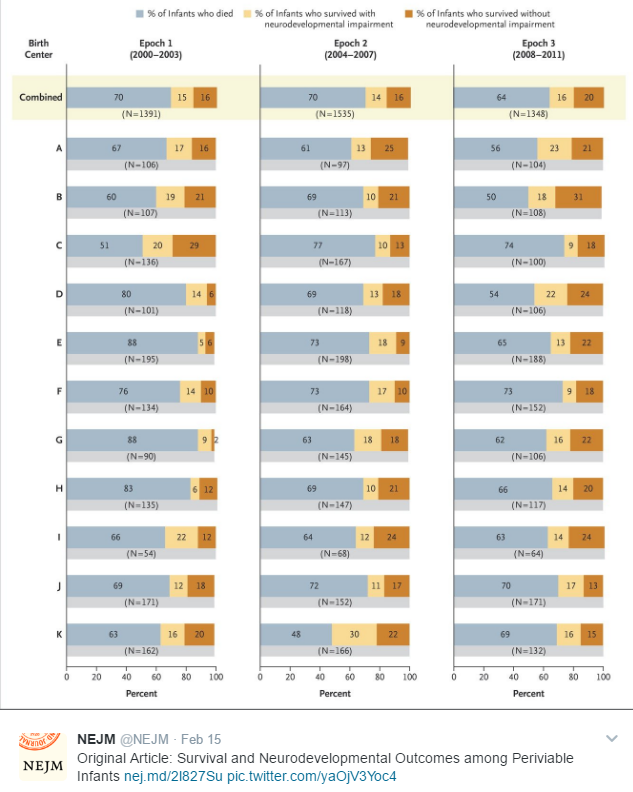
A study (N Younge et al. NEJM 2017; 376: 617-28) provides some data on the slowly changing survival and neurodevelopmental outcomes among periviable infants (22-24 weeks gestation).

From epoch 1 (2000-2003), to epoch 3 (2008-2011), there has been some improvements. Overall survival increased from 30% to 36% and the percentage without neurodevelopmental impairment increased from 16% to 20%.

Mortality and Neurodevelopmental Outcomes at ~18 months of age (combined data and 11 centers)

Mortality and Neurodevelopmental Outcomes at ~18 months of age (combined data and 11 centers)

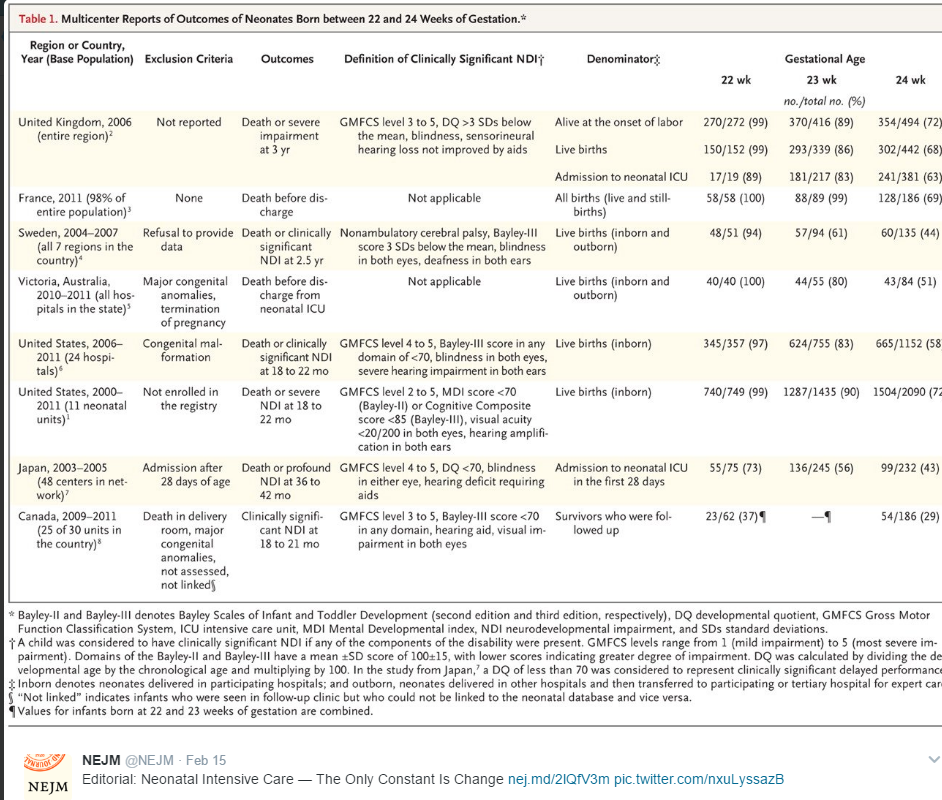
The insightful commentary (pgs 694-6) notes that there has not been improvement in survival in infants born at 22 weeks.  Furthermore, in reviewing multiple studies on outcomes, neurodevelopmental impairment was >94% in patients born at 22 weeks and between 80-90% for infants born at 23 weeks.  At 24 weeks, neurodevelopmental impairment was present between 51-72%

screenshot-137

Related blog posts:

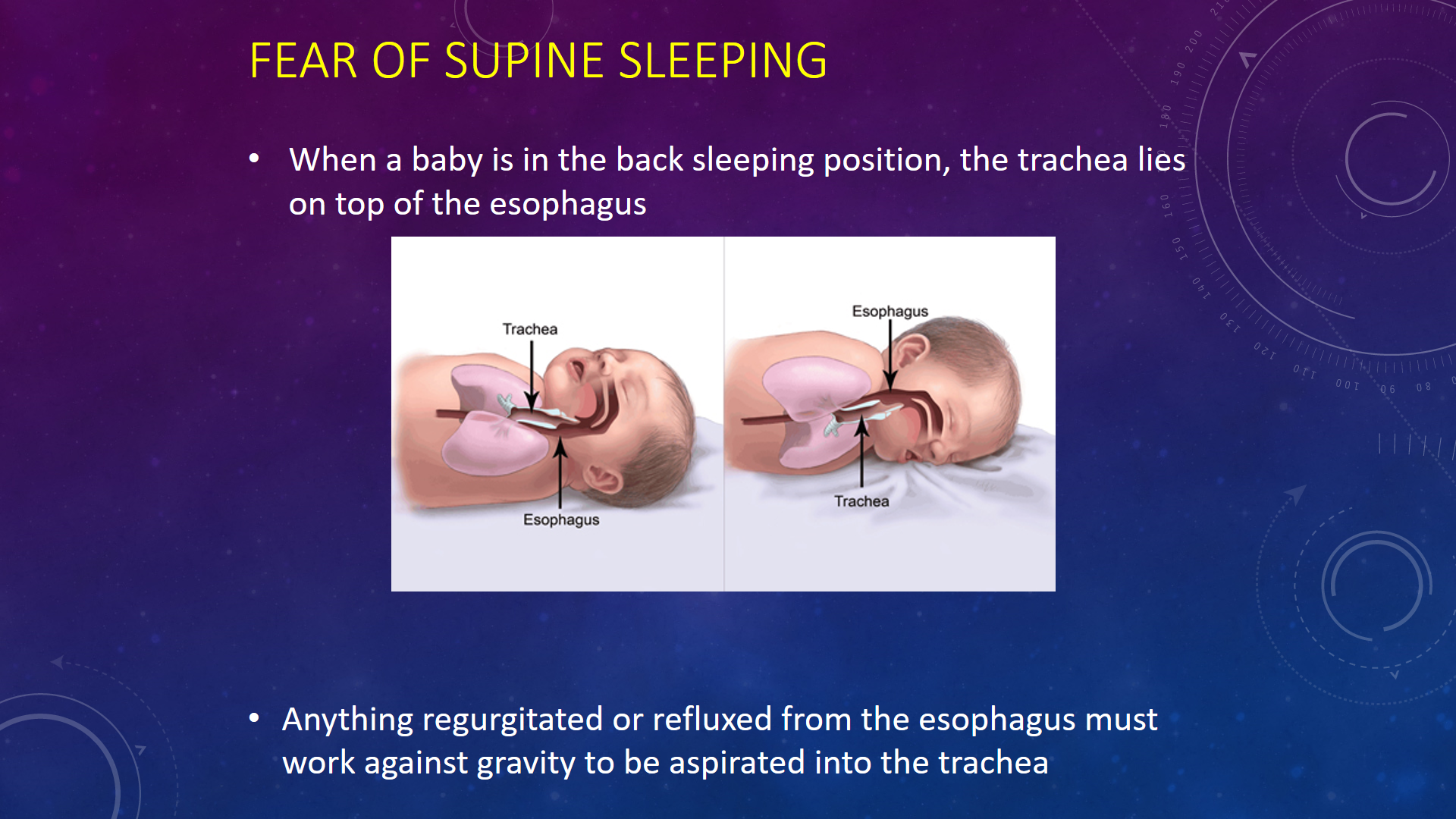
Safe Sleep (AAP 2017)

Behind the scenes, there is a core group of pediatricians and staff at the American Academy of Pediatrics working to improve the health of children and the ability of pediatricians to be effective.

A couple items from this year’s Georgia board of directors meeting:

  1. Increasing Safe Sleep practices
  2. Working with legislators to improve access to health care
  3. Establishing strategic goals for the next few years

The emphasis on Safe Sleep follows recent AAP guidelines –see previous posts:

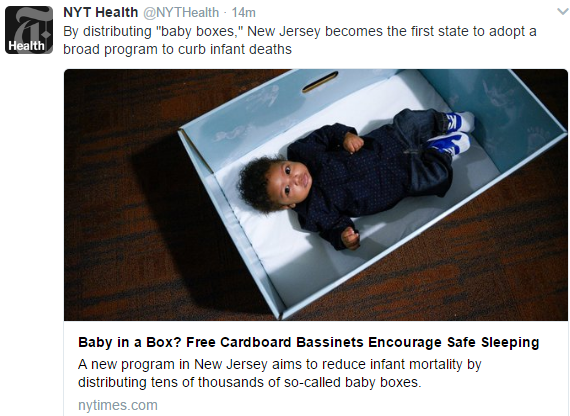
Right now, in Georgia, it is estimated that there are 3 infant deaths per week associated with sleep practices.  In Tennessee, following widespread adoption and promotion of safe sleep practices, this resulted in a 50% reduction in these types of infant deaths within two years.  In Georgia, the department of public health has been working on distributing inexpensive portable bassinets to Medicaid population, along with educational material.  There is a lot more to do.  In hospital nurseries infants are often NOT placed on their backs to go to sleep until shortly before discharge.

screenshot-120

Useful website: Charlieskids.org This website has a book called “Sleep Baby Safe and Snug” which incorporates updated recommendations on safe sleep practices.  Interestingly, the fact that the book has a picture of a pacifier has slowed distribution of this book (even when free) because this runs counter to another program (“Baby Friendly” hospital designation) to promote breastfeeding.

Here are some of the slides from Dr. Freed’s presentation on safe sleep practices:

screenshot-121 screenshot-122 screenshot-125 screenshot-126 screenshot-128 screenshot-129 screenshot-130 screenshot-133