CCFA Conference Notes (Part 1): Preemptive Therapeutic Drug Monitoring Not That Helpful

This blog entry has abbreviated/summarized this terrific presentation; most of the material has been covered in this blog in prior entries but still this was a useful review. Though not intentional, some important material is likely to have been omitted; in addition, transcription errors are possible as well.

Optimizing Therapeutic Drug Monitoring –Dr. Hans Herfarth

  • Trough levels have been recognized to correlate with remission rates. Good data from SONIC (2010) for infliximab. Ultra2 trial (2013) showed similar data for adalimumab.

Screen Shot 2016-04-17 at 11.19.23 AM

  • Low albumin predicts higher rates of failure, possibly due to loss of infliximab in stool.
Screen Shot 2016-04-17 at 11.20.14 AM


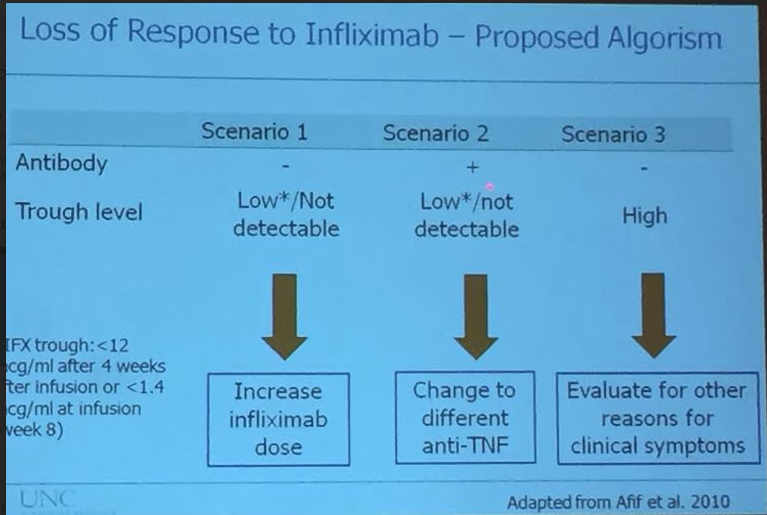
  • Reviewed algorithm for loss of response to infliximab based on trough levels. If low infliximab and no antibodies, increase dosing of infliximab has high likelihood of clinical response.
  • If high infliximab and not responding, evaluate for other reasons including irritable bowel, and strictures.

Scenarios that create confusion with therapeutic drug monitoring:

  • If clinically-well patient has antibodies and adequate drug level, could observe or possibly add immunosuppressive agent. ~3% of patients have simultaneous ATI and IFX detection.
  • If clinically-well with low infliximab level, could increase dose or observe.
Screen Shot 2016-04-17 at 11.23.19 AM

Screen Shot 2016-04-17 at 11.24.10 AM

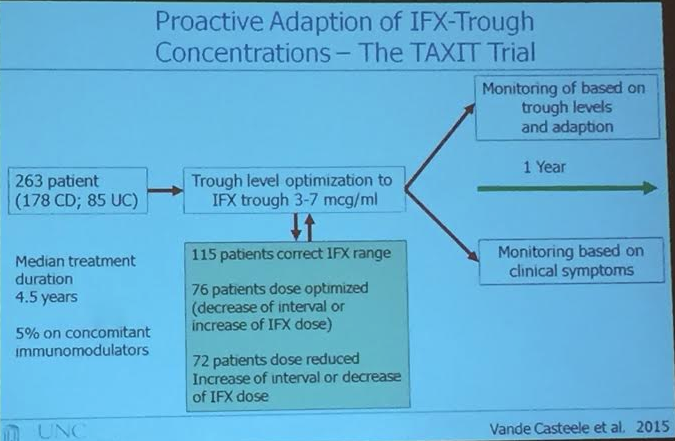
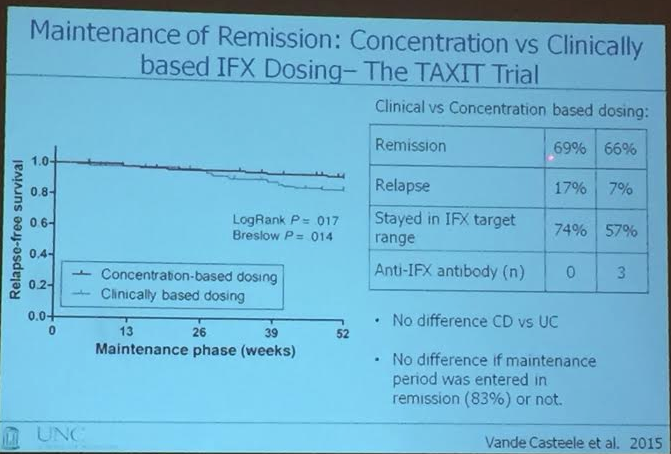
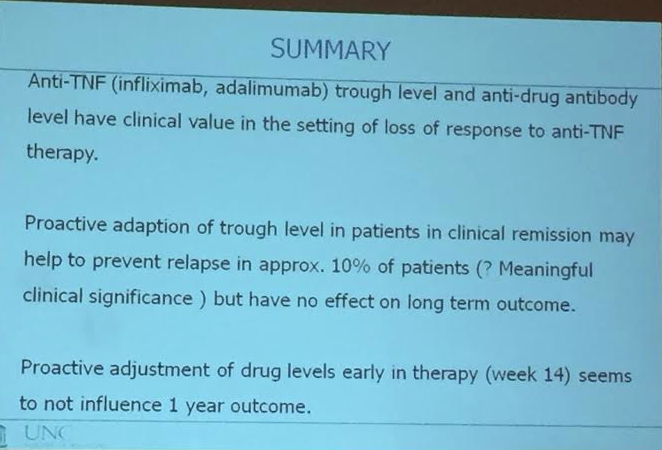
  • In TAXIT study, however, lowering dose (panel B above) to get in target range was associated with a lower rate of response. No clear difference between clinically-based changes compared with proactive monitoring. Proactive adaption of trough levels may help prevent relapse in ~10% but not shown to alter long-term outcomes
Screen Shot 2016-04-17 at 11.25.43 AM

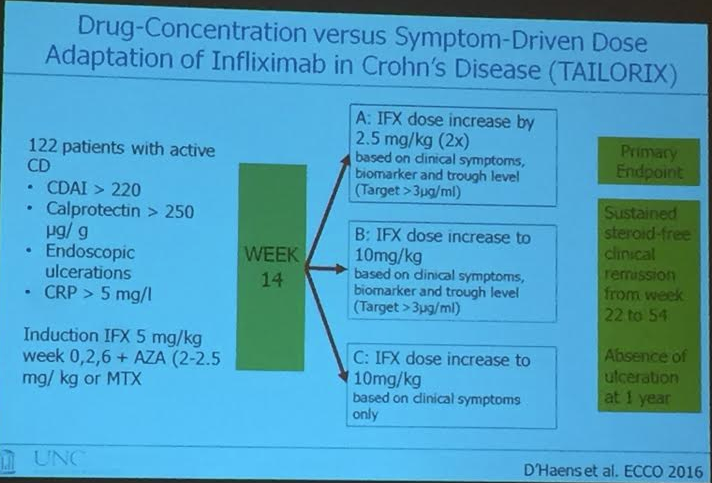
  • TAILORIX study looked at tailoring dose at week 14. ‘Week 14 adaption did not make a significant difference at 1 year.’  Limitation: 122 patients.
Screen Shot 2016-04-17 at 11.26.29 AM

Hard to see Group C (clinically-based group) in this slide

Hard to see Group C (clinically-based group) in this slide

Drug monitoring has become popular but its importance as a preemptive measure is unclear.  Dr. Herfarth’s practice is to monitor when loss of response but not to monitor if doing well. His view: if someone is doing well, therapeutic drug monitoring can be confusing. It is not proven that optimizing drug levels will improve long-term outcomes. (In children, especially due to growth, drug monitoring may be more important.)

Screen Shot 2016-04-17 at 11.30.13 AM

Screen Shot 2016-04-17 at 11.39.09 AM

One other recommendation from Dr. Herfarth: he recommends combination therapy in his patients are started on a 2nd anti-TNFs.

Don’t Touch That Cute Turtle

The risk of Salmonella from turtles is well-known.  A recent report (Walters MS et al. Pediatrics 2016; 137: 1-9) with data from 2011-2013 highlights the ongoing risk with reports of 8 multi-state outbreaks of Salmonella and pet turtles were the key risk factor.

  • Children <5 years and Hispanics were disproportionately affected.
  • 88% of the turtles were considered small (< 4 inches)

Here’s an excerpt from the abstract:

RESULTS: We identified 8 outbreaks totaling 473 cases from 41 states, Washington DC, and Puerto Rico with illness onsets during May 2011–September 2013. The median patient age was 4 years (range: 1 month–94 years); 45% percent were Hispanic; and 28% were hospitalized. In the week preceding illness, 68% (187 of 273) of case-patients reported turtle exposure; among these, 88% (124 of 141) described small turtles. Outbreak strains were isolated from turtle habitats linked to human illnesses in seven outbreaks. Traceback investigations identified 2 Louisiana turtle farms as the source of small turtles linked to 1 outbreak; 1 outbreak strain was isolated from turtle pond water from 1 turtle farm.

My take: Turtles make lousy pets.  Salmonella infection can be fatal in some and in others leave lasting problems.

Related posts:

Eric Carle artwork at High Museum

Eric Carle artwork at High Museum


“What Do I Need to Learn Today?”

A recent commentary (GT McMahon. NEJM 2016; 374: 1403-5) provides some perspective on adult learning. In this era of ubiquitous information, developing the right strategy for learning is crucial, not just in medicine but globally. Key points:

  • “Physicians seeking professional development can recognize when they’re actively learning and tend to embrace activities that allow them to do so.”
  • “Many clinicians appreciate learning alongside their peers but may struggle with the feeling that times spent in group educational settings is not efficient or productive enough to be worthwhile.”
  • “CME is most effective in changing physician performance and patient health outcomes if it is interactive.”
  • “Adults prefer education that’s self-directed, based on needs they have identified, goal-oriented, relevant, and practical.”
  • Learning facilitated by working in small groups to solve problems and with interaction (eg. smartphone polls). Other strategies include simulation programs and social media.
  • Working at getting CME to count towards other regulatory burdens (eg. maintenance of board certification), can “reduce the burden on physicians and promote lifelong learning.”

My take (with help from author): Incorporating educational innovation is important to improve physician performance and patient care. “All of that change begins with each of us having the humility and presence of mind to ask ourselves, ‘What do I need to learn today?’”

Vik Muniz Art. George Stinney Jr, the youngest person executed in U.S. at age 14 years. This artwork is composed of hundreds of pictures.

Vik Muniz Art. George Stinney Jr, the youngest person executed in U.S. at age 14 years. This artwork is composed of hundreds of pictures.

GeorgeStinneyJrInfo

Pediatric Nutritionist: Blenderized & Pureed Gtube Diets

A recent Children’s Healthcare of Atlanta Nutrition Support Colloquium provided a terrific update on the use of blenderized and pureed diets via gastrostomy tube.

Here’s the link to the talk (including slides) and a summary on the Pediatric Nutritionist blog site: The Blenderized and Pureed by Gtube Diets

I’ve found these diets to be particularly useful in children with retching.  In addition, these diets can lower costs, reduce other symptoms like constipation, and appeal to parents who desire more typical foods in their child’s diet.

Related blog postNutrition University -Part 1 | gutsandgrowth

Gibbs Gardens

Gibbs Gardens


Guidelines for Traveler’s Diarrhea in Adults

Full text: Guidelines on Traveler’s diarrhea in Adults from ACG

Some of the recommendations:

  • -use of oral rehydration if severe diarrhea (especially elderly).  “Most individuals with acute diarrhea…can keep up with fluids and salt by consumption of water, juices, sports drinks, soups, and saltine crackers
  • -against use of probiotics for acute diarrhea except in cases of post antibiotic-associated diarrhea
  • -for use of bismuth subsalicylates to slow stool passage
  • -for use of adjunctive loperamide in patients receiving antibiotics for traveler’s diarrhea (to increase chance for cure)
  • -for antibiotics in traveler’s diarrhea “where the likelihood of bacterial pathogens is high enough to justify the potential side effects of antibiotics”
  • -against antibiotics for community-acquired diarrhea

Table 4 outlines antibiotic selection.

Screen Shot 2016-04-12 at 7.52.47 PM

Disclaimer: These blog posts are for educational purposes only. Specific dosing of medications/diets (along with potential adverse effects) should be confirmed by prescribing physician/nutritionist.  This content is not a substitute for medical advice, diagnosis or treatment provided by a qualified healthcare provider. Always seek the advice of your physician or other qualified health provider with any questions you may have regarding a condition.


Don’t Let the Chief of Staff Review This Constipation Study

A useful study from Cincinnati (D Klaus et al. J Pediatr 2016; 171: 183-8) provides data on the high prevalence of constipation in Duchenne Muscular Dystrophy. (DMD)  Though, the authors acknowledge that rectal examination was “deferred unless clinically indicated.” I’m fairly certain that the former chief of staff, if asked for input, would have stated that the only two reasons for not doing this part of the exam was “either no rectum or no finger.”

In this prospective cross-sectional study, the authors relied on the Questionnaire on Pediatric Gastrointestinal Symptoms based on Rome-III criteria (QPGS-RIII) to identify constipation.  Based on this questionnaire, 46.7% (56 of 120) of patients with DMD were diagnosed with functional constipation.

  • Traditional features of constipation like bowel movement infrequency of <3/week and hard stools were present in only 16% and 17% respectively.
  • Other features that identified constipation included straining with defecation in 35.1%, painful defecation (27.8%), and clogging toilet (22.6%)
  • The Bristol Stool scale had a low sensitivity for detecting constipation (only 18%) but had a high specificity of 95% if type 1 or 2.
  • Constipation did not increase with age or functional status which makes the concern that this is primarily related to an ineffective bear-down (Valsalva) less likely

My take: Constipation in children with DMD is underreported and often overlooked.  It needs to be considered more carefully at routine visits.

Related posts:

Vik Muniz Art at High Museum

Vik Muniz Art at High Museum

When you look closely at the horse's nose, you can see that this art was completed with toy soldiers

When you look closely at the horse’s nose, you can see that this art was completed with toy soldiers

CDC: Increase in Acute Hep B in Appalachia

MMWR 2016; 65: 47-50. Increases in Acute Hepatitis B Virus Infections — Kentucky, Tennessee, and West Virginia, 2006–2013

An excerpt:

  • During 2006–2013, a total of 3,305 cases of acute HBV infection were reported to CDC from Kentucky, Tennessee, and West Virginia. During 2009–2013, incidence of acute HBV infection increased 114% in these three states, but remained stable in the United States overall
  • Among cases in which at least one risk factor was reported, the proportion of persons reporting injection drug use as a risk factor was significantly greater in 2010–2013, compared with 2006–2009 (75% versus 53%; p<0.001)…the increase was statistically significant only among cases occurring in non-urban counties
  • The findings in this report are subject to …limitations. First, NNDSS is a passive surveillance system, and therefore, unreported cases might have been missed. Second, the current case definition for acute HBV infection captures only symptomatic persons and excludes persons with asymptomatic HBV … Third, … certain populations at high risk (e.g., persons who are incarcerated, homeless, and uninsured) with limited access to care could potentially be underrepresented

My take: Increased drug use appears to be driving an increase in acute HBV in Appalachia. “Evidence-based prevention strategies, including increasing hepatitis B vaccination coverage, testing and linkage to care activities, and education campaigns targeting persons who inject drugs are urgently needed.”

Gibbs Gardens, Ball Ground

Gibbs Gardens, Ball Ground

Hepatitis A Vaccine Should Work for 30 Years

A recent study (PR Spradling et al. Hepatology 2016; 63: 703-11) provided data indicating that the Hepatitis A virus (HAV) vaccine would likely work for 30 years after childhood vaccination.  Much has changed since the implementation of the HAV vaccine.  Since 2000, the number of HAV case in the U.S. has dropped almost 90%, from 13,397 to 1781 in 2013 with the lowest incidence in those ≤18 years.

This study (n=183) examined three groups of Alaska Native children who received a two-dose inactivated HAV vaccine.

  • Vaccine starting at age 6 months (group 1)
  • Vaccine starting at age 12 months (group 2)
  • Vaccine starting at age 15 months (group 3)

Key findings:

  • All participants in groups 2 and 3 through age 10 years were seropositive (anti-HAV ≥ 20 mIU/mL), whereas in group 1 it was >90%.
  • At 15-16 years following vaccination, the seropositivity was 50-75% in group 1 and 67-87% in groups 2 and 3.
  • Using modeling, the overall 30-year anti-HAV seropositivity was predicted to be present in 64% of all participants and 84% of those that were seropositive at 15-16 years.

HAV continues to represent an ongoing threat, despite a reduction in the number of cases.  This is particularly due to unvaccinated travelers and unvaccinated adutls.  In vaccinated adults, a study (Vaccine 2015; 33: 5723-27) inidcates that seropositivity would be present in at least 95% after 30 years and 90% after 40 years.

My take: these data provide reassurance that HAV vaccine’s protection will be durable among those who were vaccinated between 6-21 months of life.

Related blog posts:

Culebra, Puerto Rico

Culebra, Puerto Rico

“The Couric Effect”

A recent commentary (Am J Gastroenterol advance online publication 29 March 2016; doi: 10.1038/ajg.2016.118) by Katie Couric provides a summary of her personal journey as an advocate for preventing colon cancer.

A good read: An Unexpected Turn: My Life as a Cancer Advocate

Here’s an excerpt:

“April is the cruelest month,” T.S. Eliot wrote in “The Waste Land,” and in 1997 it certainly was for my family. That’s when my husband Jay and I discovered he had stage IV colon cancer that had spread to his liver…and the beginning of a 9-month nightmare…

the University of Michigan found that my televised colonoscopy and educational outreach contributed to a sustained 19% increase in the number of colonoscopies performed nationwide. They called it “The Couric Effect”

Screen Shot 2016-03-29 at 4.59.42 PM