Working While Sick: Red Badge of Courage or Scarlet Letter?

With the respiratory virus season fast approaching, a recent study and editorial (J Szymczak et al. JAMA Pediatr 2105; 169: 815-21, editorial 809-10 -thanks to Ben Gold) are worth a look; they focus attention on the practice of working while sick.  In the study, the researchers use an anonymous survey of more than 900 physicians and advance practice clinicians working at a large children’s hospital. 83% reported working sick at least 1 time in the past year and 9% reported working while sick at least 5 times.  The authors note “some ambiguity persists around what constitutes being too sick to work, and a perception exists that sick leave is impractical.”  Most of the respondents understood that their illness could have an adverse effect on patients, but 97% did not want to let colleagues down and 94% did not want to create staffing shortages.

The editorial makes several more points:

  • Healthcare workers “will likely continue to come to work when mildly ill, especially when they identify their role as being essential for care and unique within the institution.”
  • “Working while sick was regarded as a badge of courage, and ill physicians who stayed home were regarded as slackers.”
  • The editorial argues for more clarity and/or use of key symptoms: conjunctivitis, vomiting, bloody diarrhea, fever >38.5, >2 episodes of watery diarrhea, or jaundice
  • “For many respiratory viruses, individuals are most contagious before they are highly symptomatic, so staying home after symptoms develop may not be effective or practical.”
  • For influenza, the CDC has recommended that employees “not return to work until 24 hours after they are fever free or 7 days, whichever is longer, with longer periods of time off for HCWs returning to work in a setting of high-risk individuals.”  However, with this approach, “staffing shortages would become critical.”

My take: These articles suggest a need for a culture change that supports paid sick leave that is adequate and non-punitive.  At the current time, adequate backup is often lacking.  Also, these articles serve as a reminder: it is a good idea to get your flu shot!

Portopulmonary Hypertension -A Little More Data

A recent study (E Echocahrd-Dugelay et al. JPGN 2015; 61: 346-54, editorial 268-9) provides a little more data on the rare condition of portopulmonary hypertension (POPH). Untreated POPH can lead to right-sided heart failure and death; a prompt diagnosis improves the chance for responding to treatment.

In brief, the authors reviewed their experience with 14 patients that were diagnosed with POPH between 1983-2009. The authors also reviewed the literature for a total of 98 patients.

Findings:

  • 0.5% of children with portal hypertension had POPH
  • 0.9% of children with end-stage liver disease awaiting liver transplantation had POPH
  • Congenital portosystemic shunts (CPSS) appeared to be a risk factor for POPH and were noted in 3 of their 14 cases as well as 22 of 98 cases overall.
  • In treated patients (n=42), five-year survival was noted to be 80%. Treatment included vasodilator therapy, closure of CPSS, or liver transplantation.
  • Hepatopulmonary syndrome (with hypoxemia) may precede POPH; this was reported in 6 of the 98 patients in this report

Dr. Ronald Sokol’s commentary noted that guidelines for timing/frequency of pulse oximetry testing and formal echocardiographic screening are needed but “challenging given the present body of evidence.”  He recommends screening all pediatric liver transplantation candidates who have cirrhosis and portal hypertension with pulse oximetry and echocardiography as well as those with clinical features of POPH (eg. syncope, shortness of breath, dyspnea).  For other patient populations, it remains unclear.

Bottomline (from the authors): “Detection of POPH at an early stage requires systematic screening at regular intervals by echocardiography in children with all causes of portal hypertension.” Unanswered questions:

  • how much portal hypertension is needed to merit screening?
  • how often should screening take place?

Related blog posts:


NY Times: “Should We Bank Our Own Stool?”

A provocative article poses the question: Should we bank our own stool?

Here’s an excerpt:

The scientific term for this is “autologous fecal transplant.” In theory, it could work like a system reboot disk works for your computer. You’d freeze your feces, which are roughly half microbes, and when your microbiome became corrupted or was depleted with antimicrobials, you could “reinstall” it from a backup copy.

That damage from antibiotics may not be trivial. Studies have linked antibiotic use early in life with a modestly increased risk of asthma,inflammatory bowel diseaseobesity and rheumatoid arthritis. These are associations, of course; they don’t prove that antibiotics cause disease…

Almost 60 years later, the “fecal transplant” is a cutting-edge treatment for the pathogen Clostridium difficile, a bug that kills 29,000 yearly and infects nearly half a million…

Memorial Sloan Kettering Cancer Center in New York has also started a proactive stool-banking study. Most of the subjects are patients with leukemia. Before stem cell transplants, patients receive antibiotics andchemotherapy, often wiping out their microbiota…

OpenBiome…started a pilot self-banking program called “PersonalBiome.” One complication: If he stores your stool, you can generally withdraw it only to treat C. difficile, not for preventive “reconstitution.” That’s because stool is regulated as a drug and not, as with embryos or blood, a tissue, which makes its use more complex.

Related blog posts:

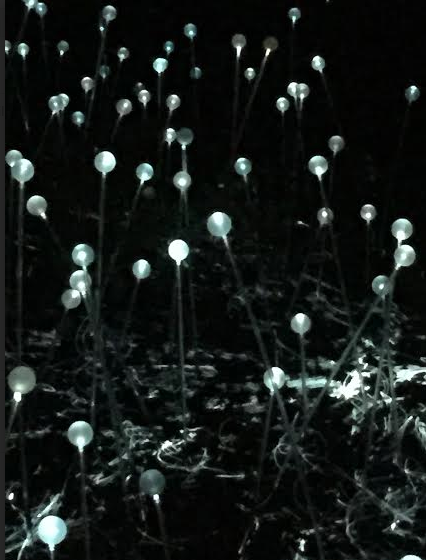
Atlanta Botanical Garden, Bruce Munro Exhibit

Atlanta Botanical Garden, Bruce Munro Exhibit

How Much Does a Doctor Visit Cost a Patient?

Opportunity Costs of Doctor Visits -YouTube Video

From the Boston Globe:

The study estimates that the typical visit to a doctor consumes 121 minutes of the patient’s time — 37 minutes in travel, 64 minutes waiting for care or filling out forms, and only 20 minutes face to face with the physician.

Based on the average sum a person could earn if working during that time, the researchers figure, it costs patients $43 in lost time for each medical visit — more than the average out-of-pocket cost for the care itself, which is about $32.

Mehrotra’s team drew their results from three national surveys, chiefly the 2003-2010 American Time Use Survey, administered by the Bureau of Labor Statistics. The survey asked randomly selected respondents to recall what they did from 4 a.m. on the previous day until 4 a.m. on the day of the survey. The researchers examined the experiences of the 3,927 respondents who had sought medical care during that 24-hour period.

The initial study: Opportunity Costs of Ambulatory Medical Care in the United States Kristin N. Ray, MD, MS; Amalavoyal V. Chari, PhD; John Engberg, PhD; Marnie Bertolet, PhD; and Ateev Mehrotra, MD, MPH.  Published in American Journal of Managed Care (August 2015)

Targeted Therapy for PFIC type 2

Progressive Familial Intrahepatic Cholestasis, type 2, (PFIC2) is due to decrease (or absent) function of the bile salt export pump (BSEP) encoded by ABCB11 has been treated mainly in a symptomatic manner with medicines like ursodeoxycholic acid and sometimes biliary diversion.  PFIC2 has been associated with increased risk for hepatocellular carcinoma (HCC).

A recent study (E Gonzales, et al. Hepatology 2015; 62: 558-66) indicates that newer therapies targeting the specific mutation may be effective.

In this study, treatment with oral 4-phenylbutyrate (4-PB) in four patients improved pruritus, serum bile acid concentrations, and liver function tests. 4-PB is considered a chaperone drug and may partially correct mistrafficking.

The associated editorial (pg 349-50) notes that 4-PB has an unpleasant taste and requires ingestion of a large number of pills. In addition, patients with complete loss of BSEP, 4-PB will not be effective. Finally, even in patients with a clinical response, it is unclear if this will lower the risk of HCC.

A second study (S Varma et al. Hepatology 2015; 62: 198-206) retrospectively studied 22 children with PFIC2.  “Children with late-onset presentation, lower ALT, and intracellular BSEP expression are likely to respond, at least transiently, to nontransplant treatment.”  Nontransplant treatment in this cohort included ursodeoxycholic acid in 19 (10 mg/kg thrice daily) and partial biliary diversion in 3.  Higher ALT values were considered to be >165 IU/L. Another point in this study: response to treatment can be slow and take many months.

My take: These studies provide useful information about which patients with PFIC2 respond medically and introduce a new therapy, 4-PB.

Related blog posts:

Is this really newsworthy? Perhaps next week: man with venomous snakes says they make great pets?

Perhaps next week the story will be: man with venomous snakes says they make great pets?

Best Tweets Two #NASPGHAN15

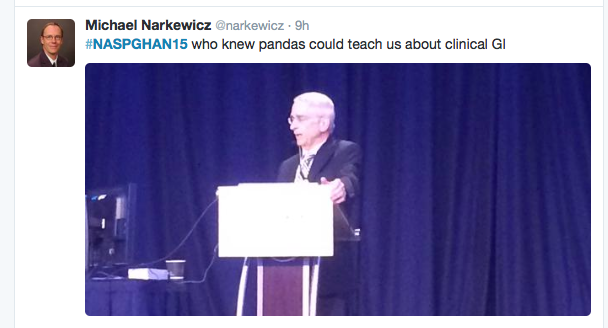
One clarification -I do not think that Dr. Narkewicz is calling Dr. Balistreri a panda:

Dr B

Screen Shot 2015-10-09 at 6.19.24 PM

Screen Shot 2015-10-09 at 6.16.32 PM

Screen Shot 2015-10-09 at 6.16.04 PM

Screen Shot 2015-10-09 at 6.07.49 PM

Screen Shot 2015-10-09 at 6.06.43 PM

Screen Shot 2015-10-09 at 6.05.27 PM

Dr. H

Screen Shot 2015-10-09 at 5.56.32 PM

Related blog posts:


Best Tweets from Postgraduate Course: #NASPGHAN15

Since I am not at this year’s national meeting, I have followed some of the information on social media.  Here are some of the best tweets:

Screen Shot 2015-10-08 at 5.58.29 PM

Screen Shot 2015-10-08 at 5.57.36 PM

Screen Shot 2015-10-08 at 5.57.19 PM

Screen Shot 2015-10-08 at 5.55.42 PM

Screen Shot 2015-10-08 at 5.55.04 PM

Screen Shot 2015-10-08 at 5.54.42 PM

Screen Shot 2015-10-08 at 5.54.25 PM

Screen Shot 2015-10-08 at 5.52.12 PM

Related blog posts:

The Slow March of the Digital Health Revolution

A recent commentary (SD Dorn. Gastroenterol 2015; 149: 516-20) provides insight on the digital health revolution.

Key points:

  • “Amara’s law –that ‘we tend to overestimate the effect of a technology in the short run and underestimate the effect in the long run’–seems to apply to digital health. Expect short-term gains to be incremental.”
  • The promise of ‘big data’ has not translated into big changes yet.  “Many systems are not interoperable owing to cost, competition, privacy concerns, and technical barriers.”
  • Mobile health, mHeath, “is skewed toward those who need the least help: the young, the fit, and the educated.” And, there is “no evidence supporting the effectiveness of the vast majority of mHealth tools.”

What’s wrong with electronic health records?

  • “The overall evidence that EHRs improve safety and quality is spotty. Cost savings remain elusive.”  Some reasons include that more time is needed and/or flaws in EHR design.
  • EHRs are not very usable –excessive clicks and scrolling.
  • EHRs “reduce productivity and can add hours to the busy clinician’s day”
  • Physicians “now spend up to two-thirds of a typical outpatient visit documenting.”
  • Clinical records may be more legible, but they are often less useful.  “Template-generated notes frequently lack coherent narratives, are bloated with extraneous and repetitive information, and sometimes contain obvious errors that are copied forward from one note to another.”
  • “Physicians suffering from ‘alert fatigue’ may ignore potentially valuable clinical alerts.”
  • EHRs require frequent sign-ins and computers often have to be unlocked.
  • EHRs are expensive.
  • In total, EHRs significantly worsen physician satisfaction.

From a patient vantage, EHRs offer the possibility of patient portals to send physician messages, obtain test results, request medication refills, and schedule appointments.  Telehealth offers the potential for expert advice from great distances.

Some integrated health systems, including the Veteran’s Health Administration and Kaiser Permanente, have shown that EHRs can be successful.

My take: The transition to digital technologies has great promise but could lead to a less personal approach. So far, the transition to digital health has been a bumpy slow road.

Related blog posts:

Atlanta Botanical Gardens

Atlanta Botanical Gardens

Why D5 1/2NS was the Right Choice in the 1950s!

For many, a frequent practice is to order D5 1/2NS intravenous fluids for maintenance IVFs.  An expert review (ML Moritz, JC Ayus. NEJM 2015; 2015: 373: 1350-60) of this topic explains why this was right in the 1950s but is usually the wrong choice today.

Key points:

  • Use of hypotonic maintenance fluids (sodium concentration <130 mmol per liter), “has been associated with a high incidence of hospital-acquired hyponatremia and more than 100 reports of iatrogenic deaths or permanent neurologic impairment related to hyponatremic encephalopathy.”
  • Acutely ill patients have “disease states associated with excess arginine vasopressin.”
  • Recommendations on the use of hypotonic fluids were “based on theoretical calculations from the 1950s, before the syndrome of inappropriate antidiuresis was recognized as a common clinical entity.”
  • “More than 15 randomized, prospective trials involving more than 2000 patients have evaluated the safety and efficacy of isotonic fluids…most of these studies involved children…isotonic fluids were superior.” Limitations: these studies were typically <72 hours and excluded patients with renal disease, heart failure, and cirrhosis.
  • The authors also note potential problems with 0.9% NS for rapid infusion, perhaps related in part to the polyvinyl chloride bags which lowers the pH.  “0.9% saline, as compared with balance salt solutions, may produce a hyperchloremic metabolic acidosis, renal vasoconstriction, an increased incidence of acute kidney injury requiring renal-replacement therapy, and hyperkalemia.”
  • Hypotonic fluids may be appropriate in the setting of established hypernatremia or a clinically significant renal concentrating defect (with free-water losses).

My take: D5 1/2 NS and other hypotonic fluids should not be used commonly as a maintenance fluid.

Related blog posts:

Yellowstone Canyon

Yellowstone Canyon