FDA Approves Adalimumab Biosimilar -But Will Enter U.S. Market in 2023!

October 31, 2018: FDA Approves Sandoz’s Biosimilar Adalimumab, Hyrimoz

An excerpt:

The FDA has approved Sandoz’s biosimilar adalimumab, Hyrimoz (adalimumab-adaz). 

The drug has been approved to treat rheumatoid arthritis, juvenile idiopathic arthritis, psoriatic arthritis, ankylosing spondylitis, adult Crohn disease, ulcerative colitis, and plaque psoriasis…

Despite today’s approval, US patients will have to continue to wait for access to Hyrimoz, as the biosimilar will not enter the US market until 2023. Earlier this month, Sandoz announced a global settlement of patent disputes with AbbVie over the drug. While the settlement allowed Sandoz to launch Hyrimoz in the European Union on October 16, 2018, it forestalled US market entry until September 30, 2023. 

My take: Why will this biosimilar be allowed in Europe but not U.$?

Related blog posts:

Zabriskie Point at Sunrise, Death Valley

IBD Shorts -November 2018

G Horneff et al. J Pediatr 2018; 201: 166-75.  This industry-funded analysis of 577 pediatric patients who received adalimumab (1440 patient-years) identified no new safety signals.  The most common serious infection was pneumonia (0.6 events per 100 patient-years).  The most common adverse events were respiratory tract infections/nasopharyngitis. Serious infections were more common in the subset of patients with Crohn’s disease (CD), (n=189), occurring in 13%.

PS Dulai et al. Gastroenterol 2018; 155: 687-95.  This study, using data from GEMINI 2 phase 3 trial with 814 patients, developed a clinical prediction tool for determining the likelihood of a clinical response to vedolizumab.  Common predictors for response:

  • No prior bowel surgery
  • No prior anti-TNF exposure
  • No prior fistulizing disease
  • Higher baseline albumin
  • Lower baseline CRP

R Matro et al. Gastroenterol 2018; 155: 696-704.  The authors performed a prospective study of women with IBD and their infants (n=72).  They “detected low concentrations of infliximab, adalimumab, certolizumab, natalizumab, and ustekinumab in breast milk samples.  We found breastfed intants of mothers on biologics, immunomodulators, or combination therapies to have similar risks of infection …compared to non-breastfed infants or infants unexposed to these drugs.”


Is There Good Evidence for Proactive Drug Monitoring of Anti-TNF Therapy?

A recent clinical review (X Roblin et al. Inflamm Bowel Dis 2018; 24: 1904-9) examines the utility of proactive drug monitoring of anti-TNF therapy in inflammatory bowel disease.

The authors note that several observational trials suggested that proactive drug monitoring would help optimize the effect of anti-TNF therapy, especially infliximab. However, two randomized controlled clinical trials, TAXIT (n=273) and TAILORIX (n=122), were not able to show long-term benefit from proactive therapeutic monitoring.

At the same time, the authors note that a recent trial (Ungar B et al. Clin Gastroenterol Hepatol 2016; 14: 550-7, e2) has shown that infliximab trough levels >5 mcg/mL and adalimumab levels >7.2 mcg/mL identified mucosal healing with 85% specificity. Higher cutoffs showed only minimal further increase in mucosal healing rates.

My take: To this point, controlled trials have not shown that proactive drug monitoring of anti-TNF therapy is beneficial; this review explains the design and limitations of these studies.  My personal view is that more studies are needed to know if proactive drug monitoring is worthwhile.  Proactive drug monitoring may be more useful in children/adolescents than adults due to much greater variation in size and dosing.

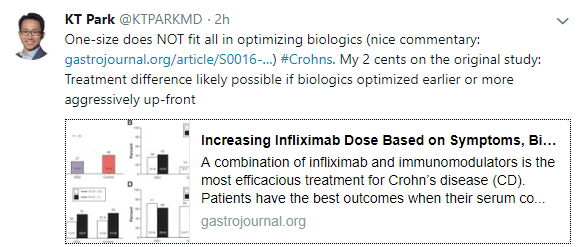
A recent commentary on therapeutic drug monitoring (from KT Park Twitter Feed): Therapeutic Targets in IBD

Related blog posts:


Moraine Lake, Banff


Sub-Analysis of DIAMOND Study

K Watanabe et al. Clin Gastroenterol Hepatol 2018; 16: 542-9.

The DIAMOND study evaluated monotherapy with adalimumab (n=85) compared with combination therapy of adalimumab with azathioprine (n=91).

Key findings:

  • In this subanalysis of patients with moderate and severe Crohn’s disease (CD), endoscopic response (defined by SES-CD drop of at least 8 points or SES-CD <4) was significantly higher at week 26: 71.6% vs 54.4%. The OR for endoscopic response was 2.12 at week 26 with combination therapy.
  • At week 52 the endoscopic response difference was not statistically significant: 60% vs. 50%.
  • Similarly, mucosal healing was more common (but not statistically significant) in the combination group compared with monotherapy: 20.9% vs 103% at week 26, and 21.5% vs 12.2% at week 52.
  •  While not statistically significant, the combination group had ADA trough that was higher (7.6 compared with 6.5).

My take: The results described above for endoscopic responses and mucosal healing rates are depicted in figure 2 (I do not have a digital copy of figure or permission to use).  After one looks at this figure, depicting the data noted above, there certainly appears to be an advantage for the use of combination therapy in patients with moderate-to-severe CD.

Related blog posts:


I have not independently verified the claims on this tweet

IBD Short Takes -Fall 2017

From ImproveCareNow: Real-World Experience with Adalimumab

An excerpt:

A total of 174 children and adolescents were treated with adalimumab as their first anti-TNF therapy…The mean age at the time of Crohn’s disease diagnosis was 13 years and, on average, they started adalimumab at 14.5 years of age…

  • At 3 months after adalimumab was started, all 174 were still on the medication, and 69-71% were in steroid-free remission
  • At 6 months after adalimumab was started, of the 174 who had a clinic visit, 95% were still on the medication, and 75-77% were in steroid-free remission
  • At 12 months after adalimumab was started, of the 154 who had a clinic visit, 94% were still on the medication, and 79-80% were in steroid-free remission
  • At 24 months after adalimumab was started, of the 71 who had a clinic visit, 97% were still on the medication, and 91-94% were in steroid-free remission
  • At 36 months after adalimumab was started, of the 39 who had a clinic visit, 80-86% were still on the medication, and 81-86% were in steroid-free remission

No positive or negative effect on remission was seen with concomitant immunomodulator therapy. However, the number of patients studied during the retrospective analysis is too small to detect all but the greatest impact of this approach.

EC Maxwell et al. JPGN 2017; 65: 299-305  CHOP experience with diverting ileostomy for severe IBD (2000-2014).

  • In this retrospective study, a diverting ileostomy in 24 patients had improvement: 71% –>22% on chronic steroids, improved growth, hemoglobin, blood transfusion and hospitalization.
  • 10 patients underwent subsequent colectomy, 7 had successful reanastomosis, and 7 remain diverted.
  • Diversion allowed a definitive diagnosis in 7 subjects (initially 13 patients were considered IBD-U).
  • Surgical complications were common (n=13 in 7 subjects) and included stoma obstruction, stoma prolapse, and resection of ischemic bowel.
  • One notable feature regarding this cohort was that 50% were 5 or younger when diagnosed with IBD.
  • The authors conclude that a diverting ileostomy can induce clinical stability and allow time to clarify diagnosis.

A Assa et al. JPGN 2017; 65: 293-98. In this study involving findings from 234 patients extracted from the ImageKids database (prospective multicenter cohort), the authors found that pediatric patients with perianal Crohn’s disease have a greater inflammatory burden; however, this was driven mainly by those who had fistulizing disease.

L Lian et al. Clin Gastroenterol Hepatol 2017; 15: 1226-31. This retrospective study from the Cleveland Clinic compared outcomes of endoscopic balloon dilation (EBD) (n=176) or surgery (n=131) for Crohn’s disease-related strictures (1998-2013). Patients who had EBD had an “average time to surgery delayed by 6.45 years.” Immediate success rate for EBD was 91.3%; the perforation rate was 1.1%.. Ultimately, 52% of patients who had EBD required surgery.  Earlier surgery lowered the risk of further surgery but also was associated with significant perioperative complications. In the operative group, 8.8% of patients experienced complications, mainly intra-abdominal abscesses and enterocutaneous fistula. Thus, in the right hands and with careful selection, EBD may be useful.

I Lawrance et al. Clin Gastroenterol Hepatol 2017; 15: 1248-55. This study reported the results of 11 patients who received rectal tacrolimus for resistant ulcerative proctitis. Dosing: The concentration of tacrolimus was 0.5 mg/mL and 3 mL was administered twice a day.Clinical response, using the Mayo Clinic score, was achieved in 73% of tacrolimus subjects compared with 10% (n=1) of placebo-treated subjects.  Mucosal healing at week 8 was noted in 73% of tacrolimus-treated patients, as well.

Soapes Creek Trail

Three Studies Show Benefit of Concomitant Therapy for Inflammatory Bowel Disease (Part 1)

In the first study (J Cheng et al. Inflamm Bowel Dis 2017; 23: 1762-73), the authors retrospectively reviewed 148 children (113 with Crohn’s disease, 35 with ulcerative colitis). 90 patients received concomitant therapy (infliximab with either a thiopurine [n=67], methotrexate [n=23]) and 58 received infliximab monotherapy. Key findings:

  • Concomitant therapy >6 months  significantly lowered the risk of secondary loss of response in Crohn’s disease (CD) (HR =0.39) compared to monotherapy.   A similar trend was noted with ulcerative colitis (UC) but did not reach statistical significance.
  • Steroid-free remission rates at 1 year were 78% for CD patients with concomitant therapy compared with 54% on monotherapy
  • Among primary nonresponders, 67% of CD patients and 75% of UC patients were receiving IFX monotherapy.
  • No differences in adverse events were evident between patients receiving monotherapy compared with concomitant therapy. One patient (receiving azathioprine) developed a follicular lymphoma; this patient was well 10 years later.

The second study (Y Qui et al. Clin Gastroenterol Hepatol 2017; 15: 1359-72) was a systemic review of 35 studies that met the authors’ inclusion criteria. In total, 6790 patients with inflammatory bowel disease were enrolled in these studies. This study looked at multiple anit-TNF agents including infliximab, adalimumab, certolizumab, and golimumab. Key finding:

  • Antidrug antibodies were reduced by 51% in patients receiving concomitant therapy
  • Conclusion from authors: “concomitant use of immunomodulators should be considered in patients treated with anti-TNF treatment.”

My take: Overall, for most pediatric patients with CD, to date, concomitant therapy has been the most effective treatment.  More prospective studies are needed to determine more conclusively the benefit and optimal duration/timing of combined therapy, particularly with the more frequent use of therapeutic drug monitoring.  Also, as will be noted in future posts from annual meeting, thiopurine use is declining.

More on this topic tomorrow.

Related blog posts:

Disclaimer: These blog posts are for educational purposes only. Specific dosing of medications (along with potential adverse effects) should be confirmed by prescribing physician.  This content is not a substitute for medical advice, diagnosis or treatment provided by a qualified healthcare provider. Always seek the advice of your physician or other qualified health provider with any questions you may have regarding a condition.

Top Anti-TNF for Ulcerative Colitis

A recent retrospective cohort study (S Singh et al. Clin Gastroenterol Hepatol 2017; 15: 1218-25) compared infliximab and adalimumab in a nationwide Danish cohort of adults with ulcerative colitis (UC) from 2005-2014. The authors used propensity score and selected 171 patients who received infliximab (IFX) from a total of 1580 and 104 patients who received adalimumab (ADA) among a total of 139.

Key findings:

  • Patients who received ADA had higher hospitalization rates (HR 1.84) and a trend toward higher UC-related hospitalization (HR 1.71, CI 0.95-3.07) compared to IFX
  • Risk of abdominal surgery was not significantly higher in ADA patients (HR 1.35) compared to IFX
  • Serious infections were higher in ADA group, HR of 5.11 of needing hospitalization due to infections

There have been no randomized clinical trials  to determine if a specific anti-TNF agent is superior to another. In an associated editorial (MT Osterman, GR Lichtenstein, 1197-99), the authors note that while we don’t know which agent is superior, by comparing similar trials (ACT 1 & 2 for IFX and ULTRA 1 & 2 for ADA), “raw week 8 induction rates of clinical remission, clinical response, and mucosal healing are approximately 16%, 18%, and 19%, respectively, higher for infliximab”..”less dramatic differences favoring infliximab (approximately 9%, 13%, and 15%, respectively) are seen during maintenance at 1 year.”

My take: Due to the lack of randomized head-to-head studies, we do not know with certainty which anti-TNF is best for UC.  However, the data we have from retrospective cohort studies and from using raw data from prospective studies suggests that infliximab is effective in more patients.

Related blog posts:

University of Virginia Rotunda Pctures


Disclaimer: These blog posts are for educational purposes only. Specific dosing of medications (along with potential adverse effects) should be confirmed by prescribing physician.  This content is not a substitute for medical advice, diagnosis or treatment provided by a qualified healthcare provider. Always seek the advice of your physician or other qualified health provider with any questions you may have regarding a condition.

Combination Therapy with Adalimumab -Is it Helpful?

A recent study (JM Chalbhoub et al. Inflamm Bowel Dis 2017; 23: 1316-27) performed a systematic review and meta-analysis to examine the effectiveness of Adalimumab (ADA) combination therapy compared with monotherapy.  With infliximab (IFX), the SONIC study, showed that combination therapy with an immunomodulator (IMM) (azathioprine) improved response; combination therapy resulted in reduced immunogenicity, lower rates of infusion reactions, and higher IFX levels.

With the advent of widespread use of therapeutic drug monitoring, some have questioned the need for combination therapy with IFX.  The need for combination therapy for ADA is also a matter of debate.  ADA has less immunogenicity than IFX and it is unclear if combination therapy will improve outcomes. There have been conflicting studies regarding combination therapy with ADA, prompting the current meta-analysis.

The authors identified 24 articles for inclusion from an initial pool of 1194. Key findings:

  • No significant difference between combination therapy and monotherapy was noted for induction of remission (OR 0.86) or response (OR 1.01). The induction of remission is based on data from 3096 patients (1400 on combination treatment).
  • No difference was noted for maintenance of remission (OR 0.97) or response (OR 0.91). The maintenance of remission is based on data from 1885 patients (859 on combination treatment).
  • Patients receiving combination therapy had lower odds of developing antidrug antibodies (OR 0.24)
  • Subgroup analysis in anti-TNF experienced patients showed improved successful induction of remission (OR 1.26) but also more frequent opportunistic infections (OR 2.44)

Overall, the authors conclude that “combination of ADA and immunomodulators does not seem superior to ADA monotherapy for induction and maintenance of remission and response to Crohn’s disease.” They do comment on the recent DIAMOND study which was a randomized open-label top-down strategy trial in anti-TNF-naive and IMM-naïve patients.  While no overall advantage of combination therapy was evident, better endoscopic response (84% vs. 64% with monotherapy) was seen at 26 weeks (but not at 52 weeks).

This study has several limitations.  Overall, there were a small number of randomized trials and the trials had significant heterogeneity.

My take (borrowed from authors): “It is unclear whether the addition of IMM impacts the efficacy of a less immunogenic anti-TNF biologic such as ADA in CD.” Though, in the subgroup of anti-TNF exposed patients, “combination therapy was associated with higher odds of induction of remission.”

Related blog posts:

Adalimumab Can Reverse Growth Failure in Pediatric Crohn’s Disease

In an industry-sponsored study (TD Walters et al. Inflamm Bowel Dis 2017; 23: 967-75), adalimumab (ADA) was shown to be effective agent in reversing growth failure associated with pediatric Crohn’s disease (CD).

Background:  About one-third of children and adolescents with CD suffer from growth failure and delayed puberty.  Several prior studies have shown that anti-TNF therapy can improve height velocity and that early treatment with anti-TNF therapy (≤3 months after diagnosis) leads to greater improvement in height obtained, if initiated before puberty or early into puberty. This study examines the effectiveness of ADA in children from the IMAgINE 1 trial.

The authors identified 73 participants with growth delays (& adequate data) along with 27 participants with no growth delays.

Key findings:

  • ADA therapy significantly improved and normalized growth rates at 26 and 52 weeks in patients with baseline linear growth impairment.
  • At week 26, height velocity z-score was 1.33 among 23 children in remission compared with -0.78 (n=29) among “nonremitters”
  • At week 52, height velocity z-score was 2.17 among 27 children in remission compared with -1.57 (n=17) among “nonremitters”

My take: In moderate to severe CD, anti-TNF agents have been demonstrated to reverse growth failure; though, this is expected to occur only in patients with clinical response. To my knowledge, no other CD medical therapies have been proven to reverse growth failure (surgical treatment can improve growth as well).

Related blog posts:

Quiet Spot on U Chicago Campus

Hepatitis B Reactivation Due to Immunosuppressive Therapies

The topic of Hepatitis B virus (HBV) reactivation has been discussed on this blog before (see link below).  Another excellent review on this topic (R Lomba, TJ Liang. Gastroenterol 2017; 152: 1297-1309) has been published.  The authors examine the course and mechanisms of HBV reactivation.  They divide the risk of reactivation into three groups: high, moderate and low risk and proposed management.

High risk groups, which have >10% risk of reactivation) include the following

  • B-cell-depleting agents including rituximab, ofatumumab, alemtuumab, and ibritumumab
  • High-dose corticosteroids (>20 mg/day in adults)
  • Antracyclines including doxorubicin
  • Potent TNF-α inhibitors: infliximab, adalimummab, certolizumab, and golimumab
  • Local therapy ofr HCC including TACE (transarterial chemoembolization)

Moderate groups (1-10% reactivation) include cytokine-based Rx (eg. abatacept, ustekinumab, natalizumab, vedolizumab), cyclosporine, systemic chemotherapy, moderate corticosteroid dosing

Low risk groups (<1% reactivation) include thiopurines (azathioprine, 6-mercaptopurine), and methotrexate as well as short-term low-dose corticosteroids.

Management:

  • For HBV screening, the authors recommend HBsAg and anti-HBc testing
  • Prophylactic therapy with potent oral anti-HBV therapies are recommended for those at moderate or high risk of reactivation.  In those at low risk, the options include prophylactic treatment or watchful monitoring.
  • A more detailed algorithm is provided in Figure 3.  In those with HBsAg positivity, if HBV DNA is less than 2000 U/mL, this algorithm suggests monitoring labs (HBsAg, ALT, HBV DNA every 3 months)

Mechanisms of HBV reactivation are discussed.  For example, with TNF-α inhibitors “can activate a unique host antiviral pathway, the APOBEC (apolipoprotein B mRNA editing enzyme, catlytic polypeptide-like) proteins, that cause the degradation of cccDNA in HBV-infected cells. Thus, blocking this endogenous antiviral pathway may lead to a higher HBV replication state and HBV reactivation.”

My take: In pediatric gastroenterology, we do not see a lot of HBV reactivation. Nevertheless, we do use many of the medications which can trigger HBV reactivation and need to keep these recommendations in mind.

Related blog post: What HBV Testing is Needed Before TNF Inhibitor Therapy

Suntrust Park