Will Bariatric Surgery Become an Endoscopic Procedure?

A recent study (BK A Dayyeh et al. Clin Gastroenterol Hepatol 2017; 15: 37-43) provides evidence that endoscopic sleeve gastoplasty can be an effective treatment for obesity.

AGA Website Summary Endoscopic Sleeve Gastroplasty: A Promising New Weight Loss Procedure

An excerpt:

In the fight against obesity, bariatric surgery is currently the most effective treatment; however, only 1 to 2 percent of qualified patients receive this surgery due to limited access, patient choice, associated risks and the high costs. A novel treatment method — endoscopic sleeve gastroplasty — might offer a new solution for obese patients. Endoscopic sleeve gastroplasty is a minimally invasive, safe and cost-effective weight loss intervention, according to a study1 published online in Clinical Gastroenterology and Hepatology, the official clinical practice journal of the American Gastroenterological Association…

In this study of 25 patients with obesity who underwent the procedure at the Mayo Clinic in Rochester, MN, endoscopic sleeve gastroplasty reduced excess body weight by 54 percent at one year. Further, the procedure delayed solid food emptying from the stomach and created an earlier feeling of fullness during a meal, which resulted in a more significant and long-lasting weight loss.

Endoscopic sleeve gastroplasty was well tolerated as an outpatient treatment, requiring less than two hours of procedure time. Patients resumed their normal lifestyle within one to three days. The treatment was performed using standard “off-the-shelf” endoscopic tools as opposed to specific weight loss devices or platforms. The cost of endoscopic sleeve gastroplasty is roughly one-third that of bariatric surgery.

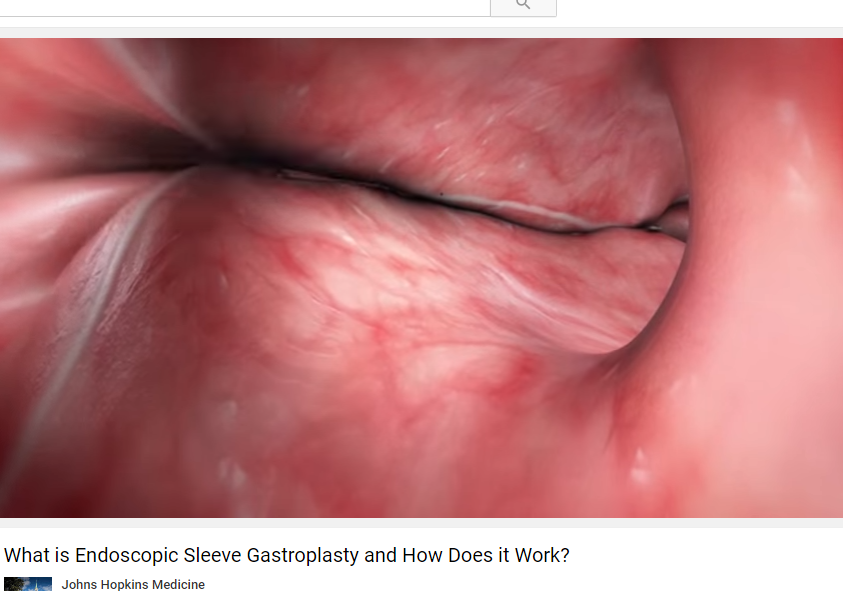
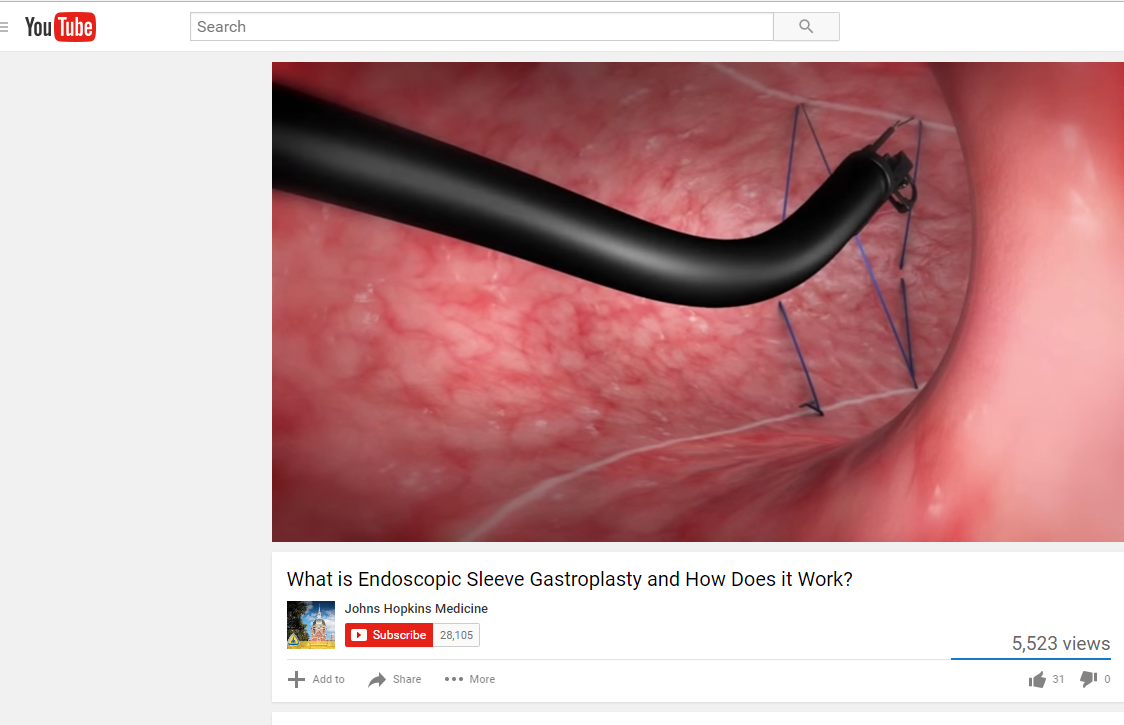
4 minute YouTube description from Johns Hopkins: What is Endoscopic Sleeve Gastroplasty and How Does it Work?
screenshot-73

screenshot-74 screenshot-75

Bariatric Surgery and Reversal of NASH

A small prospective study (M Manco et al. J Pediatr 2017; 180: 31-7) provides evidence that bariatric surgery/sleeve gastrectomy is effective at reversing nonalcoholic steatohepatitis (NASH) and hepatic fibrosis in adolescents (n=20).

All patients in this study had BMI >35 and weere 13-17 yrs of age.

Key findings at one year following intervention:

  • Among the 20 patients who underwent sleeve gastrectomy, there was a 21.5% loss in baseline weight, which compared with weight loss of 3.4% among 20 patients who received intragastric balloon device and weight increase of 1.7% among 53 patients who received lifestyle intervention counseling.
  • Sleeve gastrectomy group had resolution of NASH in all 20 and disappearance of hepatic fibrosis in 18 (90%).  In the intragastric balloon group, NASH reverted in 24% and fibrosis in 37% whereas there was no improvement in the lifestyle intervention group.

Full text link: Sleeve Gastrectomy for NASH

Limitations are discussed in the editorial by Inge and Xanthakos (pgs 6-7) and included small sample size, absence of patients with type 2 diabetes, and short followup period.  Nevertheless, this is “the largest and most informative series…in select adolescents with severe obesity.”

My take: Given the lack of effective pharmaceutical therapy and the typically impotent effects of lifestyle intervention, this data supports bariatric surgery to facilitate weight loss/NASH reversal in select adolescents.

Related article: JCF Leung et al. Hepatology 2017; 65: 54-64.  This study showed that the histologic severity and clinical outcomes are modestly better in nonobese patients (n=72) with NAFLD compared with obese patients (n=307). High triglycerides and higher creatinine were associated with more advanced liver disease in nonobese patients.

Briefly noted: D Houghton et al. Clin Gastroenterol Hepatol 2017; 15: 96-102.  This study with 24 subjects with nonalcoholic steatohepatitis showed that exercise reduced hepatic triglyceride content, visceral fat, and plasma triglycerides. However, circulating markers of inflammation and fibrosis was not reduced.  The implication is that exercise should be part of NASH treatment but that weight management/diet are needed as well.

Glacier Natl Park

Glacier Natl Park

. Related blog posts:

Adolescent Bariatric Surgery Outcomes at 3 Years

A prospective study (TH Inge et al. NEJM 2016; 374: 113-23) with 242 adolescents from five U.S. centers provides data on outcomes at 3 years. Here’s the scoop:

  • At baseline, mean age was 17 years, 75% were female, 72% were white, and mean BMI was 53.

At 3 years:

  • Mean weight decreased 27% (similar results for gastric bypass and gastric sleeve)
  • 95% had remission of type 2 diabetes (of those with diabetes at baseline)
  • 86% had remission in abnormal kidney function (of those with diabetes at baseline)
  • 74% had remission in elevated blood pressure (of those with diabetes at baseline)

lonnnngg Table 4 details the serious complications:

  • 13% of the participants (n=30, 47 procedures) had undergone additional abdominal procedures. While most of these were related to the procedure, a good number may have occurred regardlessly (eg. 18 cholecystectomies, 2 appendectomies)
  • 13% (n=29) also underwent endoscopic procedures including 9 who needed stricture dilatation.

The most common nutrient deficiency at followup was iron deficiency.  57% had low ferritin levels at 3 years compared with 5% at baseline.  Vitamin B12 deficiency was common; it declined by 35% and 8% had a deficiency at 3 years.  Vitamin A deficiencies increased (16% at 3 years). My take: this study documents the durability of weight loss and its beneficial effects on a multitude of problems.  It also shows that careful followup is needed for nutrient deficiencies and the risks of adverse events. Related blog posts:

Should Teenagers with Severe NAFLD Undergo Bariatric Surgery?

A recent commentary (Stavra A. Xanthakos and Jeffrey B. Schwimmer. Nat Rev Gastroenterol Hepatol. 2015 Jun; 12(6): 316–318.) discusses the role of bariatric surgery for teenagers with severe nonalcoholic fatty liver disease (NAFLD).  Full text Link: On a knife-edge—weight-loss surgery for NAFLD in adolescents.

Here’s an excerpt:

Abstract: A new position statement from Europe endorses expert-based recommendations to consider bariatric surgery as a treatment for severe NAFLD in severely obese adolescents. This article discusses the problem of severe paediatric obesity, its relationship with NAFLD, and the knowledge and needs regarding bariatric surgery in adolescents… it is critical that adolescents with NAFLD undergoing bariatric surgery be evaluated and managed in bariatric surgery centres with appropriate paediatric multidisciplinary expertise and a commitment to rigorously phenotype NAFLD histology at baseline and to follow outcomes prospectively as long as possible. These procedures can be particularly challenging in adolescents, who are prone to relocate in adulthood and thus might not return for follow-up. High quality prospective multicentre studies with low attrition rates, such as the Teen Longitudinal Assessment of Bariatric Surgery (USA) and the Adolescent Morbid Obesity Study (Sweden) have begun to provide short to intermediate term (1–2 year) outcomes after adolescent bariatric surgery, but do not include prospectively collected data on histological liver outcomes to support evidence-based recommendations regarding NASH as a specific indication for bariatric surgery. However, given the benefits that are emerging for type 2 diabetes and sleep apnoea, (which are comorbid conditions often associated with NASH), we concur with previously published expert guidelines that conclude that bariatric surgery is not contraindicated in a non-cirrhotic patient with NAFLD who otherwise meets appropriate medical and psychosocial criteria for bariatric surgery.2 The adolescent and family should, however, be counselled that a positive outcome with respect to NAFLD is, as yet, not a foregone conclusion.

Related blog posts:

Screen Shot 2015-12-15 at 7.37.51 PM

Overlooking Obesity in Hospitalized Children

A recent study (MA King et al. J Pediatr 2015; 167: 816-20) shows that physicians and physician trainees rarely addressed overweight/obesity in hospitalized children at a Utah pediatric hospital.

Using a chart review and an administrative database, the authors note that overweight/obesity was identified in 8.3% (n=25) and addressed in 4% (n=12) of 300 hospitalized children with overweight/obesity.  They conclude that “this represents a missed opportunity for both patient care and physician trainee education.”

My take: In many cases, addressing overweight/obesity at a stressful time like a hospitalization may be unwelcome. In children who are not very sick, offering nutritional counseling would be worthwhile.  For others, I think encouraging outpatient followup would be reasonable.

Also noted: “High Prevalence of Nonalcoholic Fatty Liver Disease in Adolescents Undergoing Bariatric Surgery” SA Xanthakos et al. Gastroenterol 2015; 149: 623-34. In this cohort of 242 adolescents, 59% had NAFLD.  None had cirrhosis; stage 3 fibrosis was identified in 0.7%. Comment: I’m surprised that only 59% had NAFLD.

white flower

NASH Update -September 2015

Briefly noted:

Obeticholic acid, a Farnesoid X Receptor Ligand, is being studied as a potential agent in nonalcoholic steatohepatitis (NASH).  According to a recent study (Lancet 2015; 385: 956-65), patients assigned to receive obeticholic acid were more likely to have improved liver histology compared with placebo (50/110 [45%] compared with 23/109 [21%]).  The  obeticholic group had increase serum cholesterol and LDL cholesterol. This study looked at a subgroup of patients in the FLINT study who had undergone liver biopsies.

E Vilar-Gomez et al. Gastroenterol 2015; 149: 367-78. This prospective study of 293 patients with histologically-proven NASH were followed after undergoing lifestyle changes for 52 weeks. At week 52, 88 subjects (30%) had lost ≥5% of their weight.  Degree of weight loss was independently associated with improvements in all NASH-related histologic parameters (steatohepatitis, NAS activity score, and fibrosis.

G Lassailly et al. Gastroenterol 2015; 149: 379-88. Between 1994-2013, 109 morbidly-obese patients with histologically-proven NASH underwent bariatric surgery.  One year after surgery, NASH had disappeared from 85% of the patients.

P Angulo et al. Gastroenterol 2015; 149: 389-97. In this retrospective analysis of 619 patients with NAFLD (1979-2005), the authors noted that “fibrosis stage, but no other histologic features of steatohepatitis, were associated independently with long-term overall mortality, liver transplantation, and liver-related events.”


Should We Be Excited About a New Medication (Liraglutide) for Obesity?

Thus far, “the benefits of medications to treat obesity remain limited because of side effects and inadequate efficacy, especially in the long term.” This is part of an editorial (Siraj ES, Williams J. NEJM 2015; 373: 82-3) that explains a recent study (Pi-Sunyer X, et al. NEJM 2015; 373: 11-22). However, there is a huge need for a cost-effective medication because bariatric surgery is not feasible for 400 million obese persons worldwide.

Liraglutide (marketed as Victoza) has been approved by the FDA for weight loss in adults based on this published study and two other trials.  Liraglutide is a glucagon-like peptide-1 (GLP-1) mimetic.  The authors conducted a 56-week, double-blind trial with 3731 non-diabetic patients. In a 2:1 design, most patients received a once-daily subcutaneous 3.0 mg injection of liraglutide; some received placebo.  Both groups received lifestyle counseling.

Key finding:

  • At week 56, the treatment group had lost a mean of 8.4 kg compared with the placebo group which lost 2.8 kg.

There were similar rates of adverse events (mildly increased in treatment group); the rate of new diagnoses of diabetes was less than one-eighth that in the placebo group.  A 2-year extension trial is being analyzed to further pursue this finding.  Also, the authors note that 4 cases of breast cancer (0.2%) were detected in the treatment group compared with 1 (0.1%) in the placebo group.  This finding could have been due to easier exam following weight loss.  It is noted that the labeling for liraglutide has a black box warning regarding thyroid c-cell tumor risk which have occurred in rodents at clinically relevant doses.

A fairly good 2 minute summary: NEJM Short Take on Liraglutide

Despite the weight loss, the editorial has a cautious tone.

  • “There were statistically significant, although sometimes quantitatively modest, improvements in secondary end points, which included glycemic control, fasting insulin concentrations, cardiometabolic markers, and quality-of-life measures.”
  • “Most obese participants stayed obese, reversal of the metabolic syndrome was not quantified, and liraglutide may be required indefinitely, like statins, but with delivery by injection and at a nontrivial cost.”  According to http://www.goodrx.com, the approximate retail price is $596.01 for 18 mg. For type 2 diabetes, the dosage varies from 1.2 to 1.8 mg per day, after the first week which is dosed at 0.6 mg.

Take-home point: This new medication may help with modest weight loss but at a very significant cost.  In addition, long-term data are lacking. Thus, right now, this medication does not provide the cost-effective option to bariatric surgery.

Related blog posts:

Georgia Aquarium

Georgia Aquarium

Reaching Consensus on Bariatric Intervention in Children and Adolescents

A recent medical position paper (Nobili V, et al. JPGN 2015; 60: 550-61) provides guidance for bariatric surgery intervention in children and adolescents with and without nonalcoholic fatty liver disease (NAFLD).

While the authors acknowledge that bariatric surgery can “dramatically reduce the risk of adulthood obesity and obesity-related diseases,” they advocate its use in adolescents with the following:

  • BMI >40 kg/m-squared with severe comorbidities: type 2 diabetes mellitus, moderate-to-severe sleep apnea, pseudotumor cerebri, or NASH with advanced fibrosis (ISHAK score >1)
  • BMI >50 kg/m-squared with mild comorbidities: hypertension, dyslipidemia, psychological distress, gastroesophageal reflux, anthropathies, NASH, impairment in activities of daily living, mild obstructive sleep apnea, panniculitis, chronic venous insufficiency, urinary incontinence
  • Additional criteria: have attained 95% of adult stature, failed behavioral/medical treatments, psychological evaluation perioperatively, avoid pregnancy for 1 year after surgery, will adhere to nutritional guidelines after surgery, informed assent from teenager (along with parental consent)

Key points:

  • “There is a lack of randomized controlled trials examining the effects of bariatric surgery on NAFLD or NASH.”  In Table 3, the authors provide a summary of 16 previous studies/outcomes; though none of the studies enrolled more than 60 patients.
  • In an adult prospective study with 381 patients (Mathurin P et al. Gastroenterol 2009; 137: 532-40), there was a significant decline in the severity/prevalence of steatosis and resolution of NASH at 1 and 5 years.
  • Bariatric surgery, in adult studies, have improved diabetes, insulin resistance, hypertension, and dyslipidemia.
  • Patients who have “undergone bariatric surgery show higher suicide rates than the general population.”  Psychological evaluation should be integrated with surgical decision.
  • Type of surgery: Roux-en-Y Gastric Bypass (RYGB) is favored by the authors; they also discuss studies with Laparoscopic Adjustable Gastric Banding (LAGB).  “RYGB and LAGB are the 2 main surgical procedures that have been used in pediatric obesity.  RYGB is considered a safe and effective option for adolescents with extreme obesity, as long as appropriate long-term follow-up is provided. LAGB has not been approved by Food and Drug Administration for use in adolescents, and there should be considered investigational only.”

It is interesting that the authors are so deferential to the Food and Drug Administration.  It is clear from their position paper that LAGB has similar evidence supporting its use in adolescents as RYGB.  They even note that it has potential for reversibility and “an excellent safety profile with a lower risk of postoperative vitamin deficiencies when compared with biliopancreatic diversion and RYGB.”

Bottomline: Given the continuation of the obesity epidemic, additional pediatric medical expertise will be needed to help evaluate adolescents for bariatric surgery and to follow them postoperatively.

Related blog posts:

Is a Three Year-Old Too Young for Bariatric Surgery?

Maybe not.

Recent article from WSJ (from Jeff Schwimmer’s twitter feed): http://online.wsj.com/news/article_

Here is an excerpt:

Daifailluh al-Bugami was just a year old when his parents noticed that his lips turned blue as he slept at night. It was his weight, doctors said, putting pressure on his delicate airways.

Now Daifailluh is 3, and at 61 pounds he is nearly double the typical weight of a child his age. So the Bugamis are planning the once unthinkable: To have their toddler undergo bariatric surgery to permanently remove part of his stomach in hopes of reducing his appetite and staving off a lifetime of health problems.

That such a young child would be considered for weight-loss surgery—something U.S. surgeons generally won’t do—underscores the growing health crisis here and elsewhere in the Middle East. Widespread access to unhealthy foods, coupled with sedentary behavior brought on by wealth and the absence of a dieting and exercise culture, have caused obesity levels in Saudi Arabia and many other Gulf states to approach or even exceed those in Western countries…

Daifailluh’s doctor, Aayed Alqahtani, is a leading advocate of a radical approach to the problem. Patients travel to him from across the country and the Gulf region. Over the past seven years, he has performed bariatric surgery on nearly 100 children under the age of 14, which experts on the procedure believe is the largest number performed by one doctor on young children… “We should not deprive our patients from bariatric surgery based on their age alone,” the surgeon says. “If they have [medical] conditions that threaten their lives, then we should not deny the bariatric surgery…”

Pediatric surgeons in the U.S. say they also are facing demands from families to operate on younger patients. Thomas Inge, surgical director of the Surgical Weight Loss Program for Teens at Cincinnati Children’s Hospital, says he will be operating on a 12-year-old later this month. He says that as younger and younger children are referred for consideration of surgery, care teams will need to carefully weigh the pros and cons…

Many doctors say they aren’t ready to follow Dr. Alqahtani yet. Kirk Reichard, chairman of the pediatric-surgery committee for the American Society for Metabolic and Bariatric Surgery, notes that there are no data to show that surgery doesn’t affect young children’s long-term sexual maturation or cognitive functioning.

Related blog posts:

Childhood Obesity and Consensus Recommendations

Everyday pediatric gastroenterologists care for obese children; in fact, the prevalence is approximately 17% in the United States (JAMA 2010; 303: 242-9).  The types of problems include the entire spectrum of pediatric gastroenterology, though some problems like encopresis and gastroesophageal reflux are more prevalent in this population.  Whether during visits for other problems or at clinic visits focused on obesity, there may be opportunities to improve the health of these patients.

A recent consensus statement provides some guidance on the problems and treatment approaches (JPGN 2013; 56: 99-109).

After reviewing epidemiology and etiology, the consensus reviews common comorbidities which include

  • NAFLD/NASH
  • Cardiovascular: Hypertension, Hyperlipidemia   Screen: Blood pressure, fasting lipids
  • Pulmonary: Obstructive sleep apnea  Screen: assess snoring
  • Psychiatric: Depression, Bullying   Screen: assess clinically
  • Orthopedic: Blount disease (pain at medial aspect of knee) and difference in leg length, SCFE
  • Endocrine: Diabetes/insulin resistance, Polycystic ovarian syndrome  Screen: look for acanthosis nigricans, fasting glucose, hemoglobin A1c.  For PCOS, inquire about oligo/amenorrhea, look for hyperandrogenism, consider pelvic ultrasound

Besides looking for these comorbid conditions, the authors discuss treatment.  “Overall, multidisciplinary, behavior-based programs should be used when lifestyle modification counseling has not worked.”  Also, the authors recommend motivational interviewing, lifestyle interventions (healthy activity and diet =”mainstay of weight management”), possibly using Orlistat, and possibly bariatric surgery.

These consensus recommendations are sensible.  Will they make a difference?

Related posts: