Linaclotide -Here’s the Pediatric Data

Last year, the FDA approved linaclotide, a guanylate cyclase C agonist, for the treatment of pediatric constipation (related post: Linaclotide -Now FDA-Approved for Children).

Here’s the phase III study data: C DiLorenzo et al. The Lancet Gastroenterol Hepatol 2024; 9: 238-250. Efficacy and safety of linaclotide in treating functional constipation in paediatric patients: a randomised, double-blind, placebo-controlled, multicentre, phase 3 trial

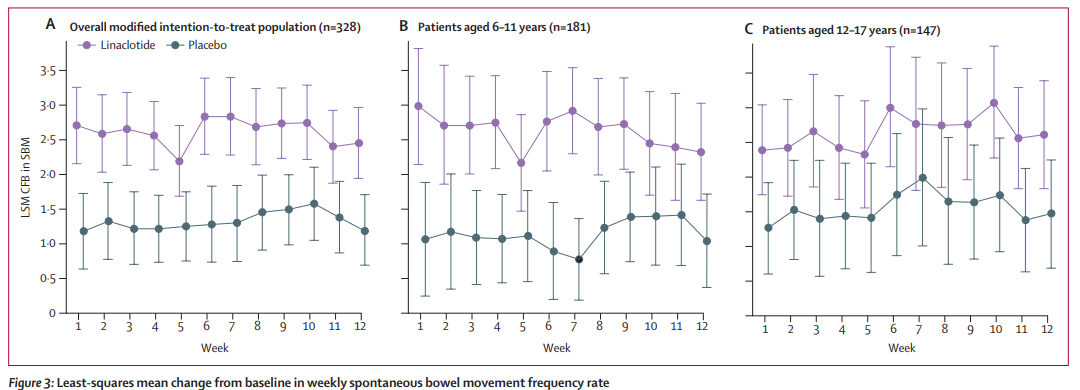
Children 6-17 yrs of age (n=328) received either oral linaclotide 72 μg or placebo once daily for 12 weeks. Key findings:

  • The mean frequency rate for spontaneous bowel movements (SBMs) was 1·28 SBMs per week (SD 0·87) for placebo and 1·16 SBMs per week (0·83) for linaclotide, increasing to 2·29 SBMs per week (1·99) for placebo and 3·41 SBMs per week (2·76) for linaclotide during intervention. 
  • Linaclotide also significantly improved stool consistency over placebo
  • Straining with stooling also improved. Change from baseline improvement (Least squares mean change) −1·19 in linaclotide group compared to −0·75 in placebo group (p<0·0001). Straining scale based on responses to the following question: When you pooped, how hard did you push? (0=not hard at all; 1=I pushed a tiny bit hard; 2=I pushed a little hard; 3=I pushed hard; 4=I pushed very hard)
  • Abdominal bloating improved as well compared to placebo, Change from baseline improvement (Least squares mean change): −0·51 vs −0·35 (p=0·027)
  • The authors note that “the subgroup analysis by age for CFB in SBM frequency rate suggests that the response of the older cohort (aged 12−17 years) was not as strong as the response of the younger cohort (aged 6–11 years).” This could indicate that a higher dose may be beneficial in this age group. “Further studies evaluating increased dosing regimens for older children will be important.”
  • The most frequent treatment-related TEAE was diarrhoea (linaclotide: six [4%] patients; placebo: two [1%] patients).
72 mcg per day dosing

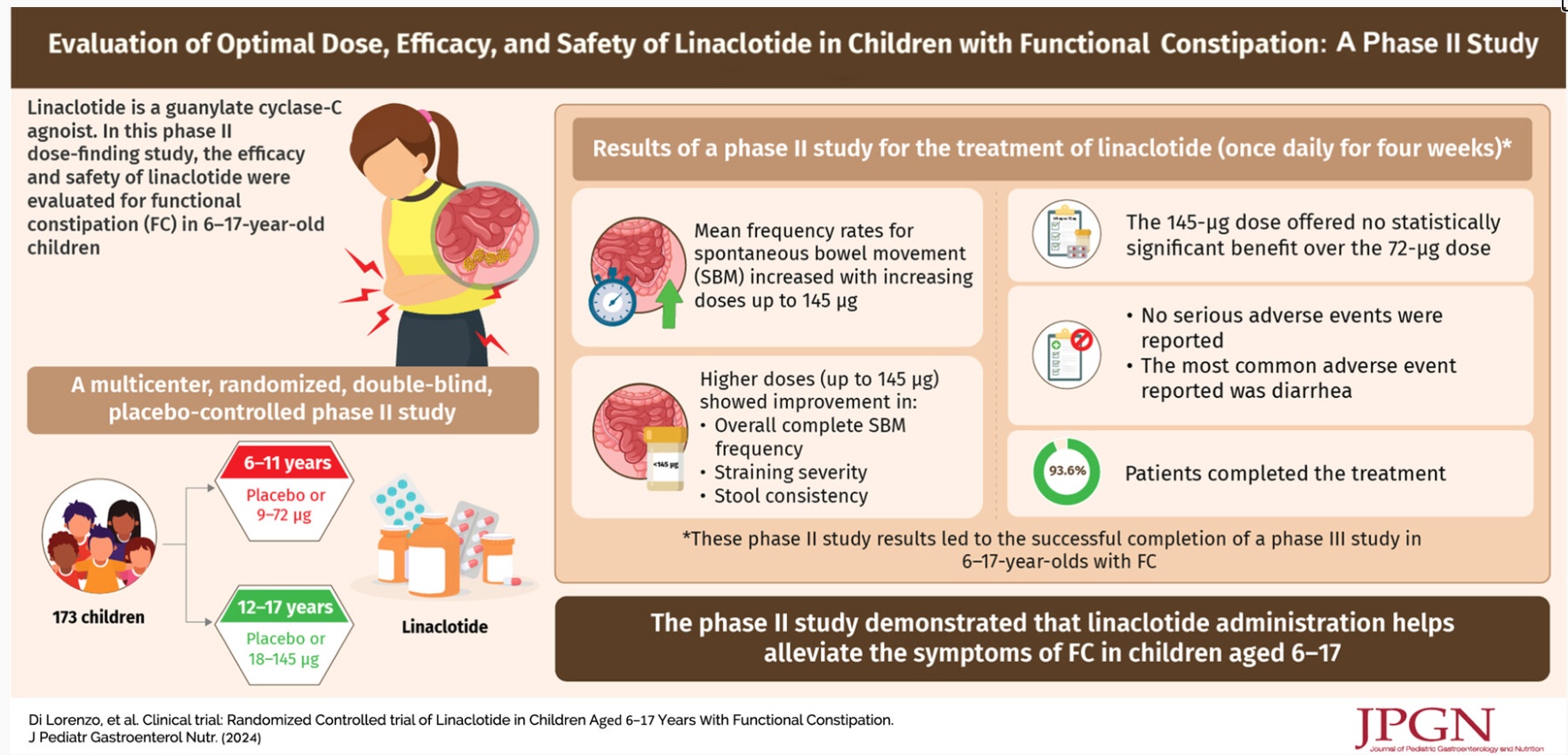
Here’s the phase II study data: C DiLorenzo et al. JPGN 2024; https://doi.org/10.1002/jpn3.12184. Randomized controlled trial of linaclotide in children aged 6−17 years with functional constipation

This was a multicenter, randomized, double-blind, placebo-controlled phase 2 study, with 173 children with functional constipation (based on Rome III criteria) were randomized to once-daily linaclotide or placebo.

Key findings:

  • A numerical improvement in mean spontaneous bowel movement (SBM) frequency was observed with increasing linaclotide doses (1.90 in 6- to 11-year-olds [36 or 72 μg] and 2.86 in 12- to 17-year-olds [72 μg]).
  • The most reported treatment-emergent AE was diarrhea, with most cases being mild; none were severe. The most reported treatment-emergent AE was diarrhea, with most cases being mild; none were severe.

My take: It is good news to have the an FDA-approved treatment for pediatric functional constipation. It is worth remembering that the estimated cost for a monthly supply is $560 via GoodRx (with coupon, queried on 5/22/24). 

Long Term Use of Polyethylene Glycol (PEG 3350)

A Bautista-Casasnovas et al. JPGN Reports 4(4):p e353, November 2023. Open access! Multicentre Study Into the Use of Polyethylene Glycol With Electrolytes Over at Least 6 Months to Treat Constipation in Paediatric Populations

Background: PEG 3350 with electrolytes (PEG+E) is the most widely used osmotic laxative in Europe, and it is normally prescribed for short or limited periods in children, such that there is little information regarding its long-term use (≥6 months).

Methods: This was a retrospective, observational, descriptive, longitudinal, and multicentre study was carried out on 74 children diagnosed with functional constipation.

Patient characteristics:  The mean (±SD) duration of the symptoms of constipation before starting PEG+E treatment was >1 year (15.6 ± 8.4 months). Fecal disimpaction was necessary in 49 children (66.2%) .

Key findings:

  • The mean PEG+E dose used was 1.0 (±0.8) g/kg.
  • The mean duration of PEG+E use was 18.6 (±13.4) months (range 8–73 months), and 59.45% (n = 44) of the patients took the treatment for more than 1 year.
  • 81% (n = 60) of the patients achieved 4 or more weekly bowel movements after having taken PEG+E for at least 3 weeks.
  •  All clinical symptoms (abdominal pain, gassiness/bloating) were reduced considerably, with the resolution of the anal fissures, bleeding, and soiling in all patients.

Polyethylene glycol (the active ingredient in Miralax) is considered a first-line treatment for pediatric constipation and for fecal impaction. “However, caregivers may be hesitant to administer medication over long periods due to a fear of a rebound effect or addiction (23). Indeed, early withdrawal of laxatives is the commonest cause of recurrence (4,5), highlighting the need for longer follow-up studies (8).”

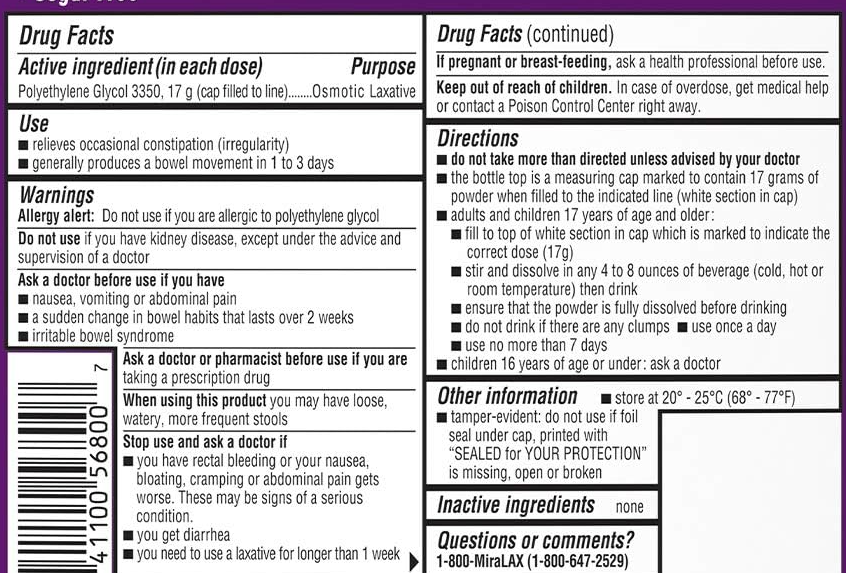
My take: It is helpful to have long term studies of PEG 3350 showing its effectiveness and safety, especially as the medication labels state to not use these medications for more than 7 days.

Related blog posts:

Clarification: However, Ben Enav pointed out that the label also states the following in bold: “do not take more than directed unless advised by your doctor.” The actual label is shown below.

Population-Based Study: Prevalence of Bowel and Bladder Dysfunction in Early Childhood (Good Bowel Control is Happening Later)

SJ Verkuijl et al. JPGN 2023; 77: 47-54. Open Access! The Prevalence of Bowel and Bladder Function During Early Childhood: A Population-Based Study

Methods: This cross-sectional questionnaire study (n=791 Dutch children) up to age 7 yrs of age.

Key findings:

  • The mean age at which parents/caregivers considered their child fully toilet-trained was 5.1 ± 1.5 years. “Compared to studies performed 15 years ago, we found toilet training to be completed at an older age (23,26–28).”
  • Prevalence of fecal incontinence among toilet-trained children was 12%.
  • Prevalence of constipation was 14%, with excessive stool retention (75.9%) and painful/hard stools (78.7%) as the 2 most common symptoms.
  • The prevalence of urinary incontinence among all toilet-trained children was 40%. The majority of these urinary incontinent children suffered from daytime incontinence (56%). Enuresis occurred in 22% and the other 22% suffered from combined daytime incontinence and enuresis.
  • There were significant associations between fecal incontinence and constipation [odds ratio (OR) = 3.88], fecal incontinence and urinary incontinence (OR = 5.26), and constipation and urinary incontinence (OR = 2.06)
  • Half of the children with constipation and almost all the children with fecal incontinence remained untreated.
Stool Frequency by age (Figure 1 B)

In the discussion, the authors note “treatment of constipation and/or fecal incontinence often leads to the resolution of urinary incontinence (34).”

In my experience, many families sent by urologists have been told that the constipation is causing urinary incontinence. For many children, the explanation is more complicated; association of constipation does not indicate causation. A lot of children have limited sensation of response to both bowel and bladder, rather than the rectum pushing on the bladder. Most children that I see with constipation/encopresis do not have urinary incontinence. However, behavior approaches to toileting can be helpful for both.

My take: This is a useful study providing an updated view on when to expect good toileting and highlighting the frequency of bowel/bladder dysfunction (which is often untreated).

Related blog posts:

Linaclotide -Now FDA-Approved for Children

FDA 6/12/23: FDA approves first treatment for pediatric functional constipation

“FDA has approved Linzess (linaclotide) capsules to treat functional constipation in pediatric patients 6 to 17 years of age. Linzess is the first treatment for pediatric functional constipation. The recommended dosage in pediatric patients 6 to 17 years is 72 mcg orally once daily.”

“The efficacy of Linzess for the treatment of functional constipation in pediatric patients 6 to 17 years of age was established in a 12-week double-blind, placebo-controlled, randomized, multicenter clinical trial (Trial 7; NCT04026113) and supported by efficacy data from adequate and well-controlled trials in adults with chronic idiopathic constipation (constipation that persists and isn’t connected to an underlying illness).”

Safety:

  • Most common adverse effect was diarrhea
  • Avoid in patients with known or suspected mechanical gastrointestinal obstruction (bowel blockage)
  • “Linzess contains a boxed warning that the medication should not be taken by patients less than 2 years of age”
  • See full prescribing information for additional information on risks associated with Linzess.

My take: While this is good news to have the first FDA-approved treatment for pediatric functional constipation, it is worth remembering that the estimated cost for a monthly supply is between $514-$536 (in Atlanta pharmacies per GoodRx.com).

Related blog posts:

Radiographs and Constipation -Bad Practice and Good Study

A really good study, in my view, is one that provides useful data and 100% backs up what I want it to find.

N Yallanki et al JPGN 2023; 76: 295-299. Inter and Intraobserver Variation in Interpretation of Fecal Loading on Abdominal Radiographs

Methods: Electronic records of 100 children seen in the emergency room for gastrointestinal symptoms who had an abdominal radiograph performed were included. Four physicians from each specialty including gastroenterology, radiology, and emergency medicine interpreted the radiographs independently.

Key findings:

  • Overall agreement among all providers: 40.8%. Fixed margin kappa 0.18
  • Intradepartmental agreement: 41.5% for Peds GI, 36.7% for Peds EM, and 47.3% for Peds Radiology.

My takes:

  1. The only surprising finding was the low intradepartmental agreement for Peds EM; many of my colleagues have insisted that all Peds EM think everyone has a high fecal burden (so there should have been uniform agreement)
  2. This study reinforces expert guidance to avoid reliance on AXRs for the diagnosis of constipation

Related blog posts:

Chattahoochee River in Sandy Springs, GA

Understanding the Laxative Effects of Coffee

V Mehta et al. JPGN 2023; 76: 20-24. Open Access! Effect of Caffeine on Colonic Manometry in Children

Methods: A prospective study of pediatric patients (N=16) undergoing standard colonic motility testing that were able to consume caffeinated coffee, decaffeinated coffee, and caffeine tablet during colonic manometry (with normal response to bisacodyl)

Key findings:

  • Caffeinated coffee resulted in a higher AUC, motility index (MI), and time to HAPC compared with decaffeinated coffee (P < 0.05).
  • Urge to defecate, or actual bowel movement in 100% (n = 16) of patients after intraluminal bisacodyl (IB), compared to 81% (n = 13) after caffeinated coffee (CC), 56% (n= 9) after caffeine tablet (CT), and 50% (n = 8) after decaffeinated coffee (DC)
  • Based on AUC between T = 1 and T = 60 minutes after each agent, the response of the colon to IB was more robust, relative to other agents (P < 0.05). Both CC and DC had resulted in a higher AUC compared to CT (P < 0.05), but no significant difference between CC and DC 
  • Caffeine is indeed a colonic stimulant; however, other components of caffeinated and non-caffeinated beverages likely induce colonic response as well
  • Limitation: Study population: patients required motility testing for refractory chronic constipation Therefore, they do not represent a normal population

My take: As with adult patients, coffee (both caffeinated and decaffeinated) acts as a colonic stimulant. Though, it is relatively weak compared to bisacodyl

Related blog posts:

Briefly Noted: Kiwi for IBS-C

R Gearry et al. AJG 2022. DOI: 10.14309/ajg.0000000000002124.Open Access! Consumption of 2 Green Kiwifruits Daily Improves Constipation and Abdominal Comfort—Results of an International Multicenter Randomized Controlled Trial

Participants included healthy controls (n = 63), patients with functional constipation (FC, n = 60), and patients with constipation-predominant irritable bowel syndrome (IBS-C, n = 61). Mean age 35 years.

Key findings: Consumption of green kiwifruit was associated with a clinically relevant increase of ≥ 1.5 CSBM (complete spontaneous bowel movement) per week (Functional constipation; 1.53, P < 0.0001, IBS-C; 1.73, P = 0.0003) and significantly improved measures of GI comfort (GI symptom rating scale total score) in constipated participants (FC, P < 0.0001; IBS-C, P < 0.0001)

Related blog post: Small Study: Kiwi For Constipation

Picking Apart the SERENE-CD Study & Constipation Vibrating Capsule FDA Approved

Several recent letters to the editor provide some insight into some of the shortcomings of the SERENE-CD study which reported that higher adalimumab induction dosing and proactive therapeutic drug monitoring (TDM) were not associated with improved outcomes.

“The rerandomization design of SERENE CD, which selectively enrolled patients with clinical response at week 12 to the TDM vs CA part of the study, may have resulted in the exclusion of those who would have benefited the most from early adjustment of their anti-tumor necrosis factor (TNF) dose. The rerandomization design and the late adaptation of the proactive strategy at week 12 were 2 significant aspects of the design that may have led to the negative results. On the other hand, PAILOT, which showed beneficial effects of proactive TDM, randomized patients as early as week 4 and assessed the outcome at week 72. This is distinct from the 1-year time frame used in most other studies, including SERENE CD.8 A properly designed, adequately powered clinical trial is needed before we can make a judgement on the use of proactive TDM in patients with inflammatory bowel disease. Until then, the jury remains out.”

“The study design only allowed patients in the TDM group with adalimumab concentrations of ≥5 and ≤10 μg/mL to be escalated to 40 mg every week if their CD activity index was ≥220 or their high-sensitivity C-reactive protein level was ≥10 mg/L.. The goal of proactive TDM is to attain a threshold concentration regardless of disease activity. This design probably led the 2 groups to have similar drug concentrations at week 56…

Second, a rather low targeted drug concentration of 5 μg/mL was used, although previous studies have suggested that higher concentrations are more appropriate.5678 A study from Ungar et al5 showed that adalimumab concentrations of 8–12 μg/mL are required to achieve mucosal healing in 80%–90% of patients with IBD, and the prospective PANTS (The Personalised Anti-TNF Therapy in Crohn’s Disease Study) study identified an adalimumab concentration of 12 μg/mL at week 14 associated with remission at both week 14 and week 54.8..

Third, dose escalation for the TDM group could only happen at weeks 14, 28, or 42 (and not earlier and more often). In the PAILOT RCT, proactive TDM based on adalimumab concentration evaluations started as early as week 4 followed by week 8 and every 8 weeks thereafter until the end of the follow-up at week 72.3 Fourth, there was a rather short follow-up of the patients (44 weeks).”

” Even with the assumption of a 30% benefit of proactive TDM and that 20% of patients would have low drug levels in the absence of symptoms, the sample size for 80% power would range from 1228 to 2170. Thus, although SERENE CD1 and other clinical trials3,4 have suggested a lack of benefit of proactive TDM in adults with inflammatory bowel disease, all were likely substantially underpowered to do so.”

My take: While the SERENE-CD results have suggested that a strategy of proactive TDM may not be helpful, there are a lot of reasons to disregard these findings. Achieving a therapeutic level is a fundamental principle and proactive TDM, particularly in pediatrics, is well-supported by other studies.

Related blog posts:

Also noted:

Quality Improvement: Fewer Xrays for Constipation

ME McSweeney et al. J Pediatr 2022; 251: 127-133. A Quality Improvement Initiative to Reduce Abdominal X-ray use in Pediatric Patients Presenting with Constipation

Key findings:

  • In total, 6723 patients completed new patient gastroenterology visits for a primary diagnosis of constipation between 2013 and 2019. Of these, 993 (14.8%) patients had abdominal radiographs taken within 24 hours of their initial visit. Over the 7 years of this project, a mean frequency of abdominal radiograph use decreased from 24% to less than 11%.
  •  No increases in subsequent emergency department visits or hospitalization for constipation within 30 days of patients’ initial visits were seen.
  • One of the keys to improvement was providing data to individual providers

The authors note that routine radiographs are NOT recommended by expert guidelines in patients presenting with functional constipation.

My take: The trend of using radiographs less frequently shows that a QI project can help avoid low value testing though more than 10% is still too high.

Related blog posts:

Most Popular 2022 Posts

The list of the most viewed gutsandgrowth blog posts in 2022.

Links to Posts: