Longer Adalimumab Dosing Intervals Associated with Worse Outcomes for Crohn’s Patients in Remission (LADI Trial)

LMA Van Lierop et al. Gastroenterol 2026; 170: 404-407. Open Access! Long-Term Outcomes of Increased Versus Conventional Adalimumab Dose Interval for Patients With Crohn’s Disease in Stable Remission: 3-Year Follow-Up of the Randomized Controlled LADI Trial

Methods: “The LADI trial enrolled adults with luminal CD in corticosteroid-free clinical (CFCR) and biochemical remission, on adalimumab, 40 mg every 2 weeks. After randomization in a 2:1 ratio, the intervention group started on a 3-week interval and increased to 4 weeks, if in clinical and biochemical remission at week 24. The control group remained on adalimumab biweekly…The primary end point in this long-term follow-up (LTFU) study was the proportion of patients in CFCR (Harvey Bradshaw Index [HBI] <5 or remission per Physician Global Assessment [PGA] without systemic corticosteroids) without complications at year 3, on the assigned adalimumab interval.”

Key findings:

  • The proportion of patients achieving the primary end point was 34 of 95 (35.8%, intervention) vs 41 of 48 (85.4%, control; P < 0.001).
  • At year 3, 39 of 95 (41.1%) in the intervention group remained on the randomized or further de-escalated adalimumab regimen
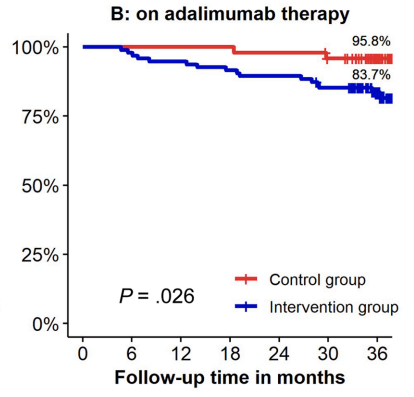
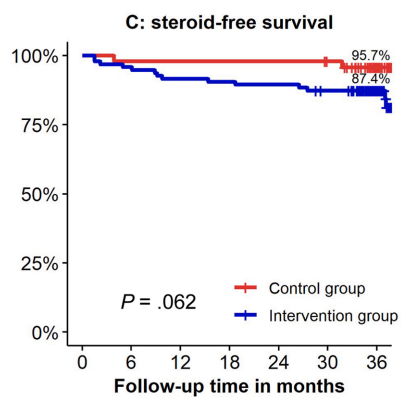
  • Kaplan-Meier analyses of secondary end points showed the following probabilities at year 3 (intervention vs control) (Figure 1): remaining on the assigned adalimumab dose, 41.4% vs 91.4% (P < .0001); remaining on adalimumab, 83.7% vs 95.8% (P = .026); corticosteroid-free survival, 87.4% vs 95.7% (P = .062); and complication-free survival, 83.2% vs 97.9% (P = .015)
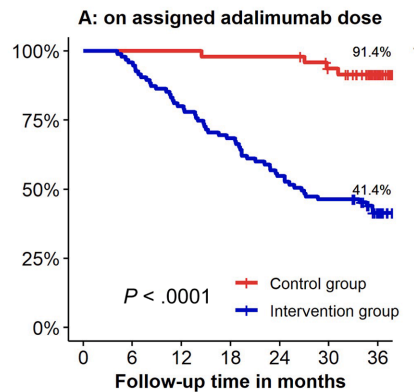
Kaplan-Meier curves visualizing maintenance of assigned dosing at baseline, continued adalimumab therapy, and corticosteroid-free survival in both groups. (A) Probability of maintaining assigned adalimumab dosing interval of 3–4 weeks (intervention) vs 2 weeks (control).
(B) Probability of remaining on adalimumab therapy over time.
(C) Probability of remaining in corticosteroid-free remission.

My take: About 60% of patients were unable to de-escalate their adalimumab dosing interval. Suboptimal dosing increased the risk of complications and having adalimumab therapy become ineffective.

Related blog posts:

How Long Will Infliximab Work?

Given the limited therapeutic options, the question of infliximab (IFX) durability in pediatrics is quite important.  One center has published its 10-year retrospective experience (Inflamm Bowel Dis 2014; 20: 606-13).

Inclusion criteria for the 188 patients included initiating IFX prior to age 21 years and patients who had a minimum of 1-year followup.

Demographics: Median age at diagnosis was 11 years for Crohn’s disease (CD) and 12 years for ulcerative colitis (UC). Indication for IFX due to steroid refractory disease was present in 42% of UC patients compared with 14% of CD patients.  Monotherapy was more common in UC patients, 65%, compared to 35% of CD patients.

Methotrexate was administered in 69 (44%) of CD patients at time of IFX with the majority (n=56) as oral treatment (low-dose <10 mg every week).  In addition, MTX was initiated after IFX induction in another 38 (24%).  Only 36 (23%) remained on IFX mono therapy throughout the duration of treatment in CD patients.

Key findings:

  • 88% of CD patients remained on IFX at 1 year, 80% at 2 years, and 72% at 5 years.
  • Only 7 of 157 CD patients were primary nonresponders.
  • 65 of 89 CD patients who did not achieve a sustained durable remission underwent dose escalation. 40 of 65 responded to dose escalation.
  • Of those who lost response to IFX, the majority were transitioned to adalimumab (ADA) and among this group, 82% remained on ADA treatment at last followup.
  • Among UC patients (n=31), 9 were primary nonresponders. At last followup, 41% (9) remained in a durable sustained response at last followup.
  • While the authors used MTX due to favorable effects on IFX pharmacokinetics (Arthritis Rheum 1998; 41: 1552-63), there was “not a significant difference in IFX durability or efficacy between this group and patients with CD on IFX monotherapy”
  • Availability of antibodies to infliximab (ATIs) and IFX trough levels were only assessed in a subset.  However, “we did see a significant difference in those that responded to dose intensification when ATIs were undetectable.”

Bottomline: The majority of CD patients can remain on IFX for >5 years.  Among those who lose response, adalimumab was a durable alternative.  A much lower durable response was evident with the subset of patients with UC.

Related blog post:

Also noted:

Inflamm Bowel Dis 2014; 20: 614-21. In this study of 78 youth with IBD, depressive symptoms warranting additional evaluation were present in 13% which was lower than in the community comparison group.  Disease severity was noted to be inactive in 63% and mild in another 18%.

Inflamm Bowel Dis 2014; 20: 495-501. This study showed that 25 children exposed to anti-TNFs prenatally for maternal IBD seemed to show good safety.  Immunologic investigation undertaken in 17 of the children was normal.  No control group limited the ability to determine if increased infections were present.

And, here’s a link to Mar-April Circle Newsletter from ImproveCareNow -topics include group medical appointments, parent working group, dieting with IBD, and includes link to self management handbook.