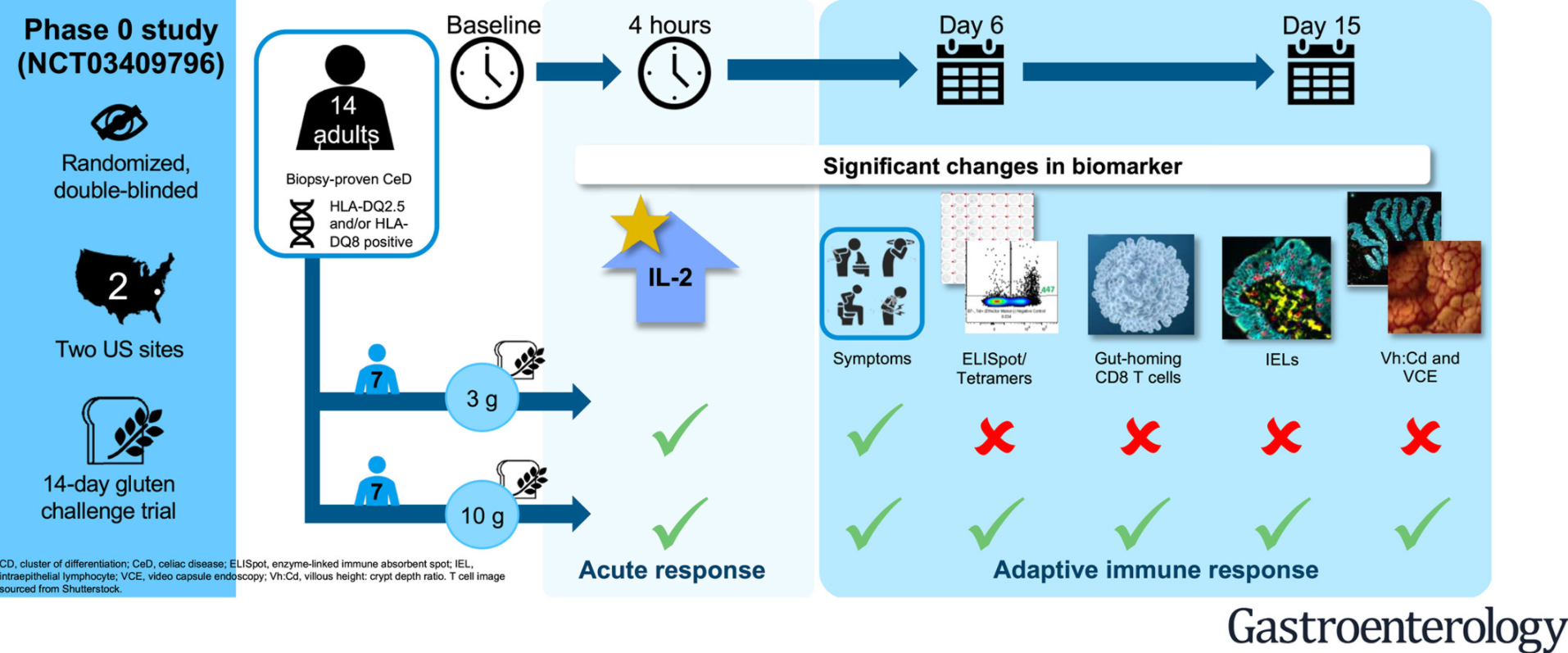
- AJM Daveson et al. Gastroenterol 2026; 171: 285-297. Open Access! A Randomized Double-Blind, Placebo-Controlled Dose–Response Study to Assess the Gluten Threshold Dose in Celiac Disease
- JA Silvester, C Catassi. Gastroenterol 2026; 171: 229-231. Editorial. Codex in Limbo? Using the Interleukin-2 Test to Lower the Bar for Gluten in a Gluten-Free Diet for Celiac Disease
Background: Interleukin 2 (IL2) rises acutely after gluten ingestion, allowing the definition of threshold doses that trigger immune activation.
Methods: This was a randomized double-blind, placebo-controlled adaptive dose–response trial in adults with biopsy-proven celiac disease on a gluten-free diet for >2 years. Participants (n = 51; median age, 52 years; 69% were female) underwent 3 oral gluten (1–1000 mg) or placebo challenges at 4-week intervals. Eliciting dose (EDp, ie, the dose at which p% of people respond) was estimated by interval-censored survival analysis.
Key findings:
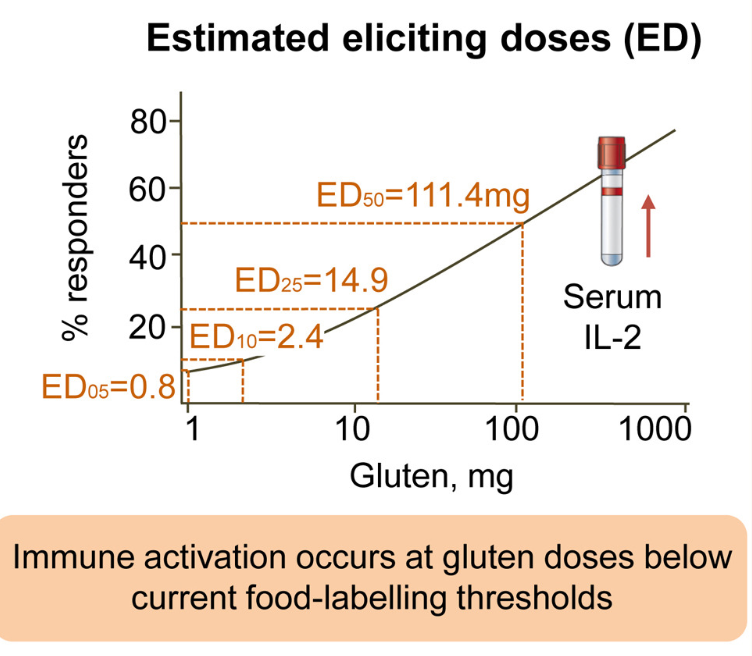
- Gluten induced dose-dependent IL2 elevations, with ≥2-fold increases in 83% at 1000 mg, 83% at 610 mg, 36% at 90 mg, 17% at 13 mg, 27% at 8 mg, and 17% at 3 mg; none responded to 5 mg, 2 mg, 1 mg, or placebo.
- Estimated ED50 was 111 mg, ED10 was 2.4 mg, ED05 was 0.8 mg, and ED01 was 0.1 mg
From the editorial:
“To date, the few investigators who addressed this question defined tolerance in relation to quantifiable histologic damage (intestinal morphometry)…Bearing in mind that the typical Western diet contains 10–15 g of gluten per day, these studies found that the protracted, daily ingestion of 1000, 200, or 50 mg of gluten elicits significant damage at the mucosal level.2,3 A daily dose of 10 mg was also associated with minimal architectural changes in some patients…
In 2007, the Food and Agricultural Organization/World Health Organization Codex Alimentarius Commission4 applied these findings to establish that commercially available gluten-free food must not contain more than 20 mg/kg gluten (20 part per million [ppm]), as this would ensure that daily gluten intake does not exceed 10 mg…Not a single case of proven intolerance to 20 ppm gluten-free food has been described…in some 20-ppm countries, most labeled gluten-free products already contain much less than 20 ppm of gluten, usually <10 ppm5…
The authors concluded that the daily gluten threshold should be decreased because acute IL2 release occurred at 3 mg, which is less than is allowed by current food-labeling rules for gluten-free products…
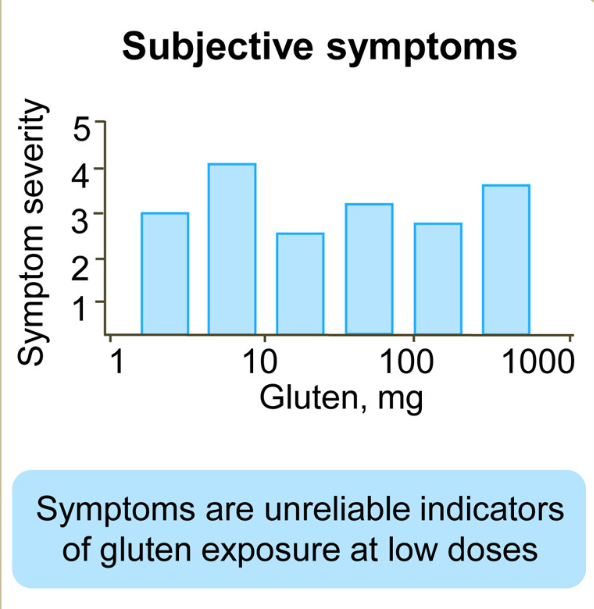
Because symptoms did not correlate with the result of the IL2 test for gluten doses <1 g, further prolonged microchallenge studies remain the only reliable strategy to investigate the correlation between the IL2 test and the gold standard of CeD activity—histologic damage of the small intestinal mucosa.10,11“
My take: This study is intriguing that there is evidence of immune activation at lower gluten exposures; however, it does not prove that changing the gluten threshold is beneficial.
Related blog posts:
- How a Gluten Challenge Could Change
- What is Gluten-Free?
- Dr. Arun Singh: Tips and Tricks to Managing Celiac Disease
- Most Common Symptoms with a Gluten Challenge in Those with Celiac Disease
- Likelihood of Celiac Disease with Conflicting Serology Results
- When Celiac Disease Symptoms Continue Despite a Gluten Free Diet
- What To Do For Pediatric Patients with Non-Responsive Celiac Disease
- Celiac Disease: Pro Tips (Part 1)
- Celiac Disease: Pro Tips (Part 2)
- Celiac Disease: Pro Tips (Part 3)
- Celiac Disease: Pro Tips (Part 4)
- Do You Need Separate Cookware for Celiac Disease?