Preliminary Work: A Vaccine to Prevent Colon Cancer and A Blood Test to Detect Colon Cancer

D’Alise, A.M., Willis, J., Duzagac, F. et al. Nat Med (2026). https://doi.org/10.1038/s41591-025-04182-9. Nous-209 neoantigen vaccine for cancer prevention in Lynch syndrome carriers: a phase 1b/2 trial. (Open Access!)

Background: “Lynch syndrome (LS) is a prevalent hereditary cancer syndrome affecting ~1 in 300 individuals, with an overall lifetime cancer risk as high as 80%. LS is caused by germline mutations in the DNA mismatch repair genes, leading to microsatellite instability (MSI) and accumulation of shared mutations. When these occur in coding regions, they generate frameshift peptides (FSPs). Nous-209 is a neoantigen-directed immunotherapy” against these FSPS. These are “the results from cohort 1 of a phase 1b/2 single-arm trial of Nous-209 for cancer interception in LS carriers (n = 45).”

Key findings:

  • Neoantigen-specific immune responses were observed after vaccination in 100% of evaluable participants (n = 37), with induction of potent T cell immunity
  • The immune response was durable and detectable at 1 year in 85% of participants
  • Both CD8+ and CD4+ T cells were induced, recognizing multiple FSPs
  • Peptide–human leukocyte antigen predictions allowed the identification of >100 immunogenic FSPs with demonstration of cytotoxic activity in vitro
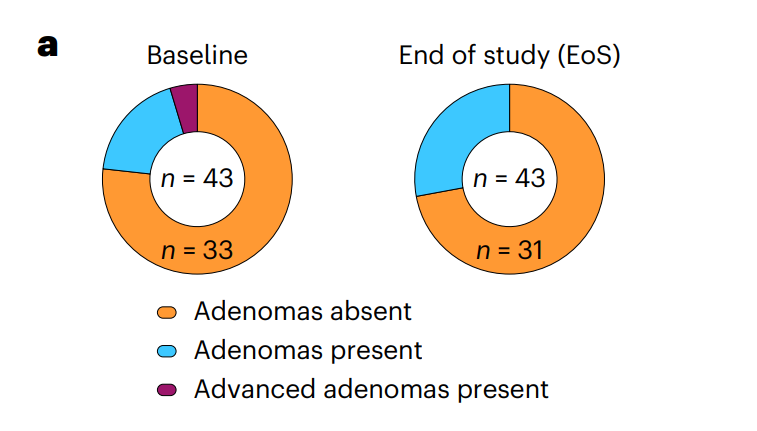
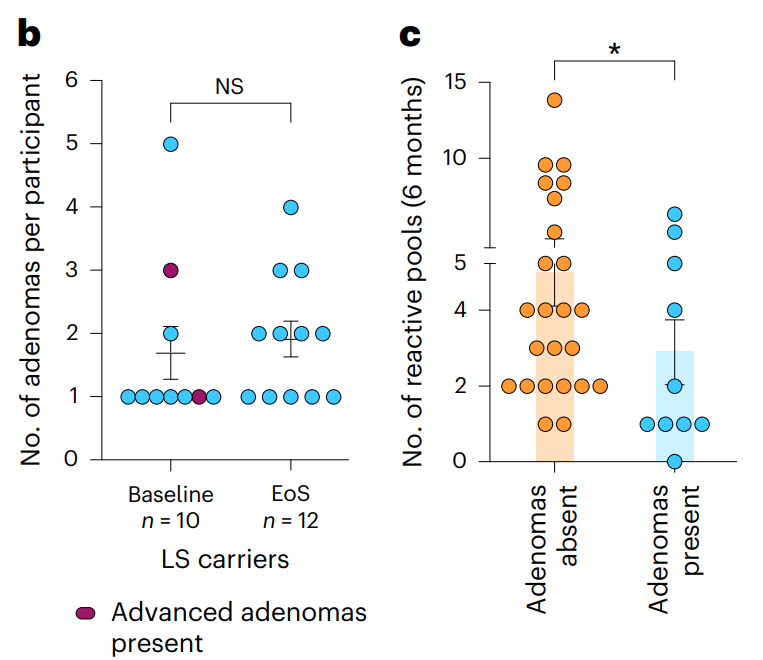
Colorectal neoplasia burden observed at end-of-study colonoscopy inversely correlates with breadth of immune response. a, Number of participants who underwent screening colonoscopy at baseline and end of study (EoS; n = 43) who had no adenomas (adenomas absent), at least one adenoma (adenomas present) and advanced adenomas (advanced adenomas present) detected.
b, Number of adenomas per trial participant at baseline and end of study; comparison of baseline versus EoS was performed using a two-tailed Mann–Whitney U-test; NS, not significant. c, Number of reactive pools measured at 6 months (n = 34 evaluable subjects) between the participants with and without adenomas. Data are shown as the mean ± s.e.m.

My take (borrowed in part from authors): “Overall, this clinical trial provides important proof-of-concept data of the safety and the robustness of induced immunogenicity of
Nous-209 in LS carriers…and supporting its clinical development as a valuable intervention for cancer immune interception.” Vaccines have a long history in reducing cancer (for Hepatitis B, Cervical Cancer (due to HPV), Anal Cancer, Leukemia (by boosting immunity) and Others). Until recently, this has been by preventing viral infections that increase the risk of cancer. This is a new approach.

Related article: Blood test for colorectal cancer: A Mannucci et al. Gastroenterol 2026; 170: 330-343. An Exosome-Based Liquid Biopsy for the Detection of Early-Onset Colorectal Cancer: The ENCODER Multicenter Study Methods: A panel of 6 cell-free and exosome-based circulating biomarkers were identified through small RNA sequencing from a biomarker discovery cohort (blood test). Key finding: “This study developed and independently tested a blood-based test with 97.3% sensitivity for screening-relevant CRC stages I–III and 61.5% for the noninvasive detection of high-grade dysplasia.”

Related blog posts:

The Latest on Lynch Syndrome

Briefly Noted:

AGA Guidelines on Diagnosis and Management of Lynch Syndrome: JH Rubenstein et al. Gastroenterol 2015; 149: 777-82. Technical Review 783-813. Patient Guideline Summary 814-14.

MB Yurgelun et al. Gastroenterol 2015; 149: 604-13.  Multigene panel testing from 1260 individuals with clinical Lynch syndrome.  9% had Lynch syndrome mutations identified, 5.6% had other cancer predisposing genes (eg. BRCA1) identified, and 479 had variants of uncertain clinical significance.

Related blog post:


Updated Guidelines on Genetic Testing/Management for Hereditary GI Cancer Syndromes

Here’s a link to abstract: Updated Guidelines on Genetic Testing/Management for Hereditary GI Cancer Syndromes (The American Journal of Gastroenterology 110, 223-262 (February 2015) | doi:10.1038/ajg.2014.435).  This ACG guideline specifically discusses genetic testing and management of Lynch syndrome, familial adenomatous polyposis (FAP), attenuated familial adenomatous polyposis (AFAP), MUTYH-associated polyposis (MAP), Peutz–Jeghers syndrome, juvenile polyposis syndrome, Cowden syndrome, serrated (hyperplastic) polyposis syndrome, hereditary pancreatic cancer, and hereditary gastric cancer.

I glanced at the guideline –it is about 40 pages in length.  It provides a lot of in-depth information on these infrequent disorders.

Some online resources for similar information:

Are you familiar with CMMR-D?

In a recent review, CMMR-D and Lynch syndrome are reviewed (JPGN 2014; 58: 144-52). The term CMMR-D refers to constitutional mismatch repair deficiency.  This occurs when an individual inherits two MMR gene defects (rather than one gene defect in Lynch syndrome). CMMR-D can occur when a different mutation is inherited from each parent. MMR genes include MLH1, MSH2, MSH6 and PMS2.

Unlike Lynch syndrome when screening for colorectal cancer (CRC) usually starts at age 20 years or 5 years before first CRC in family, with CMMR-D screening recommendations include yearly endoscopic evaluation beginning at age 3 years or at diagnosis.  Complete management guidelines are listed in Table 4.

More bad news for smokers

Add two more cancer risks for tobacco smoke (Gastroenterology 2012: 142: 233-40, 242-47).  There is now evidence linking tobacco smoke to 18 different cancers and tobacco smoke is probably the most preventable cause of death in the world.

In the first study, the investigators examined 3167 patients with Barrett’s esophagus.  This retrospective study followed patients for 7.5 years.  Patients who were current smokers (any form of tobacco) had double the risk of developing high-grade dysplasia or cancer compared to those who had never smoked.  Former cigarette smokers had a hazard ratio of 1.53.

In the second study, 386 patients with Lynch syndrome were analyzed during a 10 month period.  The hazard ratio for developing colorectal adenomas was 6.13 for current smokers and 3.03 for former smokers compared with patients who never smoked.  In addition, the authors identified a trend for developing adenomas based on pack-years.

Two more reasons to quit smoking.  On a side note, my grandmother said quitting smoking was the easiest thing that she ever did.  So easy, she did it a thousand times.

Additional references:

  • -Gastroenterolgy 2005; 129: 1825-31.  1.6% incidence of BE in adult Swedish population. Alcohol & smoking increase risk.
  • -NEJM 2011; 365: 1222. Treating smokers -useful review.
  • -NEJM 2011; 365: 1193. Cytisine -inexpensive- helps with smoking cessation (8.4% success vs 2.4%in placebo)
  • -NEJM 2008 358; 2249. Smoking and role of social networks.
  • -Gastroenterology 2011; 141: 2000. Lower risk of Barrett’s in pts taking NSAIDs & statins. n=570.
  • -Gastroenterology 2011; 141: 1179. Lower risk of Barrett’s in pts with low-grade dysplasia than previously noted -similar to non-dysplastic Barrett’s.
  • -NEJM 2011; 365: 1375. Large Danish study, n=11028. Lower incidence of Barrett’s than previous estimates. Relative risk of 11.3 compared to general population for adenoca of Esophagus with absolute annual risk of 0.12%. Barrett’s patients have the same life expectancy as general population (ed. pg 1437). Detecting cancer only ~1 in 1460 scopes with screening whereas Barrett’s detected in 10% of pts.
  • -Gastroenterology 2011; 140: 1084. AGA statement on Barrett’s . Recs screening only in those with multiple risk factors (age 50, male, chronic GERD, white, incr BMI)
  • -NEJM 2005; 352: 1851. Cases of Lynch can be missed when following screening guidelines.
  • -Gastroenterology 2010; 138: 207-2177 (entire issue) Colon cancer, Lynch syndrome
  • -Gastroenterology 2008; 135: 380.  Review of colon cancer screening and prevention -2008 up-to-date- literature review
  • -Gastroenterology 1967; 53: 517-27.  Seminal article.  Lynch HT showed gene-related cancer in family cancer syndrome -different than polyposis syndromes.