Endoscopic Ischemic Polypectomy for Polyposis Disorders

S Kurasawa et al. JPGN Reports. 2026; DOI: 10.1002/jpr3.70188. Open Access! Endoscopic ischemic polypectomy for small intestinal polyps in a 7-year-old girl with juvenile polyposis syndrome

Background: “Funayama et al.4 described the technique of endoscopic ischemic polypectomy (EIP) in detail in both pediatric and adult patients with Peutz–Jeghers syndrome (PJS). Subsequently, EIP was reported to be a safe and effective treatment for 269 small intestinal polyps in 22 pediatric PJS cases.5” Here the authors describe the use of this technique for a child with juvenile polyposis syndrome (JPS).

Key findings:

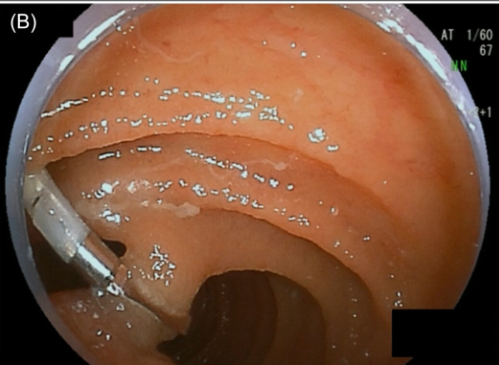
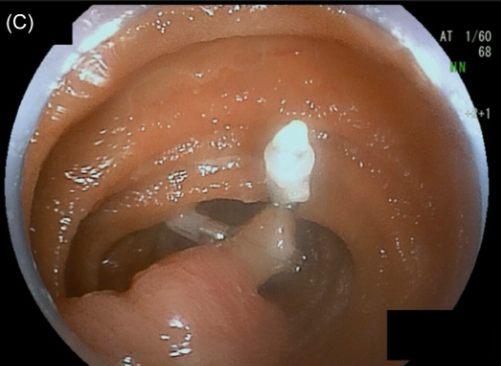
  • During a two-hour double-balloon enteroscopy (DBE) for a 7 yo child, “17 pedunculated polyps, all with a visually assessed size range of 7–15 mm, EIP was performed using the “crossed-clip strangulation method,” in which the first hemostatic clip was deployed with the aid of a distal attachment and rotated 90°, followed by placement of a second clip crossing the first at a 90° angle (Figure 1)…Subsequently, anemia and hypoalbuminemia did not recur, and growth was satisfied.”
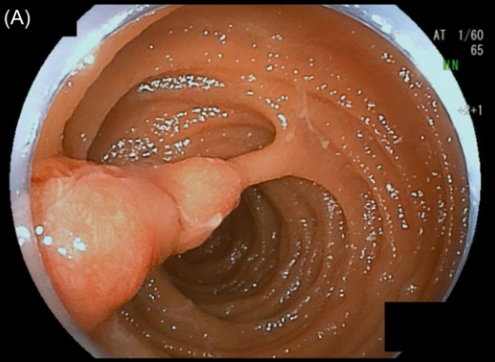
(A) Pedunculated polyp in the small intestine. (B) The first hemostatic clip was placed on the stalk of the polyp. (C) A second hemostatic clip was placed on the stalk of the polyp at a 90-degree angle to the first clip.

Discussion Points:

  • “EIP does not involve electrocautery, eliminating the risk of thermal injury and offering a safer alternative for small bowel lesions.”
  • “A limitation of EIP is the inability to retrieve resected polyps…It should only be used for lesions that appear clearly benign.”
  • There is a risk of detached polyps migrating into the lower gastrointestinal tract and inducing intussusception. This can be mitigated by managing distal small intestinal polyps first.

My take: EIP appears to be useful for inidividuals with numerous small intestinal polyps.

Related blog posts:

Polyposis in Pediatric Patients -Review

A recent review article (SP MacFarland et al. JPGN 2019; 69: 273-80) provides clearcut guidelines on polyposis syndromes in pediatric patients.

Table 1 lists the syndrome, the mutated gene (s), and recommended screening (onset & interval). The article and table provide more nuance/guidance but the basic recommendations are noted as follows:

  • For Familial Adenomatous Polyposis (FAP), the authors recommend onset of colonoscopy at 10 years and with 1 year intervals.  “Colectomy recommended by 20 to 25 years.”  EGD is recommended at 18 to 20 years. Thyroid ultrasound is recommended at 18 years.  Alpha-fetoprotein levels to check for hepatoblastoma are recommneded every 3-6 months in infancy up to 5 years of age.
  • For Juvenile Polyposis Syndrome, EGD and Colonoscopy are recommended at 15 years with interval evaluations at 1-3 years.
  • For Peutz-Jeghers syndrome, EGD and Colonoscopy are recommended at 8 to 10 years (along with small bowel evaluation with either MRE or video capsule).  Interval followup is recommended every 2-3 years.

Table 2 provides suggestions for familial screening in pediatric polyposis syndromes.

Related blog posts:

Pittock Mansion, Portland OR


ESPGHAN Peutz-Jeghers Syndrome Position Paper

Management of Peutz-Jeghers Syndrome in Children and Adolescents: A Position Paper by the ESPGHAN Polyposis Working Group; Link:JPGN 2019; 68 (3): 442-452

This position paper serves as a good review and makes clear recommendations for evaluation and management.

In a single individual, a clinical diagnosis of PJS may be made when any one of the following is present:
1. Two or more histologically confirmed PJS polyps
2. Any number of PJS polyps detected in 1 individual who has a family history of PJS in close relative(s)
3. Characteristic mucocutaneous pigmentation in an individual who has a family history of PJS in close relative(s)
4. Any number of PJS polyps in an individual who also has characteristic mucocutaneous pigmentation.

SUMMARY OF RECOMMENDATIONS

  • Recommendation 1 Predictive genetic testing for an asymptomatic at risk child should be offered from the age of 3 years and should be performed earlier in a symptomatic at-risk child. (moderate recommendation, low-quality evidence, agreement 90%)
  • Recommendation 2 Lip and mucosal freckling is not diagnostic of PJS alone. Patients with lip and mucosal freckling suggestive of PJS should be referred to a geneticist for diagnostic genetic testing. Investigation of the GI tract is recommended to start no later than age 8 unless symptoms arise earlier. (weak recommendation, low-quality evidence, agreement 100%)
  • Recommendation 3 GI surveillance by upper GI endoscopy, colonoscopy, and VCE should commence no later than 8 years in an asymptomatic individual with PJS, and earlier if symptomatic…and generally be repeated every 3 years. Earlier investigation of the GI tract should be performed in symptomatic patients. (moderate recommendation, low-quality evidence, agreement 90%)
  • Recommendation 4 Patients with symptomatic intussusception should be urgently referred for surgical reduction. There is no role for radiological or endoscopic reduction of intussusception in a symptomatic child with intestinal obstruction from a PJS polyp. At laparotomy, patients should ideally undergo an intraoperative enteroscopy to clear the small bowel of other PJS polyps. (strong recommendation, low-quality evidence, agreement 100%)
  • Recommendation 5 Elective polypectomy should be performed to prevent
    polyp-related complications. Small bowel polyps >1.5 to 2 cm in size (or smaller if symptomatic) should be electively removed to prevent intussusception. Endoscopic, surgical, and combined approaches all have their merit and the choice of modality should be made on a case by case basis (weak recommendation, low-quality evidence, agreement 100%)
  • Recommendation 6 LCCSCTs [Large-cell calcifying Sertoli cell tumours of the testes] leading to feminizing manifestations including gynaecomastia are associated with the PJS and males should be assessed for this at clinical assessment.
  • Recommendation 7 There is no role for pharmacological agents as a treatment or for chemoprevention in PJS. (strong recommendation, low-quality evidence, agreement 100%)
  • Recommendation 8 Cancer in children with PJS is an extremely rare event. Children and adolescents should be routinely clinically examined for features of sex cord tumours

Related blog posts:

Near Chattahoochee River

Disclaimer: These blog posts are for educational purposes only. Specific dosing of medications (along with potential adverse effects) should be confirmed by prescribing physician.  This content is not a substitute for medical advice, diagnosis or treatment provided by a qualified healthcare provider. Always seek the advice of your physician or other qualified health provider with any questions you may have regarding a condition.

Screenshots: Peutz-Jeghers Syndrome, Alcohol #1 for Liver Transplantation, Case report Fanconi Syndrome due to Tenofovir Alafenamide

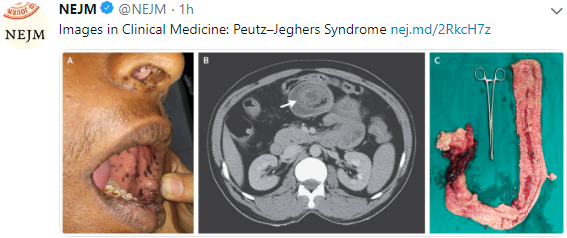
These images (S Sengupta, S Bose. NEJM 2019; 380: 472) show hyperpigmented macules on the lips, oral mucosa and nose in the first frame, a target sign on CT scan indicative of intussception, and a jejunal resection with polyps that triggered the intussception. Related blog post: Update for Peutz-Jegher Syndrome

Updated Guidelines on Genetic Testing/Management for Hereditary GI Cancer Syndromes

Here’s a link to abstract: Updated Guidelines on Genetic Testing/Management for Hereditary GI Cancer Syndromes (The American Journal of Gastroenterology 110, 223-262 (February 2015) | doi:10.1038/ajg.2014.435).  This ACG guideline specifically discusses genetic testing and management of Lynch syndrome, familial adenomatous polyposis (FAP), attenuated familial adenomatous polyposis (AFAP), MUTYH-associated polyposis (MAP), Peutz–Jeghers syndrome, juvenile polyposis syndrome, Cowden syndrome, serrated (hyperplastic) polyposis syndrome, hereditary pancreatic cancer, and hereditary gastric cancer.

I glanced at the guideline –it is about 40 pages in length.  It provides a lot of in-depth information on these infrequent disorders.

Some online resources for similar information: