Hepatitis B Therapy for Patients with Mildly Elevated Liver Enzymes Associated with Lower Risk of Cancer and Cirrhosis

J Wang et al. Clinical Gastroenterology and Hepatology, 2026; 24, 2742-2751. Open Access! Antiviral Therapy Reduces Hepatocellular Carcinoma and Cirrhosis Risk in Chinese Chronic Hepatitis B Patients With Mildly Elevated Alanine Aminotransferase

Background: “Generally, patients with normal or mildly elevated ALT levels have a low risk of disease progression and HCC, and regular follow-up instead of immediate antiviral therapy is recommended in most international CHB guidelines.3–6 However, emerging evidence suggests that a considerable proportion of patients with CHB and normal or mildly elevated ALT levels have significant histological changes and relatively high risk of HCC and cirrhosis, especially in individuals with high HBV DNA levels.7–13 The interim results from a recent randomized controlled trial (ATTENTION) add important evidence that early antiviral treatment with tenofovir alafenamide (TAF) reduces the risk of liver-related adverse events in patients with non-cirrhotic livers and normal or mildly elevated ALT levels compared with untreated patients.14“

Methods: This retrospective multicenter study included 3734 non-cirrhotic patients (mean age 36.5 yrs) with chronic hepatitis B (CHB) with ALT <2 × the upper limit of normal (ULN); ALT values used a more stringent definition of normal or mildly elevated ALT, as recommended by the 2025 AASLD guideline. To balance baseline characteristics between treated and untreated patients, inverse probability of treatment weighting (IPTW) and propensity score matching (PSM) were applied. Of all patients, 37.8% received nucleos(t)ide analogues (NA) treatment.

Key findings:

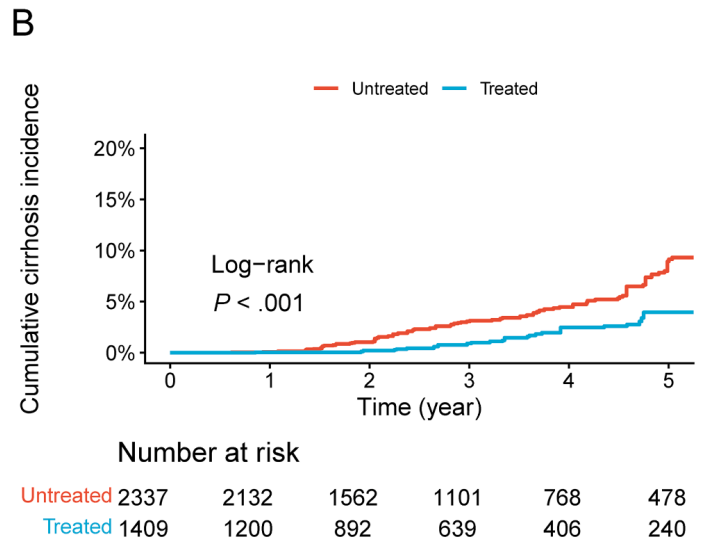
  • After IPTW, treated patients had a significantly lower 5-year cumulative incidence of HCC (0.9% vs 4.4%; P < .001) and cirrhosis (4.0% vs 8.9%; P < .001) than untreated patients
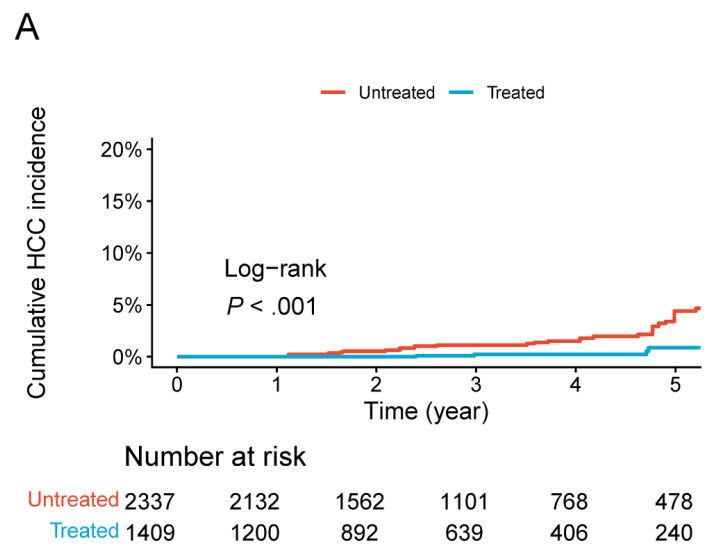
Comparison of cumulative incidence of HCC between treated group and untreated group with IPTW
Comparison of cumulative incidence of cirrhosis between treated group and untreated group with IPTW

Discussion:

“Our real-world evidence supports the ongoing shift toward a more proactive treatment approach for expanding eligibility to include patients with lower threshold ALT levels (>ULN) and HBV DNA (>2000 IU/mL), as recently recommended by the 2025 European Association for the Study of the Liver (EASL) guidelines and the 2024 World Health Organization (WHO) guidelines.4,6“

My take (borrowed in part from the authors): “NA therapy reduced the risk of HCC and cirrhosis in non-cirrhotic CHB patients with mildly elevated ALT levels (1–2 × ULN). These findings support the expansion of antiviral treatment criteria for the early treatment of these patients.” The benefits of NA therapy, though, may vary significantly in younger patients, especially those in the pediatric age group.

Related blog posts:

Disclaimer: This blog, gutsandgrowth, assumes no responsibility for any use or operation of any method, product, instruction, concept or idea contained in the material herein or for any injury or damage to persons or property (whether products liability, negligence or otherwise) resulting from such use or operation. These blog posts are for educational purposes only. Specific dosing of medications (along with potential adverse effects) should be confirmed by prescribing physician. Because of rapid advances in the medical sciences, the gutsandgrowth blog cautions that independent verification should be made of diagnosis and drug dosages. The reader is solely responsible for the conduct of any suggested test or procedure. This content is not a substitute for medical advice, diagnosis or treatment provided by a qualified healthcare provider. Always seek the advice of your physician or other qualified health provider with any questions you may have regarding a condition.

Liver Shorts: PFIC/FIC1, Best Tenofovir, Ascites Practice Guidance

DBE van Wessel et al. Hepatology 2021; 74: 892-906. Open Access: Impact of Genotype, Serum Bile Acids, and Surgical Biliary Diversion on Native Liver Survival in FIC1 Deficiency

This huge collaborative study with 130 patients provides a great deal of information about familial intrahepatic cholestasis type 1 (FIC1). Key findings:

  • Survival analysis showed an overall native liver survival (NLS) of 44% at age 18 years. NLS was comparable among FIC1-A, FIC1-B, and FIC1-C (% NLS at age 10 years: 67%, 41%, and 59%, respectively; P = 0.12)
  • The number of predicted protein truncating mutations did not correlate with natural history or prognosis

H Toyoda et al. Hepatology 2021; 74: 656-666. Treatment and Renal Outcomes Up to 96 Weeks After Tenofovir Alafenamide Switch From Tenofovir Disoproxil Fumarate in Routine Practice

In this study, the researchers 834 patients with CHB previously treated with TDF for ≥12 months who were switched to TAF in routine practice at 13 US and Asian center. Key findings:

  • “Overall, we observed continued improvement in virologic response, ALT normalization, and no significant changes in eGFR following switch to TAF from TDF.”
  • HBV DNA suppression increased from 88% to 92% at 48 weeks post-switch, and then 95% at 96 weeks postswitch
  • Improved renal function: “By week 96, 21% (55/267) of patients with CKD stage 2 at switch improved to stage 1 and 35% (30/85) of CKD stage 3-5 patients improved to stage 2 and 1.2% (1/85) to stage 1.”

SW Biggins et al. Hepatology 2021; 74: 1014-1048. Open Access. Diagnosis, Evaluation, and Management of Ascites, Spontaneous Bacterial Peritonitis and Hepatorenal Syndrome: 2021 Practice Guidance by the American Association for the Study of Liver Diseases

This practice guidance (with 276 references) is an update from similar guidelines published in 2012.

Key Points For Children:

  • Children with cirrhosis and ascites should be referred for evaluation for LT
  • Children undergoing LVP should receive 25% albumin infusion of 0.5-1.0 g/kg, or 6-8 g per liter of ascites removed.
  • Diagnostic paracentesis should be performed in children with ascites and fever, abdominal pain, or clinical deterioration. The risks and benefits of this procedure for use in all children with new ascites but without these symptoms have not been defined.
Atlanta Beltline Murals

Is Tenofovir the Best Medication for Hepatitis B Infection?

Two recent studies have suggested that tenofovir may be more effective for hepatitis B virus (HBV) infections.

  • T C-F Yip et al. Gastroenterol 2020; 158: 215-25.
  • J Choi et al. JAMA Oncol 2019; 5: 30-6. (Reviewed in a commentary by P Lampertico, M Colombo. Gastroenterol 2019; 157: 1682-88)

In the first retrospective study from Hong Kong, the authors analyzed 29,350 consecutive treated-patients  (mean age 52.9 years).  1309 were treated with tenofovir disoproxil fumarate (TDV) and 28,041 were treated with entecavir. Key findings:

  • TDF-treated patients were younger (mean age 43.2 years vs. 53.4 years) and had less cirrhosis at baseline (2.9% vs. 13.6%).
  • After a median follow-up of 3.6 years, 8 TDF-treated patients (0.6%) and 1386 (4.9%) of entecavir-treated patients developed hepatocellular carcinoma (HCC).  The authors note that TDF maintained a lower rate of HCC after propensity score weighting (hazard ratio of 0.36)

The second study was a nationwide population cohort database with >24,000 patients –all with ALT >80. Key finding:

  • HCC was significantly lower in TDF group than in the entecavir group, the percent person-years being 0.64 compared to 1.06; though, there was not a lower mortality rate or a lower liver transplantation rate.

The commentary associated with the latter study makes the following points:

  • Both TDF and entecavir could prevent “the incidence and mortality of HCC …in >85% of patients who received [them] for years.”
  • Studies comparing TDF and entecavir have come up with conflicting results.  “Three studies in Korea, the U.S, and Europe reported no differences between NAs even after patient matching by a propensity score.”
  • “Cumulatively, all these studies deliver the reassuring message of a robust risk reduction of liver cancer taking place in patients with chronic hepatitis B who experience prolonged virus suppression after NA therapy, but currently they fail to provide convincing evidence that one NA is superior to the other one in determining such clinical benefit.”

My take: Tenofovir may be better but the answer is not definitive; due to lack of randomization, there may still be confounding variables in which sicker patients are receiving entecavir and this could be contributing to the difference in outcomes.  Also, in patients with bone disease and renal impairment, tenofovir alafenamide (TAF) or entecavir is recommended.

Related blog posts:

From P’tit Train Du Nord Linear Park

Screenshots: Peutz-Jeghers Syndrome, Alcohol #1 for Liver Transplantation, Case report Fanconi Syndrome due to Tenofovir Alafenamide

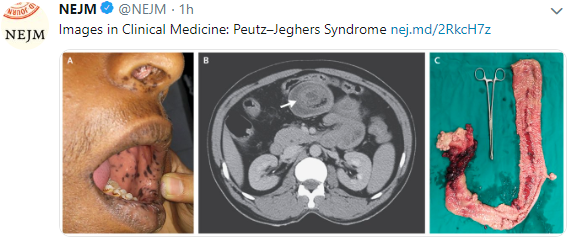
These images (S Sengupta, S Bose. NEJM 2019; 380: 472) show hyperpigmented macules on the lips, oral mucosa and nose in the first frame, a target sign on CT scan indicative of intussception, and a jejunal resection with polyps that triggered the intussception. Related blog post: Update for Peutz-Jegher Syndrome