The Median Arcuate Ligament Syndrome (MALS) Study For Skeptics Like Me

MA Nassif et al. J Pediatr Gastroenterol Nutr. 2026;83:397–403. Outcomes of surgical versus conservative treatment inpediatric median arcuate ligament syndrome

Methods: This was a retrospective pediatric study (n=34) evaluating surgical versus conservative management in pediatric MALS. Conservative therapy included the following: 100% pharmacologic, 80% behavioral, 30% botulinum toxin, 20% neurostimulation.

Key findings:

  • Conservative therapy outcomes (n=10): resolution (20%), improvement (40%), unchanged (40%), and none worsened.
  • Surgical therapy outcomes (n=24) resolution (21%), improvement (33%), unchanged (17%), worsened (29%); thus, these outcomes are not significantly different from the conservative group (p = 0.21). Median hospital stays: 4 days. Postoperative complications occurred in 21%. The one major complication was an intraoperative splenic artery injury in a patient with Ehlers-Danlos Syndrome.
  • Overall, 60% of children with MALS improved with conservative DGBI‐directed therapy and 54% improved with decompression surgery at long‐term follow‐up (at median 9.8 months), despite a robust short‐term postoperative response (87%). At 20 days postop: 52% reported resolution, 35% improved.
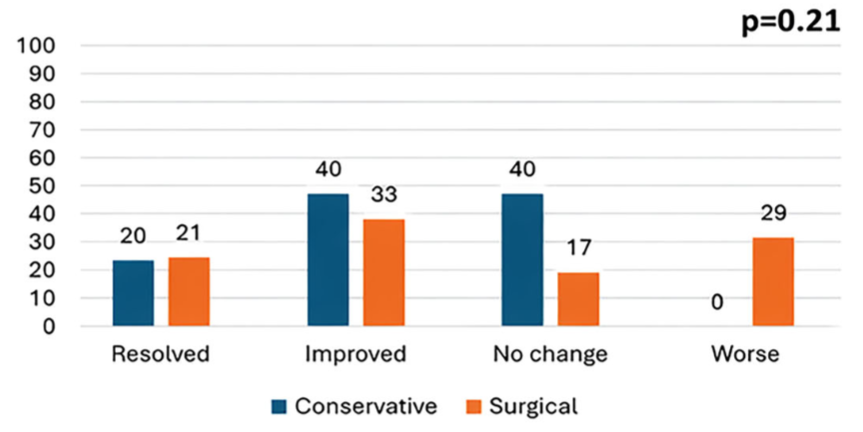
Recent follow‐up data show comparable rates of resolution and improvement between the two groups, with no statistically significant difference (p = 0.21).

Discussion points:

  • Other studies have reported higher response rates for MALS surgery: “The newest and largest‐scale review suggests a 70% symptom relief rate in three of six pediatric studies, with follow‐ups of 6–62 months after laparoscopic MALS release.[28]”
  • “A more recent study conducted in 2017 determined that only post‐exertional abdominal pain was a predictor of a good surgical outcome.[31]”
  • “The lack of universally accepted diagnostic criteria for MALS remains a challenge.”

My take: In this study, surgery for MALS did not seem to improve long-term outcome more than DGBI therapy. If one finds celiac artery compression which may be identified in many healthy individuals (10-24% of population), it is unclear to me if an MALS operation is indicated and how to determine when it is indicated.

Related blog posts:
Carlo DiLorenzo: Lessons Learnt Over 30 Years

Recently, Carlo DiLorenzo came to Atlanta as the speaker for the William Meyers Lectureship. He provided a terrific talk and was the perfect speaker for this lectureship which honors Billy.

Some of the key points:

  • When giving a lecture, often ‘a great study is one that supports the speaker’s view’
  • Physicians often have biases against patients with functional disorders as compared to those who have “rightful” suffering (eg. cancer, pancreatitis)
  • Key part of patient-physician relationship is listening (by the physician). Patients report better satisfaction and perceive to be understood better when a physician is sitting (while listening). “The most important technological advance in the practice of medicine was the invention of the chair. For you to sit in. While you take the history” (Mark Reid, MD)
  • Diagnoses have side effects
  • Families remember our words for years
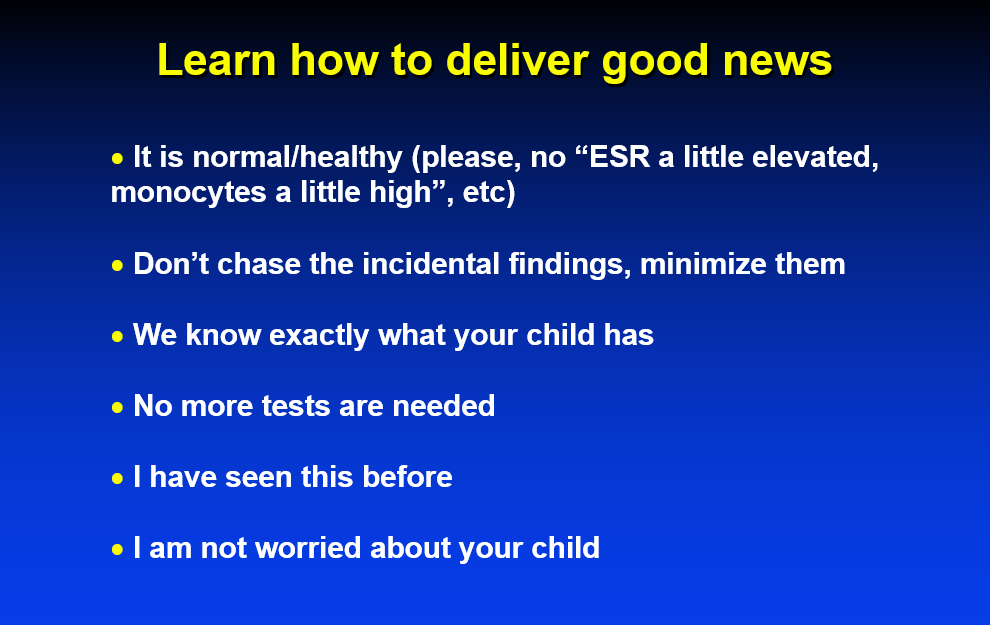
  • We are not well-equipped to deliver good news: “This is one of the best colons I have ever seen…Your child has irritable bowel and no other tests are needed.”
  • The most under prescribed treatment: 30 minutes of physical activity everyday
  • 2nd most under prescribed treatment is a good night’s sleep.  Increased symptoms when tired
  • “Psychobezoar,” referring to a fear of discomfort with eating, could be used as an alternative to ARFID
  • Most effective treatment for IBS: cognitive behavioral therapy
  • Distraction is helpful tool for pain but need to teach parents to accept this tool
  • Some of the axioms in the lecture are attributed to Mark Reid, MD

Related blog post: #NASPGHAN19 Postgraduate Course -part 3

Here are some of the slides from this talk:

Seeing More MALS Publications

Anecdotally, I’ve seen more publications recently regarding median arcuate ligament syndrome (MALS). A recent study (JP Moak et al. J Pediatr 2021; 231: 141-147. Median Arcuate Ligament Syndrome with Orthostatic Intolerance: Intermediate-Term Outcomes following Surgical Intervention) prospectively examines the outcomes in patients with MALS and with orthostatic intolerance (OI).

Background: MALS is generally considered after other more common conditions. Typical symptoms include abdominal pain after eating or exercise and often weight loss due to fear of eating. The pain is often positional and may improve with leaning forward. The diagnostic finding of celiac artery compression may be identified in many healthy individuals (10-24% of population); thus, only severe compression, which is seen in a small number, can result in symptomatic MALS.

In this study, the key findings:

  • 31 patients with both MALS and OI were identified from 2014-2019. Median f/u after surgery was 22 months.
  • Based on questionnaires, gastrointestinal symptoms of abdominal pain, nausea, and vomiting improved in 63% (P = .007), 53% (P = .040), and 62% (P = .014) of patients, respectively. 
  • Based on questionnaires, cardiovascular symptoms of dizziness, syncope, chest pain, and palpitations improved in 45% (P = not significant), 50% (P = not significant), 54% (P = .043), and 54% (P = .037) of patients, respectively.
  • Importantly, the authors could not demonstrate a “statistical relationship between a postoperative decrease in celiac artery Doppler velocity and improvement in clinical symptoms.”
  • In an effort to gauge for a potential post-surgical placebo effect, the authors determined the degree of improvement in musculoskeletal symptoms. There was a 24% improvement which was much less than the improvement in GI symptoms.

One useful feature of this article is that the authors explicitly state how they arrive at the diagnosis of MALS. They start with an abdominal ultrasound with doppler. Criteria for suspected MALS include supine celiac artery peak systolic velocity of >300 cm/s, celiac artery/aoritic peak systolic ratio of >3:1, neutral position celiac artery peak systolic velocity of >200 cm/s, and a change in the celiac artery deflection angle of >50 degrees between inspiration and expiration. If ultrasound is abnormal, the authors obtained an enhanced CT to image inspiratory and expiratory changes in the celiac artery deflection angle, the area of stenosis, poststenotic dilation, and the collateral blood vessels. If there are discrepancies between U/S and CT, a celiac arterial angiogram is obtained.

The authors conclude that there “were minimal improvements in neurologic or psychological symptoms after MALS surgery, despite their common occurrence among patients with POTS.”

My take: This study, in agreement with others, showed that about 60% had improvement in GI symptoms including pain, nausea and vomiting. In those with OI, most continued with impaired health. Overall, MALS as a clinical entity remains a ‘needle in a haystack.’

Related blog posts