Do antibiotics contribute to obesity? Not in recent study

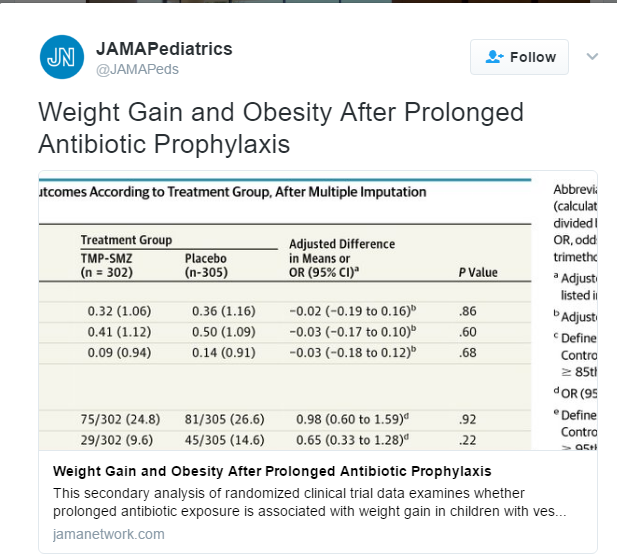
There have been studies suggesting that antibiotics at a young age promote obesity and other studies that have NOT found an association. A recent study (JAMA Pediatr. 2017;171(2):150-156. doi:10.1001/jamapediatrics.2016.3349could not find an effect of chronic prophylactic antibiotics.

Link: Weight Gain and Obesity in Infants and Young Children Exposed to Prolonged Antibiotic Prophylaxis

From Abstract:

Design, Setting, and Participants  Secondary analysis of data from the Randomized Intervention for Children With Vesicoureteral Reflux Study, a 2-year randomized clinical trial that enrolled participants from 2007 to 2011. All 607 children who were randomized to receive antibiotic (n = 302) or placebo (n = 305) were included. Children with urinary tract anomalies, premature birth, or major comorbidities were excluded from participation.

Interventions  Trimethoprim-sulfamethoxazole or placebo taken orally, once daily, for 2 years.

Results  Participants had a median age of 12 months (range, 2-71 months) and 558 of 607 (91.9%) were female. Anthropometric data were complete at the 24-month visit for 428 children (214 in the trimethoprim-sulfamethoxazole group and 214 in the placebo group). Weight gain in the trimethoprim-sulfamethoxazole group and the placebo group was similar (mean [SD] change in weight-for-age z score: +0.14 [0.83] and +0.18 [0.85], respectively; difference, −0.04 [95% CI, −0.19 to 0.12]; P = .65). There was no significant difference in weight gain at 6, 12, or 18 months or in the prevalence of overweight or obesity at 24 months (24.8% vs 25.7%; P = .82). Subgroup analyses showed no significant interaction between weight gain effect and age, sex, history of breastfeeding, prior antibiotic use, adherence to study medication, or development of urinary tract infection during the study.

My take: Whether antibiotics could contribute to obesity is not entirely clear –even the possibility could encourage better stewardship of antimicrobials.

Related blog posts:

screenshot-143

screenshot-144

Will Bariatric Surgery Become an Endoscopic Procedure?

A recent study (BK A Dayyeh et al. Clin Gastroenterol Hepatol 2017; 15: 37-43) provides evidence that endoscopic sleeve gastoplasty can be an effective treatment for obesity.

AGA Website Summary Endoscopic Sleeve Gastroplasty: A Promising New Weight Loss Procedure

An excerpt:

In the fight against obesity, bariatric surgery is currently the most effective treatment; however, only 1 to 2 percent of qualified patients receive this surgery due to limited access, patient choice, associated risks and the high costs. A novel treatment method — endoscopic sleeve gastroplasty — might offer a new solution for obese patients. Endoscopic sleeve gastroplasty is a minimally invasive, safe and cost-effective weight loss intervention, according to a study1 published online in Clinical Gastroenterology and Hepatology, the official clinical practice journal of the American Gastroenterological Association…

In this study of 25 patients with obesity who underwent the procedure at the Mayo Clinic in Rochester, MN, endoscopic sleeve gastroplasty reduced excess body weight by 54 percent at one year. Further, the procedure delayed solid food emptying from the stomach and created an earlier feeling of fullness during a meal, which resulted in a more significant and long-lasting weight loss.

Endoscopic sleeve gastroplasty was well tolerated as an outpatient treatment, requiring less than two hours of procedure time. Patients resumed their normal lifestyle within one to three days. The treatment was performed using standard “off-the-shelf” endoscopic tools as opposed to specific weight loss devices or platforms. The cost of endoscopic sleeve gastroplasty is roughly one-third that of bariatric surgery.

4 minute YouTube description from Johns Hopkins: What is Endoscopic Sleeve Gastroplasty and How Does it Work?

screenshot-73

screenshot-74 screenshot-75

Briefly Noted: Crash Test Dummies

screenshot-96

Here’s the link: Crash Test Dummies Fatter too!

Related blog posts:

Autism Drugs: Fat and Happy?

“The reason fat people are happy is that their nerves are well protected.”
– Luciano Pavarotti

It is not uncommon to see kids with behavioral problems that are also obese.  Many times, medications which help improve behavioral problems may contribute to obesity by increasing appetite.

A recent study (K Shedlock et al. J Pediatr 2016; 178: 183-7) provides some insight into this issue. In this retrospective study, using the Military Health System database (2000-2013) with 48,762 individuals with autism spectrum disorder and with 243,810 matched controls, children with autism spectrum disorder (ASD) had significantly higher rates of obesity with OR 1.85 along with obesity-related conditions.  These conditions include type 2 diabetes, hypertension, hyperlipidemia, and NAFLD/NASH.

Key points:

  • In children with ASD, mood stabilizers, antipsychotics, antiepileptic drugs, and selective serotonin reuptake inhibitors (SSRIs) were associated with obesity.  Mood stabilizers had the greatest risk in this study, with adjusted OR of 1.41; the other medications had fairly small risk with adjusted ORs between 1.13 to 1.16.
  • When kids with ASD develop complications like NAFLD/NASH or hyperlipidemia, they may be less likely to adhere with recommended lifestyle changes.  This can be due to sensory aversions and social deficits.

My take: Children with autism spectrum disorder are likely at increased risk for obesity at baseline; some of the medications to treat behavior problems may contribute to obesity, though they may be partly an epiphenomenon or a marker of a more severe autism spectrum disorder.

Portland Head Light

Portland Head Light

AAP Recommendations on Preventing Obesity and Eating Disorders

From AAP Committee on Nutrition, Pediatrics, August 2016Full text: Preventing Obesity and Eating Disorders in Adolescents

  1. Discourage dieting, skipping of meals, or the use of diet pills; instead, encourage and support the implementation of healthy eating and physical activity behaviors that can be maintained on an ongoing basis. The focus should be on healthy living and healthy habits rather than on weight.
  2. Promote a positive body image among adolescents. Do not encourage body dissatisfaction or focus on body dissatisfaction as a reason for dieting.
  3. Encourage more frequent family meals.
  4. Encourage families not to talk about weight but rather to talk about healthy eating and being active to stay healthy. Do more at home to facilitate healthy eating and physical activity.
  5. Inquire about a history of mistreatment or bullying in overweight and obese teenagers and address this issue with patients and their families.
  6. Carefully monitor weight loss in an adolescent who needs to lose weight to ensure the adolescent does not develop the medical complications of semistarvation.
Gardens at University of Virginia

Gardens at University of Virginia

Deceptive Research: When Sugar Leaves A Bitter Taste

screen-shot-2016-09-13-at-6-51-28-pm

This study was covered widely including USA Today, NBC News and other outlets.

From NY Times, an excerpt:

The sugar industry paid scientists in the 1960s to play down the link between sugar and heart disease and promote saturated fat as the culprit instead, newly released historical documents show.

The internal sugar industry documents, recently discovered by a researcher at the University of California, San Francisco, and published Monday in JAMA Internal Medicine, suggest that five decades of research into the role of nutrition and heart disease, including many of today’s dietary recommendations, may have been largely shaped by the sugar industry…

he Sugar Association, paid three Harvard scientists the equivalent of about $50,000 in today’s dollars to publish a 1967 review of research on sugar, fat and heart disease. The studies used in the review were handpicked by the sugar group, and the article, which was published in the prestigious New England Journal of Medicine, minimized the link between sugar and heart health and cast aspersions on the role of saturated fat…

The New England Journal of Medicine did not begin to require financial disclosures until 1984.

Bedtime in Preschool-Aged Children and Risk for Adolescent Obesity

An upcoming article (Journal of Pediatrics, (DOI: http://dx.doi.org/10.1016/j.jpeds.2016.06.005)shows an association between bedtime and the development of obesity:

Full-text link: Bedtime in Preschool-Aged Children and Risk for Adolescent Obesity

Abstract:

Objective

To determine whether preschool-aged children with earlier bedtimes have a lower risk for adolescent obesity and whether this risk reduction is modified by maternal sensitivity.

Study design

Data from 977 of 1364 participants in the Study of Early Child Care and Youth Development were analyzed. Healthy singleton-births at 10 US sites in 1991 were eligible for enrollment. In 1995-1996, mothers reported their preschool-aged (mean = 4.7 years) child’s typical weekday bedtime, and mother-child interaction was observed to assess maternal sensitivity. At a mean age of 15 years, height and weight were measured and adolescent obesity defined as a sex-specific body-mass-index-for-age ≥95th percentile of the US reference.

Results

One-quarter of preschool-aged children had early bedtimes (8:00 p.m. or earlier), one-half had bedtimes after 8:00 p.m. but by 9:00 p.m., and one-quarter had late bedtimes (after 9:00 p.m.). Children’s bedtimes were similar regardless of maternal sensitivity (P = .2). The prevalence of adolescent obesity was 10%, 16%, and 23%, respectively, across early to late bedtime groups. The multivariable-adjusted relative risk (95% CI) for adolescent obesity was 0.48 (0.29, 0.82) for preschoolers with early bedtimes compared with preschoolers with late bedtimes. This risk was not modified by maternal sensitivity (P = .99).

Conclusions

Preschool-aged children with early weekday bedtimes were one-half as likely as children with late bedtimes to be obese as adolescents. Bedtimes are a modifiable routine that may help to prevent obesity.

My take: Another potential reason to heed Samuel Jackson’s advice: Go the F- to Sleep (early)

Related blog posts:

Vickery Creek

Vickery Creek

Antibiotics Given Early in Life Linked to Childhood Obesity…Again

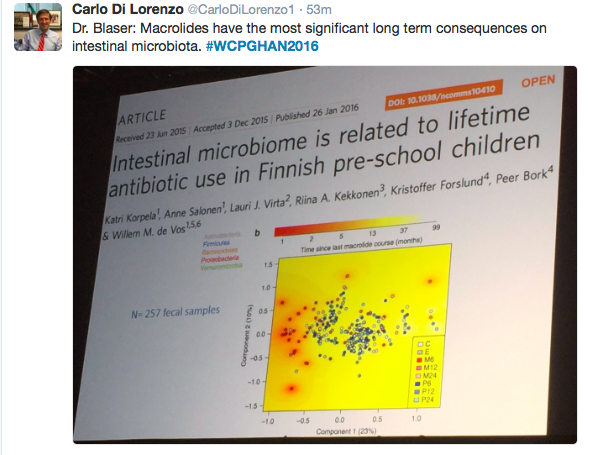
While yesterday’s post discussed quadruple therapy for H pylori/need for multiple antibiotics, today’s post will focus on one of the downsides of antibiotic usage. For several years, this blog has highlighted numerous studies which show a link between antibiotics and later obesity (see related blog posts below).  Another study (FI Scott et al. Gastroenterol 2016; 151: 120-29), using a large database, quantifies this risk further.

This retrospective study used prospectively collected data from The Health Improvement Network (THIN), using a cohort of 21,714 children from the UK.

Key findings:

  • In the cohort, 1306 (6.4%) were obese at age 4 years.
  • Antibiotic exposure was associated with an increased risk of obesity at 4 years, with odds ratio of 1.21. The OR went to 1.41 for 3-5 prescriptions.
  • Antifungal agents were not associated with an increased risk of obesity., OR 0.81

In the discussion the authors make a number of useful points:

  • In the U.S. between 2006-2008, there “were >10 million antibiotic prescriptions…annually for children without clear indication.” Thus, this is modifiable contributing factor to obesity.
  • The risk is modest with “approximately 1.2% absolute and 25% relative increase in the risk of early childhood obesity. This relationship is strongest when considering repeat exposures.”
  • Though this is a large study, the authors had many limitations, as expected in a retrospective study.  These included a lack of awareness of the indication for the antibiotic, potential selection bias, and difficulty adjusting for some confounders like breast feeding and physical activity.

The study is in agreement with data from agriculture.  Numerous studies have highlighted how antibiotics can improve weight gain in industry.  Here are some useful references:

  • Gaskins HR, et al. Antibiotics as growth promotants: mode of action. Animal Biotechnol 2002; 13: 29-42
  • Lassiter CA. Antibiotics as growth stimulants for dairy cattle: a review. J Dairy Sci 1955; 38: 1102-38.
  • Moore P, et al. Use of sulphasuccidine, streptothricin and streptomycin in nutrition studies with the chick. J Biol Chem 1946; 165: 437-41.
  • Cho I, et al. Antibiotics early in life alter the murine colonic microbiome and adiposity. Nature 2012; 488 (7413): 621-26.
  • Cox LM, et al. Altering the intestinal microbiota during a critical developmental window has lasting metabolic consequences. Cell 2014; 158: 705-21.

My take: Farmers have understood that antibiotics fatten up young animals for 70 years.  Yet, this basic information is NOT commonly understood by parents and many physicians. If this risk for obesity were widely known, it would help limit the use of antibiotics for well-recognized indications.

Related blog posts:

South Leads Obesity

Better Hydration –Less Obesity?

Perhaps the Dos Equis’ guy’s slogan “Stay Thirsty My Friends” is not such great advice.

According to a study, summarized by NPR, inadequate hydration was associated with increased odds of obesity.  While an association does not prove causation, it adds another potential reason to drink plenty of water.

NPR Story: Thirsty? New Study Links Good Hydration with Slimmer Waistlines

Here’s an excerpt:

A new study published in the Annals of Family Medicineadds to the evidence that hydration may play a role in weight management.

“What we found was that people who were inadequately hydrated had increased odds of being obese,” says study author Tammy Chang of the Department of Family Medicine at the University of Michigan.

The study was based on data collected by a federal health survey, in which researchers had documented weight and height of participants. They also conducted urine tests to establish an objective measure of participants’ level of hydration.

Chang and her colleagues found the odds of being obese were 1.59 times higher for people who were not well-hydrated. And overall, they found that a lack of proper hydration was associated with higher body mass index.

On a neighborhood walk

On a neighborhood walk