Ultrasonography to Distinguish Biliary Atresia from Alagille Syndrome

AM Upton et al. J Pediatr Gastroenterol Nutr. 2025;81:212–216. The “maximum echogenicity” at the right portal vein: Biliary atresia versus Alagille syndrome

See related ultrasound study from last week: Improving Ultrasound Examination to Identify Biliary Atresia

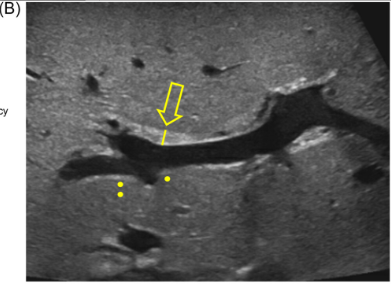
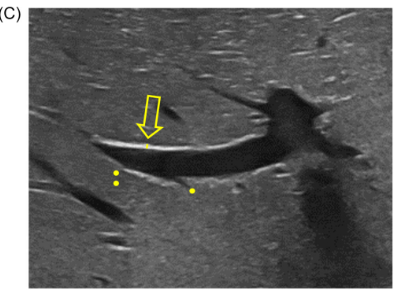
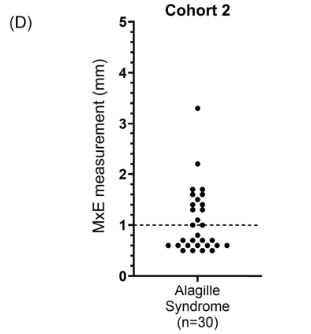
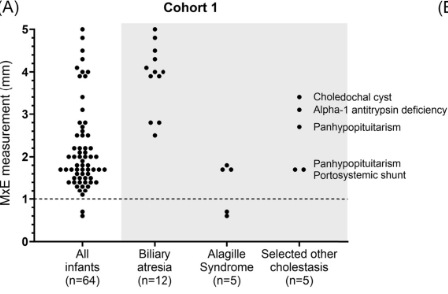
Background/Methods: One way clinicians can distinguish between biliary atresia and Alagille syndrome is with a positive “triangular cord sign.” This ultrasound finding refers to a thickened echogenicity at the anterior aspect of the right portal vein…the maximum echogenicity at the anterior aspect of the right portal vein (“maximum echogenicity” or “MxE”) was measured in a group of infants with cholestasis (Cohort 1, n=64) and in another group of infants with Alagille syndrome (Cohort 2, n=30).

Key findings:

  • “Thin echogenicity at the anterior aspect of the right portal vein may help distinguish between biliary atresia and Alagille syndrome…None of the 12 infants with biliary atresia in Cohort 1 had a MxE < 1.0 mm”
  • “A MxE < 1.0 mm could help identify Alagille syndrome. 2 of the 64 infants with cholestasis in Cohort 1 had a MxE < 1.0 mm. Both infants were eventually diagnosed with Alagille syndrome. In the Cohort 2 infants with Alagille syndrome, 16 of 30 infants had a MxE < 1.0 mm”
Infant with biliary atresia
Infant with Alagille Syndrome

Discussion Point:

“Infants with Alagille syndrome can have smaller bile ducts which may be inapparent on invasive testing such as cholangiography. As a result, they may be presumptively diagnosed with biliary atresia and inappropriately treated with the Kasai portoenterostomy. Unfortunately, these infants have poorer outcomes compared to infants with Alagille syndrome who do not receive the Kasai portoenterostomy.” Thus, distinguishing Alagille from biliary atresia is very important.

My take: This study shows that MxE (a refinement of what has previously been called the triangular cord sign) on ultrasound may help distinguish biliary atresia from Alagille syndrome. As this is a single-center study, it will be important to determine if this ultrasound finding can be replicated in other centers and whether the finding is operator-dependent.

Related blog posts:

Disclaimer: This blog, gutsandgrowth, assumes no responsibility for any use or operation of any method, product, instruction, concept or idea contained in the material herein or for any injury or damage to persons or property (whether products liability, negligence or otherwise) resulting from such use or operation. These blog posts are for educational purposes only. Specific dosing of medications (along with potential adverse effects) should be confirmed by prescribing physician.  Because of rapid advances in the medical sciences, the gutsandgrowth blog cautions that independent verification should be made of diagnosis and drug dosages. The reader is solely responsible for the conduct of any suggested test or procedure.  This content is not a substitute for medical advice, diagnosis or treatment provided by a qualified healthcare provider. Always seek the advice of your physician or other qualified health provider with any questions you may have regarding a condition

How Good Are Our Tests for Acute Pancreatitis?

A recent cross-sectional pediatric study (SH Orkin et al. J Pediatr 2019; 213: 143-8),  with a prospective clinical database, provides data on children presenting with acute pancreatitis, n=112 (2013-16).

Acute pancreatitis (AP): requires at least 2 of 3 criteria:

  1. Abdominal pain consistent with AP
  2. Serum amylase and/or lipase activity at least 3 times ULN
  3. Imaging findings compatible with AP

Key points:

  • Among AP patients who had a lipase level, the sensitivity was 95% whereas the sensitivity for amylase was 39%.
  • Among AP patients who had an ultrasound, the sensitivity was 52%.  In those with either CT or MRI, the sensitivity was 78%.
  • In this cohort, 5.4% did not meet diagnostic criteria based on biochemical elevation (amylase or lipase) and instead relied on imaging along with signs/symptoms.

The authors note that lipase has a delayed peak and longer duration of elevation with AP.   Amylase normalizes more rapidly.

My take: This study reinforces the view that an elevated lipase is more sensitive than amylase and that imaging (especially ultrasound) is frequently normal in AP.

Related blog posts:

Island Ford Park, Chattahoochee River


ER Evaluations of Visits Related to Inflammatory Bowel Disease

A short communication (C Pant et al. JPGN 2015; 61: 282-84, ed 267-8) provides some insight into what is happening in the ER when patient with inflammatory bowel disease are evaluated.

The authors analyzed a national database, the Healthcare Cost and Utilizationa Porject Nationwide Emergency Department Sample (NEDS), from 2006-2010.

Key findings:

  • ED visits for children 5-19 years of age increased from 14,527 (2006) –>18,193 (2010)
  • Frequency of computerized tomography (CT) imaging increased 80.43% (P<0.01) for Crohn’s disease and 59.26% (P<0.01) for ulcerative colitis
  • Overall rate of hospital admissions decreased by 14.32% (P<0.01)

The associated editorial by Jennifer Dotson and Michael Kappelman explain the limitations of relying on data that are derived mainly for billing rather than research and comment on the “alarming increase” in CT  usage due to the risk of radiation exposure and the potential alternatives (eg. ultrasound, MRE).  With regard to limitations, they likely included inaccurate and incomplete entries.  In addition, the database included 950 hospitals, but may have under-sampled large freestanding children’s hospitals.  This could skew the data.  Finally, the data uses “visit-level” data rather than “patient-level” data; thus, one ‘cannot distinguish between a single patient who is seen on three separate visits or three unique patients.’

My take:  There has been increasing use of ER visits and CT scanning for pediatric patients with IBD.  One of my colleagues in town (Cary Sauer) has a humorous slide of a CT scanner as the entrance door to the ER.  The message from this study indicates that we should be working on changing practice by working with our ER colleagues along with radiologists to minimize CT scans in favor of more gently imaging.

Related blog posts:

Atlanta Botanical Gardens, Bruce Munro exhibit

Atlanta Botanical Gardens, Bruce Munro exhibit

Imaging in NAFLD -Don’t Rely on Ultrasound

A recent article (Clin Gastroenterol Hepatol 2014; 12: 765-73) notes that ultrasound is not accurate for diagnosing NAFLD:

The link to the article: http://goo.gl/R1GdAG, video abstract: http://youtu.be/spnlSPTS-SE (from Jeff Schwimmer’s twitter feed) ,and an excerpt from the article’s abstract:

Results

We analyzed 9 studies comprising 610 children; 4 studies assessed ultrasonography and 5 studies assessed magnetic resonance imaging (MRI). Ultrasonography was used in the diagnosis of fatty liver with positive predictive values of 47% to 62%. There was not a consistent relationship between ultrasound steatosis score and the reference measurement of hepatic steatosis. Liver fat as measurements by MRI or by spectroscopy varied with the methodologies used. Liver fat measurements by MRI correlated with results from histologic analyses, but sample size did not allow for an assessment of diagnostic accuracy.

Conclusions

Available evidence does not support the use of ultrasonography for the diagnosis or grading of fatty liver in children. Although MRI is a promising approach, the data are insufficient to make evidence-based recommendations regarding its use in children for the assessment of hepatic steatosis.

Related blog posts:

Ultrasound Unreliable to Exclude Fatty Liver

More information on the sensitivity of ultrasonography for detecting fatty liver is available in the setting of living-related liver transplantation (Transplantation 2013; 95: DOI: 10.1097/TP.0b013e31828d1588).

In this study the authors retrospectively examined the degree of steatosis from 492 living liver donors who had normal ultrasounds and normal aminotransferase levels. The median age of the donors was 30.1 year and the median BMI was 22.4 kg/meter-squared.

Background: According to the authors, if liver histology shows severe macrosteatosis (>60%), transplantation is canceled.  Furthermore, in cases of moderate macrosteatosis (30-59%), the risks/benefits need to be considered on an individual basis due to increased risk of mortality; Spitzer et al (reference below) demonstrated that macrovesicular steatosis >30% was an independent predictor of reduced 1-year graft survival.  In addition, a previous report has indicated that both macrosteatosis and microsteatosis had similar impacts on postoperative  liver function.

Results:

  • 3 (0.6%) had severe total steatosis, moderate or greater steatosis was diagnosed in 4 (0.8%) for macrosteatosis, in 26 (5.3%) for microsteatosis, and 56 (11.4%) for total steatosis.
  • There were two identified risk factors BMI >23 kg/meter-squared and triglycerides >88 mg/dL.  Individuals with both risk factors had a 28.6% prevalence of moderate or greater degree of total steatosis compared with 6.6% with no risk factors.  In these individuals, a liver biopsy may be worthwhile.

Why this study matters for the non-transplant physician:  This study provides additional data that ultrasonography is not adequate to exclude significant degrees of fatty liver.

Study limitations included the retrospective analysis which relied on medical record accuracy, degree of steatosis was not based on a single pathologist, ultrasonography was not based on not based on a single radiologist, both BMI and triglycerides may vary based on age, gender, ethnicity and other factors.

Related blog entries:

Related references:

  • -Spitzer AL et al. Liver Transpl 2010; 16: 874-84.
  • -Liver Transpl 2013; 19: 437-49. Difficulty with precisely determining steatosis
  • -Hepatology 2011; 54: 1082.  U/S w ~85% sensitivity in detecting fatty liver.
  • -Gastroenterol 2008; 135: 1961.  Liver biopsy (in pediatrics) still needed as surrogates not accurate for correlating degree of fibrosis/injury.
  • -J Pediatr 2009; 155: 469.  Review.  No evidence-based guidelines for treating in pediatrics –main Rx wt loss/exercise.  Consider obtaining ultrasound.