Selecting Patients with Biliary Atresia for Variceal Endoscopy Screening

Y-C Ling et al. JPGN 2024;79:222–228. Performance of Baveno VII criteria for the screening of varices needing treatment in patients with biliary atresia

Methods: This retrospective study enrolled 48 BA patients (23 females and 25 males) who underwent an esophagogastroduodenoscopy (EGD) and transient elastography at a mean age of 11.18 ± 1.48 years. Transient elastography (Fibroscan® 502 Touch; Echosens) was applied for the LSM assessment in all BA patients recruited in this study.

Clinically-significant portal hypertension (CSPH) of Baveno VI criteria recommend avoiding upper endoscopies for cirrhotic patients with liver stiffness <20 kPa and platelets>150 × 10-9 cells/L (favorable Baveno VI status), and the CSPH of the expanded Baveno VI criteria as the exclusion of subjects with LSM < 25 kPa and platelet count >110 × 10-9 cells/L. (Ref: D Thabut et al. Gastroenterol 2019. Validation of Baveno VI Criteria for Screening and Surveillance of Esophageal Varices in Patients With Compensated Cirrhosis and a Sustained Response to Antiviral Therapy)

CSPH of Baveno VII criteria was defined as LSM ≥ 25 kPa and excluded patients with LSM < 15 kPa and platelet count ≥150 × 10-9 /L. Subjects with LSM between 20 and 25 kPa and platelets <150 × 10-9 /L or LSM between 15 and 20 kPa and platelets <110 × 10-9/L are also defined as CSPH. (Ref: Baveno VII criteria Ref: M Mendizabal et al. Annals of Hepatology; 2024: 29: 101180. Evolving portal hypertension through Baveno VII recommendations)

Key findings:

  • The sensitivity and negative predictive value of Baveno VI and Baveno VII criteria for the prediction of varices needing treatment (VNT) in BA patients were both 100% and100%, respectively

In the discussion, the authors note that the utility of the Baveno VII criteria for adults. “The real‐world data showed the CSPH defined by Baveno VII criteria predicts a five‐times increase in the risk of liver decompensation in chronic active liver disease patients.”

My take: This study shows that the combination of LSM and platelet counts using the Baveno VI or VII criteria help select patients with BA who need upper endoscopy to screen for varices needing treatment. These criteria also identify patients needing liver transplantation.

Related blog posts:

Channel Islands off California coast
View from Griffith Park, Los Angeles

Disclaimer: This blog, gutsandgrowth, assumes no responsibility for any use or operation of any method, product, instruction, concept or idea contained in the material herein or for any injury or damage to persons or property (whether products liability, negligence or otherwise) resulting from such use or operation. These blog posts are for educational purposes only. Specific dosing of medications (along with potential adverse effects) should be confirmed by prescribing physician.  Because of rapid advances in the medical sciences, the gutsandgrowth blog cautions that independent verification should be made of diagnosis and drug dosages. The reader is solely responsible for the conduct of any suggested test or procedure.  This content is not a substitute for medical advice, diagnosis or treatment provided by a qualified healthcare provider. Always seek the advice of your physician or other qualified health provider with any questions you may have regarding a condition.

Why Carvedilol Is Considered Best Pharmaceutical Agent to Prevent Variceal Bleeding (in Adults)

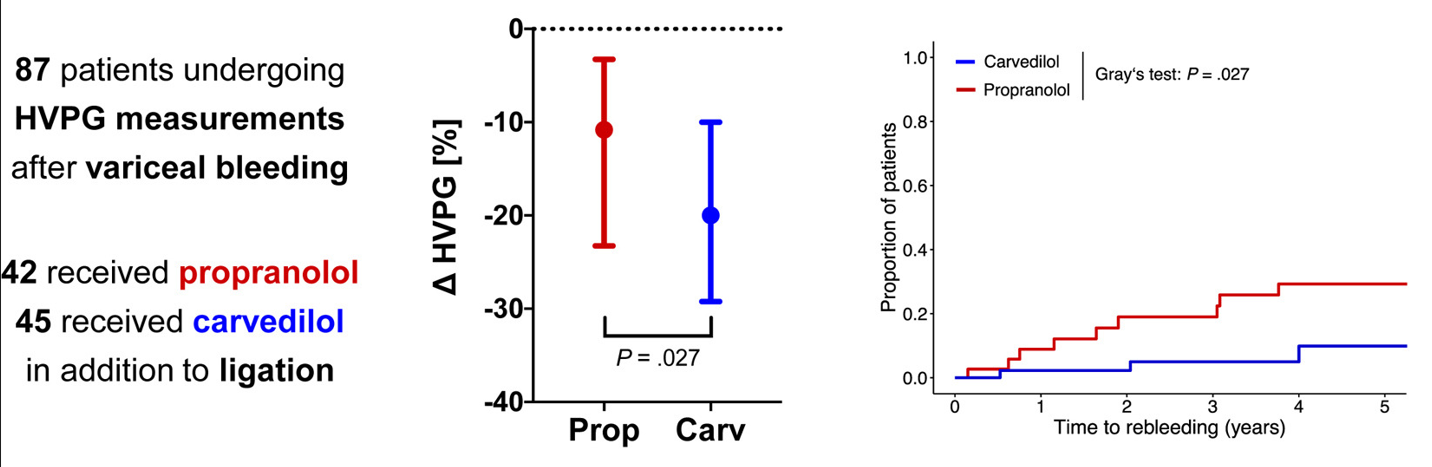
M Jachs et al. Clin Gastroenterol Hepatol 2023; 21: 2318-2326. Open Access! Carvedilol Achieves Higher Hemodynamic Response and Lower Rebleeding Rates Than Propranolol in Secondary Prophylaxis

Associated editorial: J Bosch. Clin Gastroenterol Hepatol 2023; 21:2195-2196. Open Access! Carvedilol as Best β-Blocker for Secondary Prophylaxis of Variceal Bleeding: Are We There, or Not Yet?

Key findings:

  • In a retrospective cohort comprising 87 adult patients receiving NSBB (non-selective beta blocker) in addition to band ligation after variceal bleeding, carvedilol induced more profound decreases in hepatic venous pressure gradient compared with propranolol. The higher rate of chronic hepatic venous pressure gradient response to carvedilol (53.3% vs 28.6%; P = .034) was paralleled by lower rates of variceal rebleeding, liver-related death, and further nonbleeding decompensation.

In the discussion and the editorial, it is noted that there is high-quality evidence that carvediol is superior for primary variceal prophylaxis in adults. “Carvedilol increasingly is used for the prevention of variceal bleeding, 2 and, based on the recent landmark PREDESCI study, overall hepatic decompensation/ascites3 in compensated cirrhosis, because it induces HVPG response (a ≥10% decrease in HVPG is sufficient in primary prophylaxis17) in up to 75% of patients vs 50% when using propranolol. However, it induces more pronounced decreases in blood pressure, which may be detrimental in patients with (refractory) ascites.15

Though there are concerns about dropping blood pressure, the editorial notes that “up to two-thirds of patients with compensated cirrhosis” have high blood pressure. The editorial concludes that “the study still strongly suggests that carvedilol is at least as safe as propranolol…. I am in complete agreement with the authors in suggesting that carvedilol is likely to represent the best NSBB in the treatment of portal hypertension regardless of the clinical scenario, including prevention of decompensation, ascites, first bleeding, or recurrent bleeding.” The author notes that the “recent Baveno VII recommendations declare carvedilol as the preferred NSBB, and support its use in all compensated patients with direct (HVPG ≥10 mm Hg) or indirect signs of clinically significant portal hypertension.”(J Hepatol. 2022; 76: 959-974. Baveno VII: renewing consensus in portal hypertension)

My take: In adults, Carvediol is the best NSBB for portal hypertension. In children, who may be more prone to hypotension, more data is needed.

Related blog posts:

Juan-Les-Pins, France

Liver Briefs -June 2019

YH Yeo et al. Hepatology 2019; 69: 1385-97.  The prevalence of high risk individuals in the U.S. who are susceptible (not immune) to hepatitis B has decreased from 83% to 69% from 2003 to 2014.  That still leaves 64 million who would benefit from HBV vaccination.

M Sharma et al. Hepatology 2019; 69: 1657-75. This meta-analysis compared therapies for primary prevention of esophageal varices and concluded that nonselective beta-blocker (NSBB) monotherapy may decrease all-cause mortality and carried a lower risk of serious complications than variceal band ligation (VBL). However, the commentary (1382-84 by L Laine) reaches a different conclusion. “Current recommendations for primary prevention with VBL or NSBB or carvediolo still appear to be acceptable…using a shared decision-making approach” to weigh issue such as daily medication or periodic endoscopy.

J Nguyen et al. J Pediatr 2019; 207: 90-6. This study modeled the cost-effectiveness of early treatment with direct-acting antiviral therapy in adolescents with hepatitis C infection.  With pangenotypic agenst, the cost would be $10000 to $21000 per QALY gained.

S Trinh et al. Clin Gastroenterol Hepatol 2019; 17: 948-56. This retrospective hepatitis B study examined the changes in renal function between 239 tenofovir disoproxil fumarte (TDF) treated patients and 171 entecavir treated patients.  Key finding: TDF was not associated with higher risk of worsening renal function in this cohort with a mean followup of 43-46 months in patients with baseline normal renal function.  In patients with renal impairment, deterioration of renal function was noted in TDF-treated patients.  Thus, TDF should be avoided in patients with impaired renal function.


Rhododendrom in Sandy Springs

.

“Cat in the Hat” Effect with Transjugular Intrahepatic Portosystemic Shunt (TIPS)

IL Holster et al (Hepatology 2016; 63: 581-89) provide useful data on the use of transjugular portosystemic shunt (TIPS) compared with endoscopic therapy/Beta-blocker for prevention of variceal rebleeding.

In this multicenter randomized trial, TIPS was compared with either endoscopic variceal ligation or glue injection along with beta-blocker treatment in 72 patients with either a first or 2nd episode of variceal bleeding.  The median followup was 23 months.

Key findings:

  • 0 of 37 (0%) of TIPS patients had rebleeding compared with 10 of 35 (29%) in the endoscopic group.
  • TIPS mortality 32% compared with endoscopic group mortality of 26% (P=0.418)
  • Hepatic encephalopathy was 35% (TIPS) vs 14% (endoscopic group) (P=0.035)

This study shows that rebleeding is common in the endoscopic therapy group but that TIPS, while fixing bleeding, often resulted in other problems.  In “The Cat in the Hat” analogy, this would equate to moving the bathtub stain to the dress or curtains but not really improving the situation.

My take: It is helpful to see how these treatment strategies compare.  The data from this study does not clearly point to one strategy over another for dealing with this serious consequence of cirrhosis.

Related blog posts:

Statue at Ferry Dock, Culebra

Statue at Ferry Dock, Culebra

What is the role for preventing variceal bleeding in Biliary Atresia?

During medical school, I read a book called “The House of God”  (The House of God – Wikipedia, the free encyclopedia.  One of this cynical book’s premises is that doing more diagnostic tests and treatments to help patients actually harms them.

A recent study of children with biliary atresia reminded me of this premise (Gastroenterol 2013; 145: 801-7, eidtorial 719-22).   In this retrospective study, there were 66 children with endoscopic evidence of portal hypertension who underwent endoscopic therapy for either primary (n=36, mean age 22 months) or secondary (n=30, mean age 24 months) treatment of esophageal varices biliary atresia (2001-2011).  These children were at high risk for bleeding; they had a mean bilirubin of >10 mg/dL and 20% had ascites.

Results:

Primary prophylaxis group: mean of 4.2 sessions were needed to eradicate varices.  Varices reappeared in 37%; there was no breakthrough bleeding.  97% survived for 3 years.  All of these patients had varices grade 2 or higher and 94% had red wale markings.

Secondary prophylaxis group (after previous bleeding): mean of 4.6 sessions to eradicate varices.  Varices reappeared in 45% and 10% had breakthrough bleeding.  84% survived for 3 years.

Treatment:

  • For bleeding group, sclerotherapy was used in 73%, banding in 17%, and both in 10%.
  •  For prophylaxis group, sclerotherapy was used in 44%, banding in 41%, and both in 14%.
  • By the end of the study, sclerotherapy was mainly used in patients weighing less than 8 kg.
  • Each endoscopy session had the same endoscopist, used octreotide (2 mcg/kg/hr) an 1 hour before and then for 2-3 days afterwards.
  • With bleeding patients, these sessions occurred after the patient was stabilized, with a mean of 10 days afterwards.
  • Patients had an average of four 3-day hospitalizations.
  • Within an average of 14 months, more than half of the primary prophylaxis group had undergone transplantation

The authors interpret their data as follows:  “primary or secondary prophylaxis of bleeding is well tolerated and greatly reduces the risks of variceal bleeding in children with biliary atresia and high-risk gastroesophageal varices.  The results support the active detection of these signs by endoscopic procedures.”

In contrast, the editorial is much less supportive of primary prophylaxis.  “We need to weigh the risks and benefits of multiple procedures in a nonbleeding child who may not bleed for years, when varices have a high chance of recurring and transplant is sometimes imminent. Because mortality from gastrointestinal bleeding in children is quite low (zero in this small study), we may need to consider a ‘wait and see’ approach.”

Bottomline: A failed Kasai is an indication for transplantation which is a much more definitive treatment for portal hypertension.

Previous related blog posts: